

Automotive supply-chain risk is becoming increasingly concentrated in a few materials, technologies, suppliers, and processing hubs. A September 2026 ACEA analysis found that six of ten critical automotive inputs have refining and processing as their most vulnerable stage, while limited alternatives and long capacity-development timelines compound exposure. The assessment covers semiconductors, rare-earth magnets, silicon, copper, wiring harnesses, and other critical inputs.
Trade and geopolitical pressures are adding another layer. A 2026 automotive industry survey found 79% of respondents identified tariff-driven cost pressures as a major challenge, while 53% cited geopolitical disruptions and 30% pointed to semiconductor and critical-mineral availability. Meanwhile, the IEA reports that prices for aluminium, copper, and tin rose by roughly one-third between January 2025 and April 2026, highlighting the financial consequences of concentrated and volatile supply chains.
For OEMs and suppliers, automotive supply chain risk analysis can help reveal where dependencies are concentrated, which disruption points could have the greatest impact, and where resilience measures may be most valuable.
Risk Is No Longer Limited to the Direct Supplier
A supplier can appear financially stable and operationally reliable while still depending on a vulnerable sub-tier producer, processor, logistics route, or raw-material source. This makes visibility beyond Tier 1 increasingly important. Semiconductor and critical-mineral supply chains are particularly exposed because qualification cycles can be long and replacement sources may be limited. The real question is therefore not simply “Which supplier is at risk?”, but “Where does the dependency sit, and how far can a disruption travel through the network?”
Places Where Automotive Risk Can Concentrate
A meaningful risk assessment should distinguish between visible supplier exposure and deeper structural dependencies:
- Critical Inputs: Map materials, components, and technologies with limited substitutes, concentrated production, or high strategic importance to vehicle programs.
- Supply Nodes: Identify suppliers, processing hubs, manufacturing locations, logistics routes, and sub-tier dependencies where disruption could affect multiple downstream programs.
- Geographic Exposure: Assess concentration by country or region, including tariff exposure, export restrictions, geopolitical conditions, infrastructure dependencies, and alternative-source availability.
Together, these dimensions can help organizations distinguish isolated supplier issues from systemic dependencies capable of creating broader production or cost disruption.
Nexdigm’s Expertise in Automotive Supply Chain Risk
Nexdigm combines automotive industry knowledge with supplier, market, and geographic intelligence to help organizations understand complex dependencies and identify where supply-chain exposure could affect business continuity by offering:
- Industry-Led Understanding: Apply automotive sector knowledge to assess critical materials, components, suppliers, technologies, and regional dependencies within evolving vehicle supply chains.
- Connected Risk Visibility: Link supplier concentration, sub-tier exposure, material dependencies, geographic factors, and disruption points to reveal risks that isolated assessments may overlook.
- Action-Oriented Prioritization: Evaluate potential business impact, substitution difficulty, recovery options, and sourcing alternatives to identify risks requiring deeper assessment or mitigation.
This expertise helps turn complex automotive supply chain risk analysis into clearer priorities for resilience planning, sourcing decisions, and risk management.
How Experts at Nexdigm Turn Risk Visibility Into Resilience Priorities
Once critical dependencies are visible, the next step is determining where resilience efforts can create the greatest value. Nexdigm can help organizations translate risk findings into focused priorities across their supply networks:
- Critical Dependency Mapping: Identify suppliers, materials, regions, or technologies where disruption could create disproportionate operational or financial impact.
- Mitigation Opportunities: Evaluate diversification, alternate sourcing, regional shifts, capacity expansion, inventory strategies, and supplier development as potential resilience levers.
- Priority Setting: Rank opportunities based on risk severity, business criticality, feasibility, recovery time, and potential impact on sourcing continuity.
This helps organizations move from identifying where risk exists to determining where resilience action can make the greatest difference.
Nexdigm’s Supply Chain Risk Assessment Framework
Nexdigm can structure the assessment around five connected stages to move from broad supply-chain exposure to prioritized resilience actions:
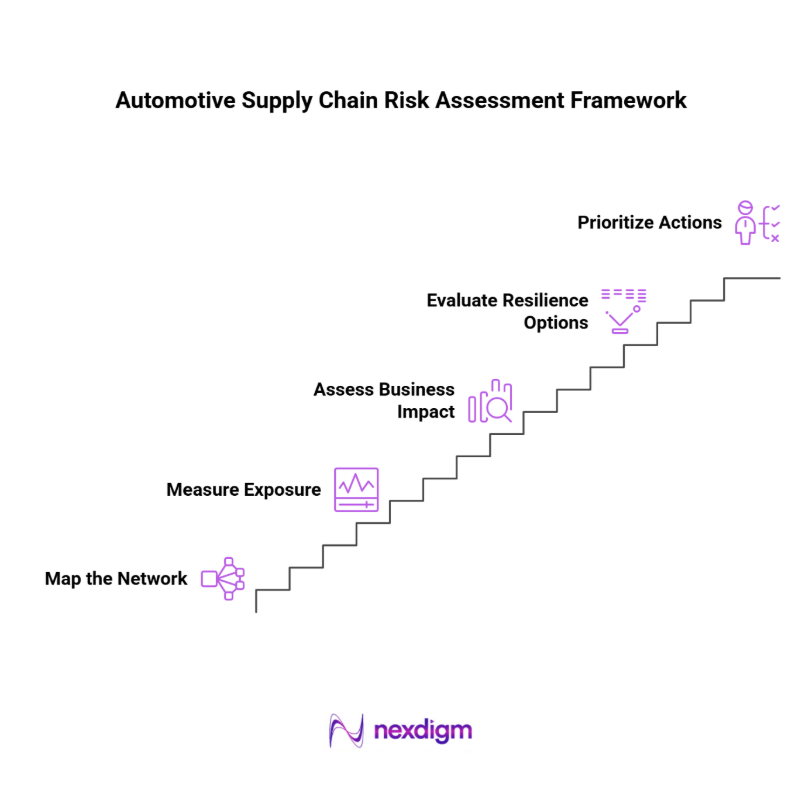
- Map the Network: Identify suppliers, sub-tier relationships, critical materials, manufacturing locations, logistics routes, and geographic dependencies.
- Measure Exposure: Assess concentration, substitution difficulty, capacity constraints, geopolitical factors, trade exposure, and other disruption drivers.
- Assess Business Impact: Determine how potential disruptions could affect production, costs, customer commitments, sourcing continuity, and recovery timelines.
- Evaluate Resilience Options: Examine alternative suppliers, regional sourcing, inventory buffers, supplier development, capacity expansion, and other mitigation options.
- Prioritize Actions: Rank risks and mitigation opportunities based on severity, business criticality, feasibility, cost, and potential resilience benefit.
This framework helps turn automotive supply chain risk analysis into a structured basis for identifying, evaluating, and addressing the dependencies that matter most.
Nexdigm’s Case
An automotive manufacturer assessed 35 critical suppliers across eight component categories and five regions using Nexdigm’s supply-chain risk analysis. The assessment identified 22% of supplier relationships with elevated concentration exposure and prioritized 14 mitigation opportunities involving supplier diversification, regional sourcing, and capacity planning. The findings helped the organization focus resilience investments on the supply-chain dependencies with the greatest potential impact on production continuity.
To take the next step, simply visit our Request a Consultation page and share your requirements with us.
Harsh Mittal
+91-8422857704