

Automotive procurement is being asked to solve three priorities at once: maintain competitive costs, secure supply, and reduce environmental and social exposure. The challenge is becoming more measurable. EcoVadis’ 2026 Sustainable Procurement Barometer reports that 98% of surveyed companies have started embedding ESG data into procurement processes, while only 48% have visibility into ESG practices for most Tier 1 suppliers. Supplier data quality remains another constraint, with 30% of suppliers still reporting no emissions data.
The automotive sector faces additional pressure from changing cost structures and supply risks. Nexdigm’s 2026 supplier study highlights persistent input-cost pressures, geopolitical tensions, labor shortages, and supply-chain fragility, while emphasizing resilient, multilocal supply systems as a strategic priority. At the same time, WBCSD notes that embedded emissions in materials such as steel, aluminium, batteries, and plastics are becoming increasingly important to automotive lifecycle footprints.
For procurement leaders, automotive sustainable sourcing research can help connect these priorities and identify sourcing choices that balance commercial performance with supply security and sustainability requirements.
Cost, Security, and Sustainability Are Becoming Interdependent
The traditional lowest-cost sourcing model is becoming harder to sustain when suppliers face tariffs, geopolitical disruptions, capacity constraints, and increasing sustainability requirements. A cheaper source may carry higher transportation exposure or weaker emissions visibility, while a more sustainable option may involve higher upfront costs but provide stronger resilience or regulatory positioning. The objective is therefore to evaluate total sourcing value rather than purchase price alone.
Major Questions Helping With More Balanced Sourcing Decision
Procurement teams can use three questions to bring the competing priorities together:
- What Is the True Cost? Consider purchase price, logistics, tariffs, inventory, compliance, switching costs, and potential disruption exposure when comparing sourcing options.
- How Secure Is Supply? Assess supplier capacity, geographic concentration, financial stability, alternative sources, lead times, and resilience before making sourcing commitments.
- What Is the Sustainability Profile? Evaluate emissions, materials, resource efficiency, labor practices, certifications, and supplier transparency alongside commercial and operational factors.
Hence, a balanced sourcing decision emerges when cost, continuity, and sustainability are evaluated together rather than optimized independently.
Nexdigm’s Approach to Balanced Sourcing Decisions
Once cost, supply security, and sustainability are considered together, procurement teams need a clear way to compare competing sourcing options. Nexdigm can help structure this evaluation around:
- Commercial Fit: Compare supplier pricing, total cost, logistics, tariffs, and contractual considerations to understand the economic implications of each option.
- Supply Security: Assess capacity, supplier concentration, geographic exposure, lead times, and alternative-source availability to evaluate continuity.
- Sustainability Fit: Examine emissions, material efficiency, resource use, supplier practices, and transparency against relevant sourcing priorities.
This enables organizations to use automotive sustainable sourcing research to identify sourcing options that offer the strongest overall balance of cost, security, sustainability, and long-term value.
How Nexdigm’s Approach Turns Balanced Sourcing Insights Into Action
A balanced comparison becomes valuable when it leads to clear sourcing choices. Nexdigm can help procurement teams translate supplier and market findings into practical actions:
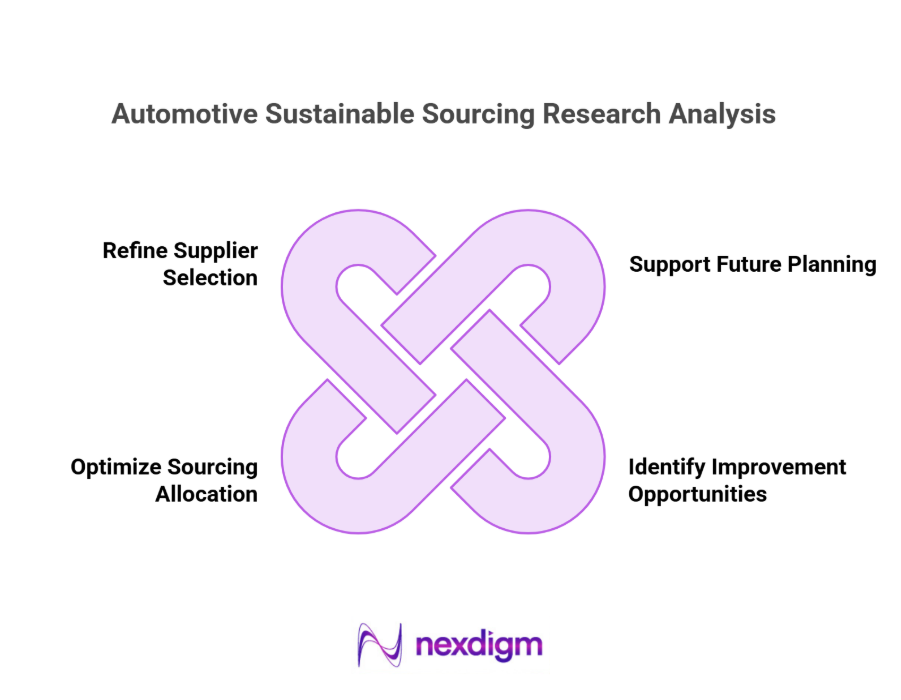
- Refine Supplier Selection: Identify suppliers that offer the strongest combination of commercial value, supply reliability, and sustainability performance.
- Optimize Sourcing Allocation: Determine where volumes should be distributed across suppliers or regions to balance cost efficiency with supply security.
- Identify Improvement Opportunities: Highlight areas where supplier development, material changes, regional shifts, or process improvements could strengthen overall sourcing performance.
- Support Future Planning: Use market and supplier intelligence to anticipate changing costs, regulations, supply constraints, and sustainability expectations.
This helps procurement teams turn automotive sustainable sourcing research into decisions that support both immediate sourcing requirements and longer-term competitiveness.
How Nexdigm Creates Value Through Balanced Sourcing
Nexdigm can help procurement teams connect commercial, supply, and sustainability considerations within a single sourcing perspective. Our analysis can support:
- Stronger Cost Decisions: Evaluate total sourcing economics alongside supplier risks, logistics, tariffs, and sustainability-related costs.
- Greater Supply Security: Identify supplier, regional, material, and capacity exposures that could affect continuity and assess practical alternatives.
- Meaningful Sustainability Integration: Incorporate emissions, resource efficiency, supplier practices, and transparency into supplier and sourcing evaluations.
- Long-Term Procurement Value: Identify sourcing configurations that can improve resilience, flexibility, competitiveness, and preparedness for evolving requirements.
Through automotive sustainable sourcing research, Nexdigm helps organizations move beyond individual procurement metrics toward sourcing decisions that balance cost efficiency, supply security, and sustainability.
Nexdigm’s Case
An automotive manufacturer evaluated 35 critical suppliers across five regions using Nexdigm’s automotive sustainable sourcing research. The assessment identified 22% of sourcing relationships with elevated exposure and prioritized 14 opportunities across supplier diversification, regional sourcing, material efficiency, and sustainability improvements. The findings helped procurement teams balance cost competitiveness and responsible sourcing while prioritizing actions with stronger long-term business value.
To take the next step, simply visit our Request a Consultation page and share your requirements with us.
Harsh Mittal
+91-8422857704