

Automotive supply chains increasingly span multiple countries, making tariffs an important factor in sourcing economics. In 2025, global vehicle production reached 96.4 million units, while the United States remained one of the world’s largest automotive import markets. The U.S. also introduced a 25% tariff on imported automobiles and certain automotive parts in 2025, creating a significant cost consideration for companies supplying the market.
Meanwhile, the EU applies a 10% common external tariff on imported passenger cars from many non-preferential trading partners. These developments show why automotive tariff impact analysis needs to look beyond the headline duty rate. Businesses must understand how tariffs interact with product classification, origin, freight, insurance, and other landed-cost components to evaluate the real impact on sourcing and margins.
Tariffs Can Change the Economics of Sourcing
An import duty may appear as a single percentage, but its commercial effect depends on the customs value of the product, tariff classification, country of origin, applicable trade agreements, and logistics costs. A component with a lower purchase price can become less competitive after duties and transportation are included. Similarly, sourcing from a higher-cost market may become attractive if it benefits from preferential tariff treatment. This makes landed-cost analysis important when comparing suppliers and sourcing locations.
Understanding the Tariff Exposure
Tariff exposure becomes clearer when businesses examine how duties interact with the wider cost structure.
- Product Classification: Different automotive products and HS codes can attract different duty rates, making accurate classification important for cost assessment.
- Country of Origin: Preferential agreements, rules of origin, and trade measures can change the effective tariff burden between alternative sourcing markets.
Together, these factors help businesses determine how much tariffs actually add to procurement costs and which sourcing options remain commercially viable.
Nexdigm’s View on Automotive Tariff Impact
Tariff analysis becomes commercially useful when duty rates are connected with the products, suppliers, and trade routes affected by them. Nexdigm combines trade intelligence, automotive market research, tariff research, company intelligence, and supply-chain analysis to assess these relationships.
Our automotive tariff impact analysis can examine HS codes, import values, tariff rates, countries of origin, supplier markets, trade agreements, customs requirements, freight costs, and landed-cost implications.
This helps businesses understand not simply what tariff applies, but how the tariff changes the economics of sourcing from different countries and suppliers.
Areas Nexdigm Assesses for Automotive Tariff Exposure
Nexdigm evaluates tariff exposure across the factors that determine the actual cost and competitiveness of automotive imports. These areas are as follows:
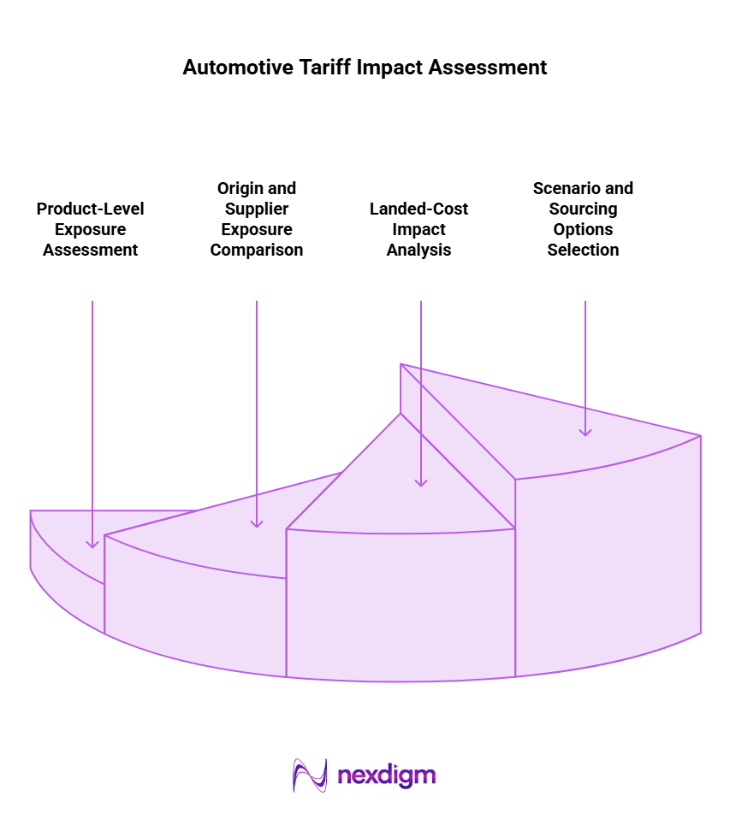
- Product-Level Exposure: Assess HS codes, component categories, import values, and applicable tariff rates to identify products facing higher or changing duty burdens.
- Origin and Supplier Exposure: Compare sourcing countries, supplier locations, rules of origin, and trade agreements to determine how geography affects effective tariff costs.
- Landed-Cost Impact: Combine duties with freight, insurance, handling, taxes, and other costs to compare the true economics of different sourcing routes.
- Scenario and Sourcing Options: Model alternative suppliers, countries, and tariff scenarios to identify routes that could reduce cost exposure while maintaining supply continuity.
These focused assessments help businesses understand where tariff pressure is concentrated, and which sourcing or commercial responses may offer greater cost resilience.
How Nexdigm’s Tariff Assessment Supports Business Decisions
Tariff exposure becomes strategically relevant when businesses can see how it affects supplier economics, margins, pricing, and sourcing choices. Nexdigm’s analysis can support decisions across several areas:
- Sourcing Optimization: Compare suppliers and countries on total landed cost rather than purchase price alone, helping identify more competitive sourcing options.
- Margin Protection: Assess how tariff changes could affect procurement costs and product margins, supporting pricing and commercial planning.
- Supplier Negotiations: Use tariff and landed-cost evidence to strengthen discussions around pricing, contract terms, sourcing locations, and cost-sharing arrangements.
- Market and Route Selection: Evaluate alternative trade corridors and sourcing markets to identify options with lower tariff and overall cost exposure.
- Scenario Planning: Model potential changes in tariffs, suppliers, or trade conditions to help businesses prepare for different cost environments.
By linking tariff exposure with commercial outcomes, Nexdigm helps businesses translate trade-policy changes into practical sourcing, pricing, and supply-chain actions.
Nexdigm’s Case
Nexdigm supported an automotive-sector client by assessing tariff exposure across 12 sourcing markets and component categories. The analysis found that tariff changes increased landed costs by more than 10% for selected components, while alternative sourcing routes offered cost reductions of up to 9%. The assessment helped the client compare supplier economics, identify lower-exposure sourcing markets, and strengthen its tariff-response strategy.
To take the next step, simply visit our Request a Consultation page and share your requirements with us.
Harsh Mittal
+91-8422857704