

Tier 1 suppliers occupy a central position in automotive manufacturing because they supply components, assemblies and integrated systems directly to original equipment manufacturers (OEMs). Their influence extends beyond production volumes. Many participate in product development, manage relationships with upstream suppliers and maintain manufacturing networks designed to serve multiple vehicle platforms.
India’s Tier 1 ecosystem includes large domestic manufacturers, international automotive groups and specialist companies with established positions in particular product categories. Their competitive strengths differ across business scale, product focus, technology capabilities and geographic reach. Understanding these differences provides a clearer picture of who leads the supplier base and where individual manufacturers hold their strongest positions.
The Scale of India’s Tier 1 Supply Base
The Indian automotive component industry recorded turnover of approximately ₹6.73 lakh crore in FY2024–25, with OEM supplies reaching ₹5.70 lakh crore. Exports increased to US$22.9 billion, reflecting the industry’s growing participation in international automotive supply chains.
The market includes suppliers operating across powertrain systems, electrical equipment, vehicle electronics, braking, suspension, driveline components, interiors and structural products. Some manufacturers operate across several categories, while others have built their market positions around a narrower technical specialisation.
This distinction matters when evaluating leadership. A company’s consolidated revenue may indicate business scale, but it does not necessarily establish dominance in a specific component category. Product-level presence, customer relationships and manufacturing capabilities offer a more useful basis for comparison.
Major Tier 1 Manufacturers and Their Areas of Strength
- Samvardhana Motherson International is among India’s most geographically diversified automotive suppliers. Its portfolio includes wiring harnesses, mirrors, polymer products and integrated modules. Its international footprint and broad OEM relationships make it relevant to manufacturers seeking suppliers with multi-region production capabilities.
- Bosch Limited operates across automotive technology and mobility solutions, including fuel injection, electronics and powertrain-related systems. Its engineering orientation and technology portfolio distinguish it from suppliers focused primarily on mechanical components.
- Uno Minda has a broad product presence across switches, lighting, alloy wheels, seating, sensors and controllers. Its portfolio provides exposure to several vehicle systems and changing requirements in automotive electronics.
- Bharat Forge has established capabilities in forging and precision-engineered components, including products used in automotive and other industrial applications. Its scale and engineering capabilities make it a significant participant in the forged component segment.
- Endurance Technologies focuses on aluminium die castings, suspension and braking systems, and transmission-related products. Its presence across two-wheeler and passenger vehicle applications gives it a distinct position within mechanical components.
Other notable manufacturers include Schaeffler India, Sona BLW Precision Forgings, Sundram Fasteners, Minda Corporation, Varroc Engineering and Tata AutoComp Systems. Their competitive positions vary by product category, vehicle segment and customer relationships.
How Should Tier 1 Leadership Be Measured?
The automotive tier 1 supplier landscape should be examined through several indicators rather than a single company ranking.
Business scale provides an initial indication of a manufacturer’s resources and market presence. Automotive-specific revenue, manufacturing facilities and geographic diversification help establish how much of the business is relevant to vehicle production.
Product focus reveals where a supplier has established technical depth. A manufacturer with a concentrated portfolio may hold a strong position in a particular component category, even if its total revenue is lower than that of a diversified competitor.
OEM relationships provide another indication of market reach. Existing customer relationships, vehicle segment exposure and experience supplying international manufacturers can help explain a supplier’s competitive position. However, customer presence should not automatically be interpreted as market leadership without considering the scale and nature of those programmes.
Technology investment is increasingly relevant as vehicle architectures change. The government’s PLI Auto scheme had 82 approved applicants as of November 2025, with participation from manufacturers across advanced automotive technology categories. This reflects the policy emphasis on domestic manufacturing and localisation of advanced components.
Geographic Reach and International Participation
Manufacturing geography is an important source of competitive advantage. Suppliers located near major vehicle production centres may benefit from access to OEM facilities, engineering resources and supporting manufacturers. Pune, Chennai, NCR, Gujarat and Madhya Pradesh are among India’s important automotive manufacturing regions.
International reach adds another dimension. India’s auto-component exports reached US$22.9 billion in FY2024–25. North America accounted for 32% of exports, Europe for 29.5% and Asia for 26%, according to ACMA. These markets represent different customer bases and trade conditions, making export exposure relevant when comparing supplier strategies.
A manufacturer with an international production network may be better positioned to serve global vehicle programmes, while a domestically focused supplier may have stronger regional relationships or a more concentrated product specialisation.
Automotive Tier 1 Supplier Landscape Framework
Nexdigm can help organisations understand the competitive structure of the Tier 1 market through a category-based assessment of manufacturers and their market positions.
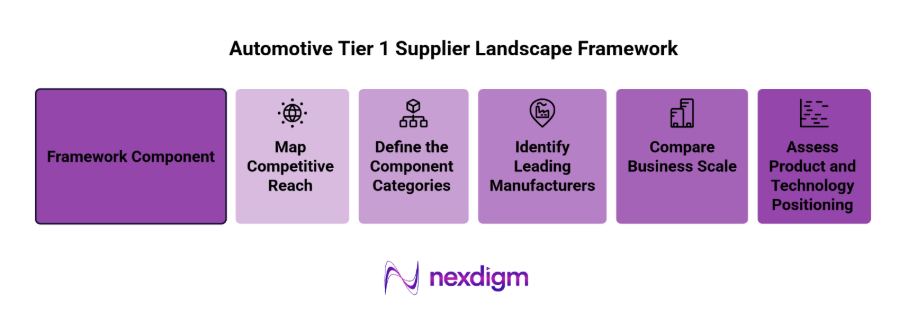
- Map Competitive Reach: Compare domestic and international presence, OEM relationships and geographic concentration to identify category leaders.
- Define the Component Categories: Segment the market by vehicle system, product type and relevant manufacturing technology.
- Identify Leading Manufacturers: Map suppliers by ownership, automotive focus, product portfolio and manufacturing presence.
- Compare Business Scale: Examine relevant revenue indicators, facility networks, customer exposure and expansion activity.
- Assess Product and Technology Positioning: Evaluate specialisation, engineering capabilities and participation in advanced automotive categories.
Nexdigm Case: Mapping Tier 1 Competition
An automotive business assessing a new product category required a view of the competitive supplier base. Nexdigm mapped 42 Tier 1 manufacturers across six automotive clusters, compared product portfolios and geographic reach, and identified 11 businesses for further evaluation, including four with relevant advanced-technology capabilities.
To take the next step, simply visit our Request a Consultation page and share your requirements with us.
Harsh Mittal
+91-8422857704