

The automotive supply chain extends well beyond the manufacturers that supply vehicle makers directly. Behind many Tier 1 suppliers is a network of businesses producing castings, forgings, machined parts, fasteners, electrical sub-components, engineered plastics and specialised manufacturing inputs.
These Tier 2 manufacturers form an important part of the industrial infrastructure supporting automotive production. Their capabilities influence the availability, cost and manufacturability of larger components and assemblies. Yet they are often less visible to OEMs and investors because their commercial relationships may be concentrated around Tier 1 manufacturers.
Mapping this ecosystem provides a more complete understanding of manufacturing depth, regional specialisation and upstream supply dependencies.
Understanding the Tier 2 Position
In a conventional automotive supply structure, Tier 1 manufacturers supply components or systems directly to OEMs. Tier 2 manufacturers provide sub-components, materials or specialised processes to Tier 1 businesses. Tier 3 suppliers typically operate further upstream, supplying raw materials and basic inputs.
These categories are not always fixed. A manufacturer may supply a finished component directly to an OEM while also producing sub-components for another Tier 1 supplier. Its position should therefore be identified at the product and customer-relationship level rather than assigned solely according to company size.
The MSME segment plays an important role in this structure. A 2025 SIDBI sector analysis estimated that MSMEs account for approximately 29–32% of the automotive component industry’s turnover. Their presence is particularly relevant in suspension and braking parts, body and chassis products and other specialised manufacturing categories.
Mapping the Ecosystem by Product and Process
A useful automotive tier 2 supplier mapping exercise should begin with the product categories and manufacturing processes that support larger vehicle systems.
- Metal processing and engineered components: Forging, casting, stamping, machining and fabrication businesses supply products used in engines, transmissions, chassis, suspension and structural assemblies. Their capabilities depend on material expertise, tooling, process specialisation and precision manufacturing.
- Fasteners and precision parts: Nuts, bolts, studs, pins, clips and turned components are used across multiple vehicle systems. Although some products are standardised, application-specific requirements can vary by material grade, tolerance, strength and operating conditions.
- Electrical and electronic sub-components: Connectors, terminals, wiring sub-assemblies, sensors and electronic manufacturing services support increasingly complex vehicle electrical systems. The growth of connected vehicles and electric mobility is expanding the range of technologies required from upstream suppliers.
- Polymer and rubber components: Moulded plastics, seals, gaskets, hoses, rubber parts and interior components serve a broad range of automotive applications. Product requirements can differ according to vehicle type, operating conditions and material specifications.
- Specialised manufacturing services: Heat treatment, surface finishing, precision grinding, CNC machining and toolmaking are supporting capabilities that may not be immediately visible in conventional supplier directories. These processes can nevertheless be essential to the production of finished automotive components.
Why Geographic Mapping Matters
Tier 2 manufacturers often operate close to Tier 1 suppliers, OEM facilities and established industrial clusters. Their location can reflect access to customers, skilled labour, materials, industrial infrastructure and specialised services.
India’s major automotive regions include Pune, Chennai, NCR, Gujarat and Madhya Pradesh. Additional clusters such as Ludhiana, Rajkot, Pithampur and Sri City contribute to the wider manufacturing network.
Pune’s industrial ecosystem, for example, includes a substantial base of automotive and engineering businesses. Tamil Nadu combines vehicle assembly operations with a broad component-manufacturing network, while NCR has a significant concentration of suppliers serving passenger vehicles, two-wheelers and commercial vehicles.
A geographic supplier map can reveal whether a component category is concentrated in a small number of industrial locations. It can also identify regions where relevant manufacturing capabilities exist but are less connected to established OEM supply networks.
What Tier 2 Mapping Reveals About Supply Dependencies
A Tier 1 manufacturer may appear to have multiple suppliers while relying on several businesses that source a critical input from the same upstream manufacturer or geographic region. Without visibility below the immediate supplier relationship, these dependencies can remain hidden.
Mapping product categories, manufacturing locations, ownership and customer relationships helps identify such concentrations. It can also reveal categories where domestic manufacturing capabilities are limited or where suppliers have a narrow product focus.
For investors, this information can highlight opportunities in specialised manufacturing, process capabilities and regional industrial expansion. For OEMs and Tier 1 businesses, it can support localisation assessments and a better understanding of alternative sourcing markets.
Automotive Tier 2 Supplier Mapping Framework
Nexdigm can support market-level mapping of upstream manufacturers through product segmentation, supplier identification and geographic market assessment.
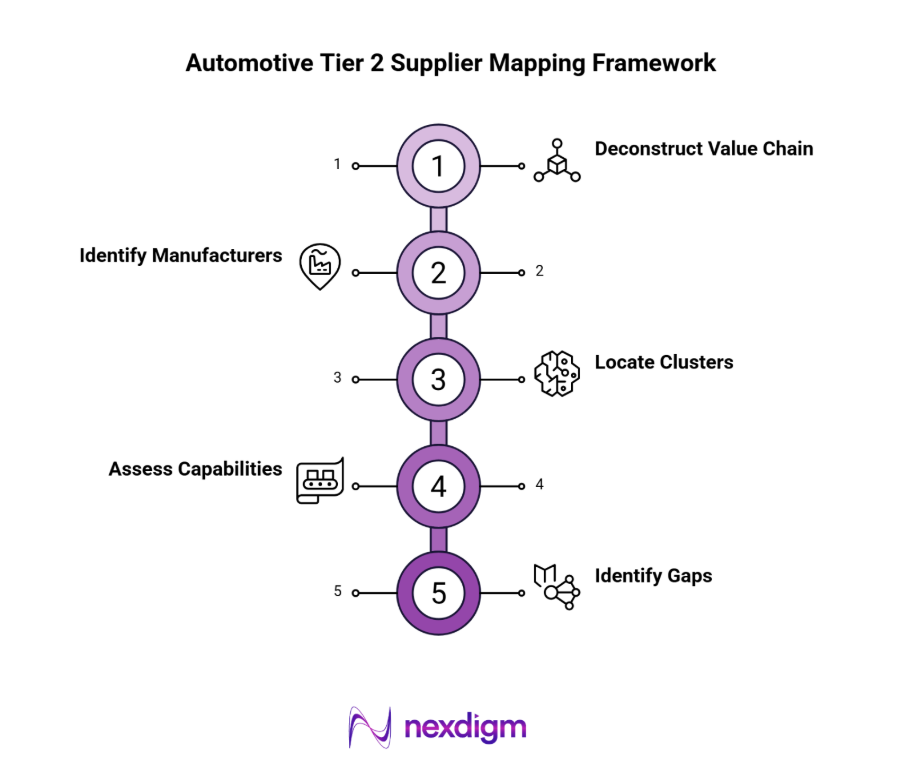
- Deconstruct the Component Value Chain: Break vehicle systems into finished components, sub-components, materials and specialised processes.
- Identify Tier 2 and Tier 3 Manufacturers: Map relevant businesses by product category, process capability, ownership and market presence.
- Locate Manufacturing Clusters: Identify supplier concentrations across established and emerging automotive regions.
- Assess Capability and Specialisation: Compare product portfolios, manufacturing processes, customer segments and technology exposure.
- Identify Ecosystem Gaps: Highlight concentrated categories, limited regional alternatives and potential opportunities for localisation or market entry.
Nexdigm Case: Mapping Upstream Manufacturing Capabilities
A component manufacturer seeking greater visibility into its upstream supplier ecosystem required a regional assessment. Nexdigm mapped 57 businesses across four product groups and five industrial clusters, identifying 14 manufacturers with relevant process capabilities and three regions requiring further evaluation for alternative sourcing.
To take the next step, simply visit our Request a Consultation page and share your requirements with us.
Harsh Mittal
+91-8422857704