

Automotive manufacturers entering a new country must evaluate more than vehicle demand. Import duties, domestic production requirements, technical standards, and certification procedures can change the economics of market entry. A country may offer strong sales potential but remain commercially difficult to serve from an overseas manufacturing base.
Understanding these barriers helps manufacturers assess where to export, where to establish local operations, and how to structure regional supply chains.
Assess Tariffs And Trade Agreements
Import duties affect vehicle prices, distributor margins, and the competitiveness of foreign manufacturers. The impact varies by vehicle category, engine type, country of origin, and applicable trade agreement. Passenger cars, commercial vehicles and automotive components may face different tariff schedules.
Manufacturers should compare applied tariff rates across target markets rather than relying only on headline trade agreements. Preferential rates may depend on rules of origin, which determine whether a vehicle or component qualifies for reduced duties. These rules can require detailed documentation of component sourcing and manufacturing processes.
Examine Localization Requirements
Some markets encourage domestic manufacturing through local-content requirements, investment conditions, procurement preferences, or incentives linked to local production. These policies can influence decisions about assembly plants, component sourcing, and partnerships with domestic suppliers.
For automotive trade barrier analysis, companies should distinguish between formal legal requirements and commercial incentives that make local production more attractive. A mandatory local-content threshold creates a different operational obligation from a subsidy that rewards companies for manufacturing domestically.
Localization can improve market access, but it also introduces costs related to supplier qualification, production setup, workforce development, and quality control.
Evaluate Regulatory Approval
Vehicles must satisfy the safety, emissions, testing, and certification requirements applicable in each destination market. Manufacturers may need additional testing, documentation, vehicle modifications, or local approvals before sales can begin.
Electric vehicles add further considerations, including battery safety, charging compatibility, and high-voltage system requirements. Commercial vehicles may face additional rules relating to dimensions, axle loads, and operating standards. These requirements can influence launch schedules and the cost of adapting products for different markets.
Automotive Market Access Assessment Framework
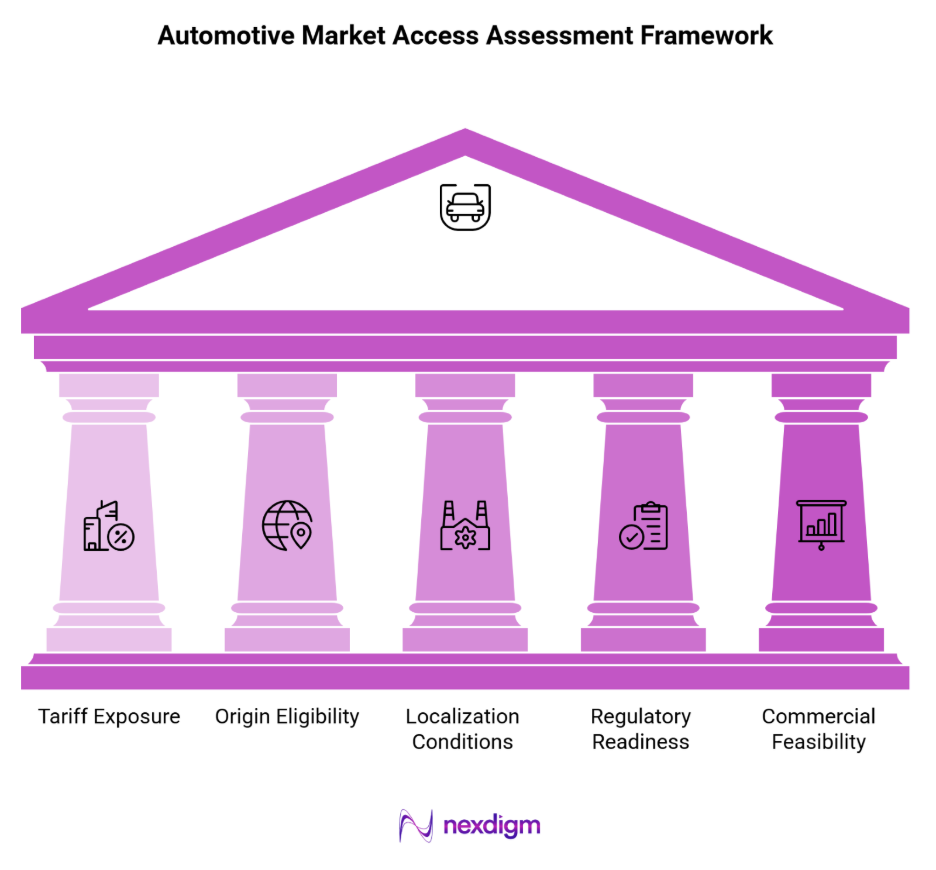
- Tariff Exposure: Compare applied duties, preferential rates and possible trade-policy changes to understand their effects on vehicle prices, margins and competitiveness.
- Origin Eligibility: Verify rules of origin, component sourcing records and documentation requirements before assuming products qualify for preferential tariff treatment.
- Localization Conditions: Identify mandatory local-content rules, domestic investment obligations, procurement preferences and incentives that could influence manufacturing or sourcing decisions.
- Regulatory Readiness: Map applicable testing, certification, emissions and safety approvals, including their costs, timelines and implications for product modifications.
- Commercial Feasibility: Calculate total entry costs across duties, compliance, distribution and potential local investment to determine whether projected sales justify market entry.
These factors should be assessed together. Lower tariffs may not compensate for lengthy approval procedures, while local assembly may be uneconomic if the addressable market is too small.
Make Market Entry Decisions With Better Evidence
Automotive market entry requires a joined-up view of trade policy, regulation and production economics. Comparing these factors by destination and vehicle segment allows companies to identify viable export markets, anticipate compliance costs and determine when local manufacturing or sourcing partnerships make commercial sense.
Nexdigm’s Case Study
A vehicle manufacturer assessing two export markets finds that one offers lower import duties but requires extensive model-specific testing. The other has higher duties but offers a viable assembly partnership and clearer approval timelines. Comparing total entry costs and time to revenue helps determine which option better fits the manufacturer’s investment strategy.
To take the next step, simply visit our Request a Consultation page and share your requirements with us.
Harsh Mittal
+91-8422857704