

Automotive trade is being reshaped by changing production locations, electric-vehicle adoption, supplier diversification, and evolving consumer demand. Global vehicle production reached 96.4 million units in 2025, up 3.9% from 2024, while sales reached 99.8 million. Asia accounted for more than 61% of global production.
China alone produced 34.53 million vehicles, while India’s production reached 6.49 million. EVs are also changing trade patterns: nearly 22 million electric cars were produced globally in 2025, with China accounting for around 75% of production and more than 2.5 million Chinese electric cars exported.
These shifts make automotive trade flow intelligence increasingly important for understanding suppliers, buyers, production hubs, demand centers, and emerging trade opportunities.
Production Hubs Are Becoming More Geographically Important
Automotive production is increasingly concentrated in markets combining manufacturing scale, component ecosystems, technology capabilities, and access to growing demand. Asia produced around 59.2 million vehicles in 2025, representing more than 61% of global output. China remained the largest production hub, while India also expanded its manufacturing footprint. Tracking these shifts helps businesses understand where production capacity, supplier ecosystems, and export potential are developing.
Demand Centers Are Influencing Trade Relationships
Changes in vehicle demand can alter import requirements, supplier participation, and production strategies. In the first half of 2026, global new-car registrations declined 4.9%, but regional performance varied significantly: South America grew 16.9%, while Asia declined 11%. The EU increased registrations by 5.7%, highlighting how uneven demand conditions can redirect automotive trade and investment.
Nexdigm’s Expertise in Assessing Automotive Trade Demands
Changing demand, production footprints, and supplier relationships are creating new patterns across the automotive value chain. Nexdigm helps businesses interpret these movements by:
- Tracking Supply Networks: Analyzing OEMs, component suppliers, production locations, and trade relationships to identify where automotive supply chains are expanding or becoming concentrated.
- Understanding Demand Shifts: Connecting vehicle registrations, product preferences, imports, and market growth to identify emerging demand centers and changing buyer requirements.
- Identifying Commercial Opportunities: Combining trade, pricing, competitive, and market-access insights to identify attractive sourcing markets, export destinations, and potential expansion opportunities.
This assessment approach helps businesses move from observing automotive trade movements to understanding their implications for sourcing, manufacturing, market entry, and growth strategy.
How Nexdigm Assesses Automotive Trade Ecosystem?
Nexdigm examines the automotive trade ecosystem across several connected dimensions through Automotive Trade Flow Intelligence, to determine:
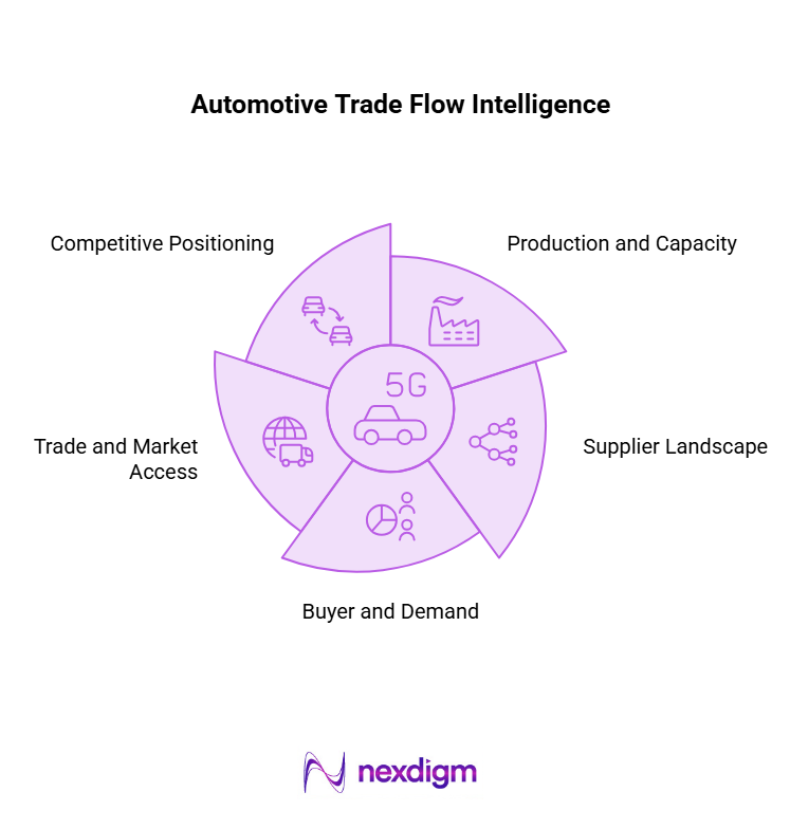
- Production and Capacity: Assess vehicle production, manufacturing locations, plant activity, capacity, and production specialization to identify emerging automotive hubs.
- Supplier Landscape: Map OEMs, component suppliers, supplier concentration, origin countries, and sourcing relationships to identify opportunities and dependencies.
- Buyer and Demand Landscape: Analyze vehicle registrations, imports, market growth, product segments, and buyer preferences to understand changing demand centers.
- Trade and Market Access: Evaluate import-export volumes, trade values, tariffs, logistics, ports, and transportation routes to assess market accessibility.
- Competitive Positioning: Track company participation, market shares, new entrants, product launches, and changing supplier-buyer relationships to identify competitive shifts.
Together, these focus areas provide a structured view of the supply, demand, competitive, and trade forces influencing automotive markets, creating the foundation for a detailed assessment.
Nexdigm’s Services Supporting in Automotive Trade Decision-Making
Nexdigm’s automotive trade intelligence services help businesses convert fragmented trade, production, supplier, and demand information into insights that can support key strategic decisions:
- Where to Source: Supplier and trade analysis helps identify alternative sourcing countries, component suppliers, and production locations based on availability, trade activity, and market access.
- Where to Expand: Demand and market analysis helps identify attractive countries based on vehicle demand, imports, competition, growth, and customer segments.
- Where to Manufacture: Production and capacity analysis helps compare manufacturing hubs based on existing ecosystems, supplier presence, export activity, and infrastructure.
- Which Partners to Consider: Company and competitive intelligence helps evaluate OEMs, suppliers, distributors, and potential strategic partners across target markets.
- Where to Prioritize Investment: By combining these signals, Nexdigm helps businesses rank markets, suppliers, production locations, and opportunities according to their strategic and commercial relevance.
This approach provides businesses a structured basis for sourcing, manufacturing, market-entry, partnership, investment, and growth decisions.
Nexdigm’s Case
Nexdigm supported an automotive-sector client by analyzing vehicle and component trade records across 16 markets, covering 40+ suppliers and 30 buyer groups. The assessment identified 8 priority markets, 12 potential supplier relationships, and emerging production hubs, helping the client make more targeted decisions on sourcing, market entry, and supply-chain expansion.
To take the next step, simply visit our Request a Consultation page and share your requirements with us.
Harsh Mittal
+91-8422857704