

Vehicle wiring harnesses have become increasingly important as automakers introduce electric powertrains, advanced driver assistance systems, connected features and software-defined vehicle architectures. A harness is no longer simply a collection of wires connecting electrical components. It is a vehicle-specific network of cables, connectors, terminals, and protective elements that must support power distribution, data transmission, safety, and reliable operation.
This change is reshaping supplier requirements. Automakers need partners capable of handling complex designs, multiple voltage levels, demanding packaging constraints, and high-volume production. The challenge is identifying suppliers that can combine engineering capability with manufacturing scale and regional delivery support.
How Vehicle Electrical Architectures Are Changing Harness Requirements
Traditional vehicle architectures often use multiple distributed electronic control units connected through extensive wiring networks. Newer architectures are moving towards domain-based and zonal designs, changing how electrical connections are organised and routed.
Three developments are particularly relevant:
- Electrification: Battery electric vehicles require high-voltage cables, battery connections, charging interfaces, and thermal-management-related wiring alongside conventional low-voltage systems.
- Advanced electronics: ADAS sensors, cameras, displays and connectivity modules increase the number and complexity of electrical connections.
- Architecture consolidation: Domain and zonal architectures can alter harness length, connector requirements, routing and manufacturing complexity.
These developments create different opportunities for suppliers. A manufacturer specialising in conventional low-voltage harnesses may not have the same capabilities as one with established high-voltage systems, specialised connectors and advanced engineering resources.
Comparing Major Wiring Harness Suppliers
The global market includes established suppliers such as Yazaki, Sumitomo Electric, Aptiv, Lear, Furukawa Electric, and Leoni. In India, Samvardhana Motherson Wiring India and other automotive component manufacturers participate in a market supported by domestic OEM production and export programmes.
Supplier comparison should examine the scope of each company’s capabilities rather than relying only on market presence.
Key areas include:
- Product range: Low-voltage harnesses, high-voltage systems, battery wiring, charging cables, connectors and specialised data connections.
- Engineering capability: Design support, computer-aided engineering, routing optimisation, weight reduction and integration with vehicle electrical architectures.
- Manufacturing scale: Number and location of production facilities, installed capacity, workforce availability and ability to ramp up.
- Customer exposure: Existing OEM relationships, platform participation and dependence on a small number of vehicle manufacturers.
- Technology development: Experience with high-voltage applications, Ethernet-based vehicle networks, and next-generation electrical architectures.
A supplier’s existing OEM relationships can provide useful evidence of programme experience. However, customer concentration and capacity commitments should also be considered before treating those relationships as proof of available supply.
Assessing Manufacturing Capacity and Regional Suitability
Wiring harness production combines automated and labour-intensive activities. Cutting and crimping operations can be automated, while circuit preparation, routing and final assembly often require significant manual work. This makes workforce availability, training systems, and plant-level productivity important parts of capacity assessment.
Installed capacity alone does not establish whether a supplier can support a new programme. Procurement teams should examine:
- Current production utilisation and available capacity.
- Manufacturing locations relative to vehicle assembly plants.
- Labour availability, productivity, and operating costs.
- Automation levels and process consistency.
- Plant expansion plans and investment commitments.
- Logistics infrastructure and delivery lead times.
Regional suitability is particularly relevant where harnesses are supplied on just-in-time or just-in-sequence schedules. A supplier with a competitive manufacturing cost may still be unsuitable if its plant is too distant from the OEM’s assembly operations or if cross-border logistics create excessive lead-time exposure.
Cost, Quality and Supply Risk
Harness cost depends on copper prices, connector and terminal specifications, insulation materials, design complexity, labour costs, and manufacturing location. High-voltage systems may require specialised insulation, shielding, and protective components, changing the cost structure compared with conventional harnesses.
A meaningful cost comparison should account for:
- Material composition and exposure to copper-price movements.
- Connector, terminal, and protective component costs.
- Labour and manufacturing productivity.
- Tooling, engineering, and design-change expenses.
- Freight, duties, and inventory requirements.
- Rework, warranty, and quality-related costs.
Automotive wiring harness supplier analysis can cover electrical continuity, insulation performance, crimp integrity, connector retention, environmental resistance, and traceability. The supplier’s quality systems matter, but procurement research should also examine the consistency of its product and process capabilities across different plants.
Supply risk may originate upstream. Connector terminals, specialised plastics, copper inputs and certain high-voltage components can have their own supplier concentration and lead-time constraints. Mapping these dependencies helps identify where an apparently diversified harness supplier may still face common sourcing exposure.
Identifying Suppliers for Future Vehicle Platforms
The right supplier depends on the vehicle programme. A high-volume compact vehicle may prioritise manufacturing efficiency and regional cost competitiveness. A premium electric platform may require high-voltage engineering, advanced connectivity, and experience with complex electrical architectures.
Nexdigm’s procurement research can help automakers compare wiring harness manufacturers by product capability, production footprint, customer relationships, capacity indicators and regional market positioning. The research can also identify suppliers with relevant technology exposure and assess the structure of the markets in which they operate.
Automotive Wiring Harness Supplier Assessment Framework
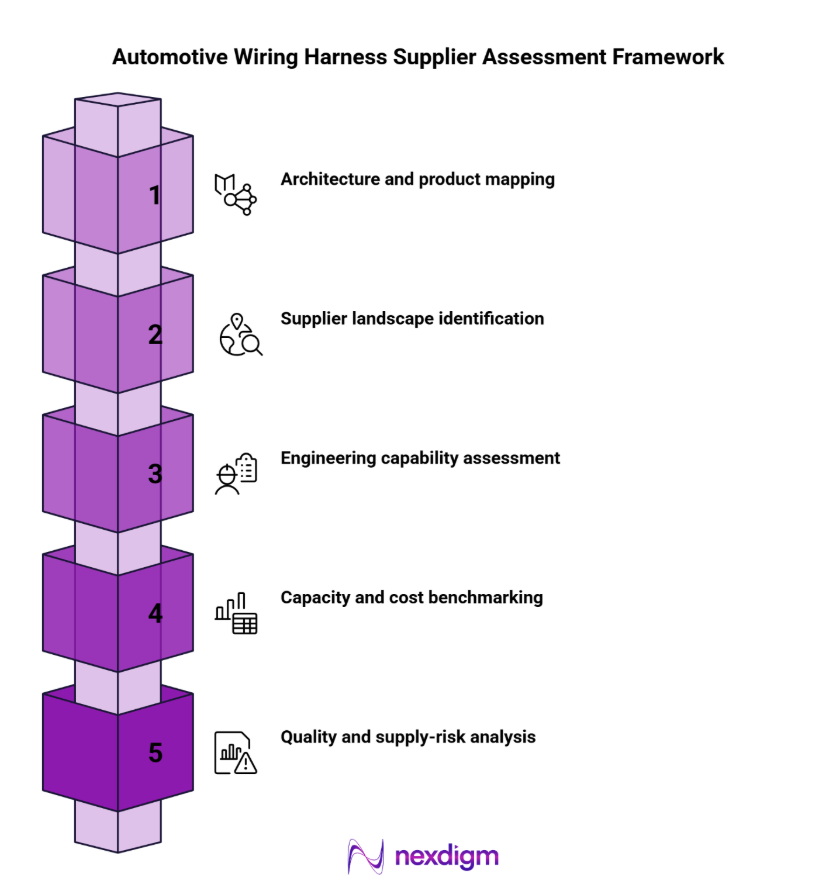
- Architecture and product mapping: Define low-voltage, high-voltage, data-transmission and connector requirements for the target vehicle platform.
- Supplier landscape identification: Map global and regional manufacturers by product portfolio, customer base and manufacturing presence.
- Engineering capability assessment: Compare design resources, high-voltage experience, architecture compatibility, and product development capabilities.
- Capacity and cost benchmarking: Assess plant locations, utilisation indicators, labour economics, production scale and logistics requirements.
- Quality and supply-risk analysis: Examine process capabilities, upstream dependencies, customer concentration, and alternative sourcing options.
Case Study: Assessing Wiring Harness Supplier Capacity
An OEM evaluating suppliers for a new electric vehicle programme needed to compare high-voltage capability and regional manufacturing coverage. Nexdigm’s research mapped 21 suppliers across five markets, assessed their product portfolios and plant networks, and shortlisted six vendors for detailed technical and commercial evaluation.
To take the next step, simply visit our Request a Consultation page and share your requirements with us.
Harsh Mittal
+91-8422857704