

Autonomous systems are scaling first where the operating environment can be defined, monitored, and repeated. Warehouses, manufacturing facilities, ports, mines, and selected freight corridors offer predictable routes, controlled access, established safety procedures, and fewer unpredictable interactions than public urban roads. These characteristics reduce the number of edge cases an autonomous system must handle and make deployment economics easier to model.
The autonomous mobile robots market illustrates this shift toward structured environments. The global AMR market is estimated at approximately $5.5 billion in 2026 and is projected to reach $14.0 billion by 2033, representing a 14.4% CAGR. Asia Pacific accounted for approximately 30% of market revenue in 2025, reflecting the importance of manufacturing and logistics-intensive markets to autonomous-system adoption.
The commercial question is therefore becoming more specific: which applications combine sufficient demand with an operating environment that allows autonomy to deliver measurable economic value?
Mobility Is Expanding, but Geography Still Defines the Opportunity
Autonomous mobility is progressing beyond isolated demonstrations, although deployment remains highly dependent on geography and operating conditions. Waymo expanded its autonomous ride-hailing operations to Las Vegas in September 2026, adding another major US market to its commercial footprint. Pony.ai has also announced plans with Uber to deploy more than 2,000 robotaxis across European cities.
Freight autonomy is developing through similarly constrained routes. Pony.ai unveiled a Level 4 autonomous electric heavy-duty truck in Germany in September 2026, with mass production planned for later in the year and initial applications including logistics and port transportation. The emphasis on ports and defined freight corridors is commercially significant because these environments offer greater predictability than unrestricted urban mobility.
Logistics and warehouse intralogistics remain among the clearest near-term opportunities. AMRs, automated forklifts, inventory-scanning robots, and goods-to-person systems can operate within facilities where routes, charging infrastructure, safety zones, and workflows can be designed around the technology. High asset utilization and persistent labor requirements can further strengthen the business case.
Industrial applications provide another scalable segment. Autonomous material tuggers, inspection systems, robotic handling platforms, and automated quality-control systems can perform repetitive or hazardous tasks in manufacturing plants, chemical facilities, steel mills, and other controlled environments. Their commercial viability depends on whether the productivity or safety improvement justifies integration and capital costs.
Defense-adjacent civilian applications occupy a broader operating spectrum. Drones and uncrewed ground systems can support pipeline inspection, infrastructure monitoring, disaster assessment, and security around critical assets. These applications may offer significant value where human access is costly or dangerous, but deployment must account for airspace restrictions, communications coverage, terrain, operating permissions, and human supervision requirements.
The Unit Economics Change with Every Operating Domain
An autonomous systems market opportunity study needs to examine more than the price of the autonomous asset. Capital expenditure can include sensors, compute hardware, safety systems, software, facility modifications, charging infrastructure, integration, and validation. Operating expenditure can include maintenance, connectivity, remote supervision, insurance, compliance, and technology support.
Utilization is particularly important. A high-cost autonomous asset that operates for only a few hours a day may struggle to achieve an acceptable return, while an asset deployed across multiple shifts can distribute its fixed costs across substantially more productive hours.
Intervention rates also matter. An autonomous vehicle that requires frequent human assistance may still generate value, but its economics differ considerably from a system that operates independently for long periods. The assessment should therefore model autonomous operating time, intervention frequency, labor displacement, throughput, maintenance, and expected asset life together.
The same principle applies to mobility. A robotaxi operating inside a defined service area faces a different cost structure from an autonomous truck crossing jurisdiction. Charging or fueling, fleet maintenance, remote operations, road conditions, regulatory approvals, insurance, and cross-border requirements can materially alter the economics of deployment.
Nexdigm Framework for Prioritizing Autonomous-System Opportunities
Nexdigm can evaluate potential autonomy markets through a structured assessment focused on commercial scalability:
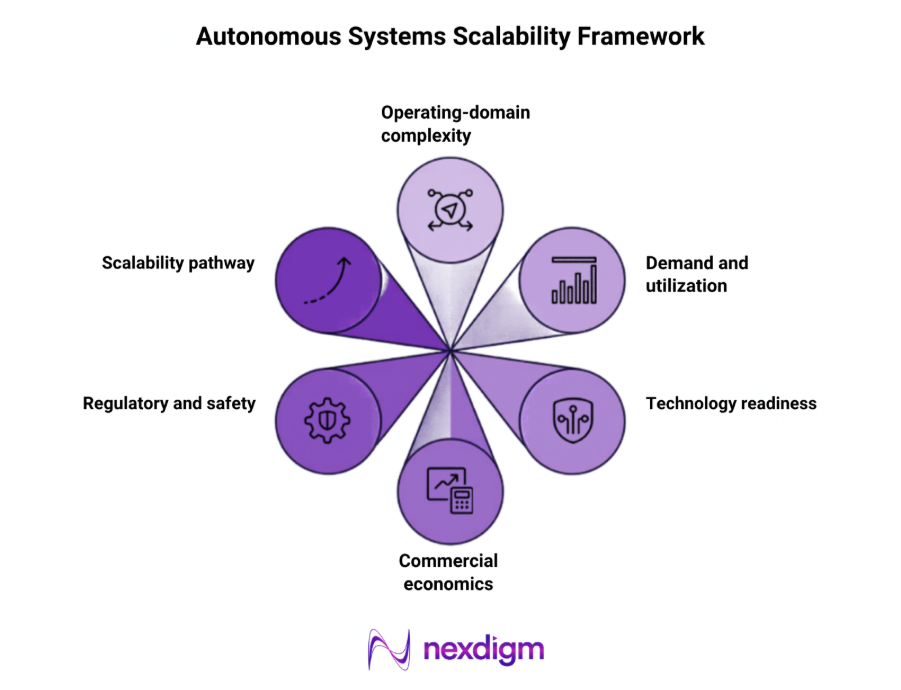
- Operating-domain complexity: Map routes, environmental variables, human interaction, exception frequency, and task criticality.
- Demand and utilization: Quantify addressable demand, operating hours, asset requirements, utilization potential, and demand concentration.
- Technology readiness: Assess autonomy level, sensor and compute requirements, connectivity, software integration, infrastructure, and technology maturity.
- Commercial economics: Model capital expenditure, labor substitution, maintenance, supervision, insurance, operating costs, productivity gains, and payback.
- Regulatory and safety environment: Evaluate certification, operating permissions, liability, worker safety, data requirements, and jurisdiction-specific restrictions.
- Scalability pathway: Rank applications according to repeatability, infrastructure requirements, economics, regulatory readiness, and potential for geographic expansion.
This framework allows decision-makers to compare an AMR deployment against an autonomous freight corridor, industrial inspection application, or civilian drone operation using consistent commercial criteria.
Nexdigm Case: Turning Network Assessment Into Quantified Outcomes
Nexdigm supported a manufacturing company evaluating logistics hub locations across three high-growth trade markets. The assessment shortlisted two viable hubs and projected distribution-cost reductions of 14–16%, a 35% improvement in delivery coverage, and approximately 25% lower average transit time.
The relevance to autonomous deployment lies in the surrounding network economics. Autonomous technology creates greater value when the operating network, infrastructure, demand density, and service requirements support high utilization. A technically capable system can therefore have very different commercial potential across two otherwise similar markets.
To take the next step, simply visit our Request a Consultation page and share your requirements with us.
Harsh Mittal
+91-8422857704