

Autonomous driving is moving gradually from testing environments into real-world commercial applications, particularly across ride-hailing, logistics, and controlled-route operations.
Waymo reported more than 20 million autonomous trips by early 2026 and had expanded its commercial service to 10+ metro areas, showing that autonomous mobility is moving beyond pilot-stage testing.
Recent deployments show that commercialization is not only a technology question. The pace of adoption increasingly depends on regulation, operating conditions, customer acceptance, infrastructure, and economics.
For automotive businesses, the opportunity lies in determining which autonomous-driving applications are commercially ready, where adoption can scale, and what barriers need to be addressed before wider deployment.
When Can Autonomous Driving Reach Commercial Scale?
Technology readiness provides the starting point, but commercial scale depends on whether autonomous systems can operate safely, consistently, and economically in real-world conditions. The assessment needs to look beyond technology demonstrations and examine:
- Technology maturity
- Regulatory approval
- Safety and reliability
- Use-case economics
- Infrastructure availability
The distinction matters because the same autonomous technology can have very different commercial potential depending on where and how it is deployed. A controlled logistics route may be easier to automate than a mixed-traffic urban environment. Similarly, autonomous fleet applications may achieve commercial value sooner than widespread private-vehicle autonomy.
Factors Determining the Commercial Opportunity
- Technology readiness. Sensor performance, AI systems, computing platforms, mapping, vehicle controls, and software reliability determine how effectively autonomous systems can operate.
- Regulation. Testing permissions, safety requirements, liability rules, data regulations, and commercial deployment frameworks determine where autonomous services can legally operate.
- Use-case economics. Vehicle utilisation, operating costs, driver requirements, system costs, and potential productivity gains determine whether autonomous deployment makes commercial sense.
- Operating environment. Road quality, traffic conditions, weather, route predictability, connectivity, and mapping availability can influence deployment complexity.
- Market demand. Fleet operators, mobility providers, logistics companies, and consumers need to see sufficient value before adoption can scale.
Together, these factors help determine where autonomous driving is closest to commercial scale and where significant barriers remain.
How Close Is Autonomous Driving towards Commercial Scale?
Autonomous driving is no longer limited to technology trials. Commercial deployments are emerging, but readiness varies significantly by use case, geography, technology level, and operating environment. An autonomous vehicle market assessment can assess the distance to commercial scale by looking at:
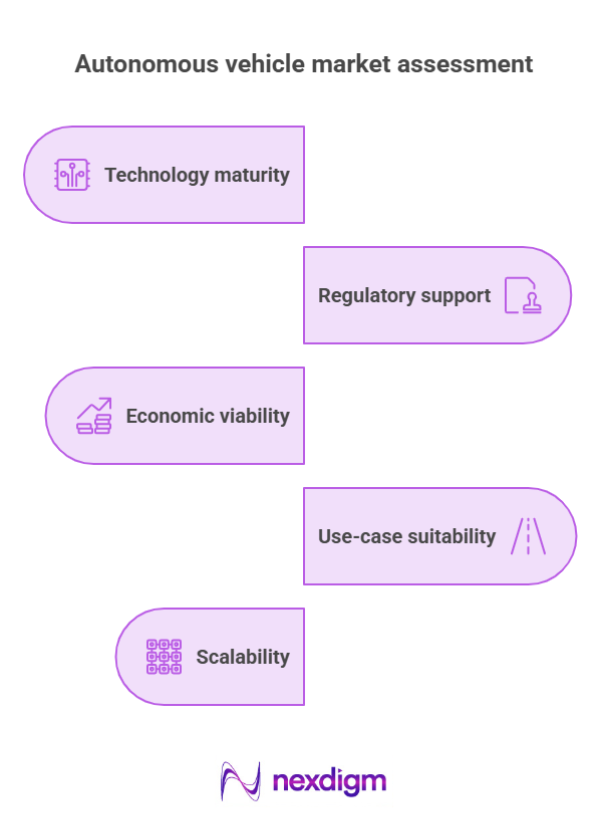
- Technology maturity: Determine whether autonomous systems can deliver reliable performance in real-world operating conditions.
- Regulatory support: Assess whether local regulations allow testing, deployment, and commercial operation.
- Economic viability: Compare system costs, operating savings, vehicle utilisation, and potential revenue models.
- Use-case suitability: Identify applications where predictable routes, high utilisation, or controlled environments can support faster adoption.
- Scalability: Evaluate whether a successful pilot can expand across additional vehicles, routes, cities, or markets.
The assessment can therefore distinguish between technologies that are ready today, applications approaching commercial scale, and opportunities that require further development.
Assessing Autonomous Driving Opportunities with Nexdigm
Nexdigm can conduct an Autonomous vehicle market assessment using a structured approach. This assessment connects technology readiness, regulatory conditions, market demand, use-case economics, competitive activity, and scalability to identify the most attractive opportunities, in the following ways:
- 1 | Assess technology readiness: Evaluate sensors, AI, software, computing, mapping, vehicle integration, safety, and validation.
- 2 | Map regulatory conditions: Analyze testing permissions, safety requirements, liability frameworks, data regulations, and government policies.
- 3 | Identify attractive use cases: Compare robotaxis, logistics, trucks, shuttles, and passenger vehicles based on operational and commercial potential.
- 4 | Evaluate market economics: Assess system costs, utilization, operating expenses, revenue models, savings, and expected returns.
What Can an Autonomous Vehicle Market Assessment Reveal?
A structured Autonomous vehicle market assessment can highlight important differences between technological potential and commercial readiness.
For example, a technology may be mature but face regulatory restrictions. A logistics application may offer stronger near-term economics than complex urban driving. Similarly, infrastructure limitations may restrict deployment even where technology is sufficiently advanced. Nexdigm can help businesses identify these differences and prioritise applications based on technology, regulation, economics, demand, and scalability.
Nexdigm’s Autonomous Vehicle Market Assessment Case
Nexdigm assisted an automotive player in assessing autonomous-driving readiness as commercial robotaxi services expanded across 20+ cities globally in 2026. The study evaluated technology, regulation, and use cases, identifying scalable opportunities.
To take the next step, simply visit our Request a Consultation page and share your requirements with us.
Harsh Mittal
+91-8422857704