

Autonomous vehicle strategies are evolving as rising investments in AI, sensors, robotics, and mobility innovation accelerate the shift toward self-driving transport. Automakers, technology firms, and mobility providers are exploring autonomous systems for passenger vehicles, robotaxis, logistics fleets, and controlled urban mobility use cases.
A clear market entry strategy is essential to assess regulatory readiness, safety validation, infrastructure needs, public acceptance, technology maturity, and partnership opportunities before entering this complex market. Autonomous vehicle technology entry strategy helps companies manage deployment risks, align with innovation trends, and build scalable solutions for future mobility ecosystems.
Autonomous mobility is gaining momentum as investment flows into AI, sensors, vehicle software, simulation, and connected infrastructure. The global autonomous vehicle market is estimated at USD 86.32 billion in 2025 and is projected to reach USD 214.32 billion by 2030, growing at 19.9% CAGR.
These figures show rising commercial interest in self-driving systems, especially across robotaxis, logistics fleets, assisted mobility, and controlled urban transport applications.
How Can Companies Build a Market Entry Strategy for Autonomous Vehicle Technologies?
Companies can build a market entry strategy for autonomous vehicle technologies by assessing regulations, safety testing needs, infrastructure readiness, AI capability, partnerships, target use cases, public acceptance, and deployment risks:
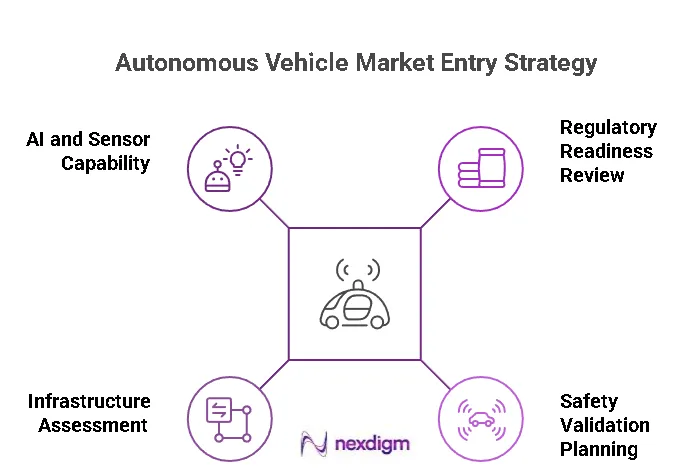
- Regulatory Readiness Review – Assess autonomous vehicle laws, testing permissions, approval timelines, liability rules, and policy support across target markets.
- Safety Validation Planning – Review simulation, road testing, scenario validation, fail-safe systems, and safety evidence required before autonomous vehicle deployment.
- Infrastructure Assessment – Evaluate road quality, mapping availability, connectivity, traffic systems, charging access, and smart city readiness for autonomous mobility.
- AI and Sensor Capability – Assess perception systems, cameras, radar, lidar, software models, decision-making algorithms, and real-time processing capability.
Nexdigm’s Market Assessment for Robotaxis, Autonomous Shuttles, and Driverless Logistics
Nexdigm’s Market Assessment for Robotaxis, Autonomous Shuttles, and Driverless Logistics helps companies evaluate commercial opportunities across key autonomous mobility use cases. Nexdigm can assess urban mobility demand, logistics activity, infrastructure readiness, regulations, customer acceptance, fleet economics, and partnership opportunities. This enables companies to prioritize viable segments, reduce deployment risks, and build a focused autonomous vehicle market entry strategy.
Nexdigm’s Perspective on AI Investment Reshaping Autonomous Vehicle Development Strategies
Nexdigm’s perspective highlights how AI investment is accelerating autonomous vehicle development by improving perception systems, decision-making software, simulation testing, safety validation, and commercialization strategies across future mobility markets.
- Technology Investment Mapping – Nexdigm tracks AI, sensor, software, mapping, and mobility investments shaping autonomous vehicle development priorities.
- Commercial Use Case Evaluation – Nexdigm identifies practical opportunities across robotaxis, autonomous shuttles, driverless logistics, industrial mobility, and controlled transport routes.
- Partnership Ecosystem Review – Nexdigm maps OEMs, AI firms, sensor providers, fleet operators, and city stakeholders for autonomous mobility collaboration.
- Market Entry Roadmap – Nexdigm converts AI investment insights into phased entry plans covering pilots, partnerships, compliance, risks, and commercialization priorities.
Nexdigm’s case:
Nexdigm supported an autonomous vehicle solutions provider in evaluating AI-led growth opportunities across passenger and commercial mobility segments. Nexdigm analyzed 5 urban markets, reviewed 30+ regulatory and infrastructure indicators, and assessed 50+ potential ecosystem players across AI software, sensors, mapping, fleet operations, and mobility platforms. The study helped the company select 2 pilot-ready cities, identify 10 collaboration opportunities, and reduce early-stage deployment uncertainty by 20–25%.
To take the next step, simply visit our Request a Consultation page and share your requirements with us.
Harsh Mittal
+91-8422857704