

India’s bakery market is becoming increasingly segmented. Bread and biscuits continue to provide scale, while cakes, pastries, premium breads, frozen bakery and health-oriented products are creating additional value pools. The commercial question for bakery companies is therefore less about whether demand exists and more about which formats, price tiers and channels are generating incremental demand.
Nexdigm estimates India’s bakery-products demand at US$12.9 billion in 2024, with households accounting for 80.1% of total demand. The industry remains highly fragmented, with 862,714 companies and the five largest accounting for 34.4% of production value.
That structure creates very different opportunities for national packaged-food companies, regional bakeries and premium operators.
Freshness Still Drives a Large Part of the Market
Fresh bakery has an inherent advantage in categories where consumers associate quality with texture, aroma and same-day consumption. Bread, buns, cakes and pastries can therefore support frequent purchases and strong local loyalty, particularly where distribution radius matters. At the same time, freshness creates operating constraints.
Shelf life, production scheduling, wastage, local manufacturing and route density all influence margins.
This makes fresh bakery particularly dependent on geography.
A national packaged brand can distribute biscuits across long distances, while a fresh bakery may need production close to the consumer.
Market assessment therefore needs to identify where population density and consumption frequency are sufficient to support localized production.
Packaged Bakery Wins on Reach and Shelf Life
Packaged bakery products have a different growth equation.
Bread, biscuits, cookies and rusks can travel through general trade, modern retail and increasingly digital channels without the same immediate shelf-life constraints as fresh products.
Industry estimates place India’s bakery market at US12.36billionin2024,withprojectionsofUS21.66 billion by 2030 at a 9.8% CAGR. Online is identified as the fastest-growing distribution channel.
The opportunity is particularly relevant where brands can combine:
- Longer shelf life
- Affordable price points
- Small and family packs
- Broad retail distribution
- Strong repeat consumption
The challenge is that packaged bakery also faces intense competition. With a fragmented supply base, shelf visibility, price architecture and route-to-market execution become important determinants of market share.
Premiumization Is Creating a Different Profit Pool
Premium bakery demand is increasingly linked to product experience rather than basic calorie delivery.
Artisanal breads, specialty cookies, croissants, premium cakes, pastries and products using distinctive ingredients can command higher prices where consumers perceive meaningful differences in quality, freshness or formulation.
Mordor Intelligence estimates that bread represented 34.78% of the premium bakery market in 2025. Fresh products accounted for 68.62%, while frozen premium bakery products are forecast to grow at 5.18% through 2031.
Consumers looking for higher-fibre, organic, gluten-free or other specialized products may accept higher prices, but the opportunity is highly dependent on consumer education and local purchasing power.
Premium demand also overlaps with health.
Convenience Is Expanding the Bakery Occasion
Bakery demand is also being pulled into new consumption occasions.
Breakfast, snacking, office consumption, travel and foodservice all create demand for products that require little preparation. Frozen and ready-to-bake bakery products can extend this opportunity into both households and professional kitchens.
In the broader premium bakery market, online retail is forecast to grow at 7.42% through 2031, reflecting the increasing importance of digital discovery and replenishment.
Quick commerce adds another layer by making premium and convenience-led bakery products available in small baskets and short purchase cycles.
Where the Opportunity Actually Sits
The most useful bakery assessment does not treat all demand as interchangeable.
A company considering expansion should distinguish between:
- Mass consumption: bread, biscuits, cookies and other high-frequency products where distribution and affordability dominate.
- Fresh local demand: products where proximity, freshness and daily production determine competitiveness.
- Premium consumption: cakes, pastries, artisanal breads and specialty products where experience and formulation support higher realization.
- Convenience demand: frozen, ready-to-bake and packaged products that reduce preparation time.
- Institutional demand: buns, bases, breads and other products purchased by QSRs, hotels, cafés and catering businesses.
Each segment requires a different production, pricing and distribution model.
Nexdigm’s bakery market assessment research helps companies evaluate category demand, consumer segments, pricing, competitive intensity, production economics and channel opportunities to identify commercially viable bakery growth areas.
Nexdigm’s Bakery Opportunity Mapping Framework
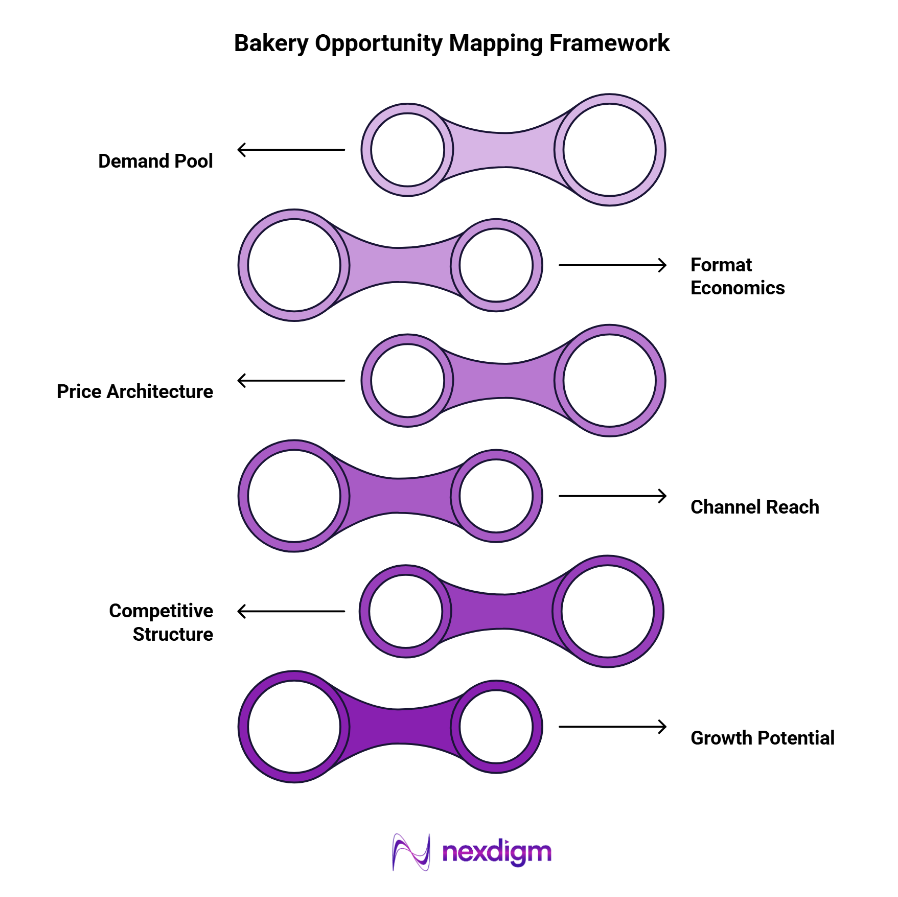
- Demand Pool: Size consumption by product, occasion, geography and household segment.
- Format Economics: Compare fresh, packaged, frozen and ready-to-bake models across shelf life, wastage and production requirements.
- Price Architecture: Map entry, mainstream and premium price tiers against consumer affordability.
- Channel Reach: Assess general trade, modern retail, specialty stores, foodservice, e-commerce and quick commerce.
- Competitive Structure: Benchmark national brands, regional players, artisanal operators and private labels.
- Growth Potential: Identify categories and locations where volume growth, premiumization or channel expansion can support attractive commercial opportunities.
This approach helps companies distinguish high-volume categories from segments where incremental value and margin are more important than absolute consumption.
Nexdigm Case: Identifying Bakery Growth and Premiumization Opportunities
Nexdigm assessed 4 bakery segments across 7 cities, combining 2,800 consumer interviews with 45 competitor benchmarks. Premium and convenience-led products showed the strongest opportunity, supporting a portfolio strategy targeting 15% higher average selling prices.
To take the next step, simply visit our Request a Consultation page and share your requirements with us.
Harsh Mittal
+91-8422857704