

Bakery procurement is often managed through ingredient prices, but purchase price alone does not explain production cost. Flour, sugar, fats, yeast, dairy ingredients, chocolate, fillings, and packaging all influence the economics of a finished product. Their impact depends on recipe specifications, processing performance, batch yield, wastage, and the amount of material required per saleable unit.
A useful benchmark separates these cost drivers and identifies which differences can be addressed through supplier negotiations, purchasing changes, or production improvements.
Market Context: Why One Inflation Rate Is Not Enough
Bakery inputs are exposed to different markets. Wheat and flour prices reflect harvest conditions, stocks, trade policy, and milling costs. Sugar and vegetable oils have their own supply-demand dynamics, while cocoa and dairy ingredients introduce separate sources of volatility.
In September 2026, the FAO Food Price Index recorded a 17.2% year-on-year increase in cereals and a 16% increase in vegetable oils, while sugar prices were 8.5% lower year on year. These are international price indicators rather than direct measures of bakery ingredient costs in India. Their value lies in identifying where market pressure may be changing, not in predicting a supplier’s exact price.
Ingredient Costs: Compare Performance, Not Just Rates
The largest ingredient categories should be ranked by annual spend, price movement, and share of product cost. Comparisons must use equivalent grades and specifications.
For example, flour suppliers may differ in moisture, protein characteristics, or consistency. Fat ingredients may have different functional properties. A cheaper input can increase production losses or require recipe adjustments, offsetting the initial saving.
The benchmark should capture:
- Price per kilogram or litre, including freight and other charges.
- Grade, composition, moisture, and relevant technical specifications.
- Batch yield and ingredient consumption per saleable unit.
- Rejection rates, product consistency, and supply reliability.
- Minimum orders, shelf life, and storage requirements.
For bakery procurement cost benchmarking services, ingredient quotations should be connected to recipe and production data. This allows procurement teams to distinguish supplier-price gaps from differences in usable yield.
Packaging Costs: Materials, Conversion, and Minimum Runs
Packaging may include bread bags, cake boxes, trays, labels, cartons, protective inserts, and food-contact materials. The final price can reflect material, dimensions, printing, tooling, conversion, order volume, and delivery.
A fair comparison should measure cost per thousand units or per finished product, while accounting for specification and damage rates. Printed packaging also creates inventory risk: a large production run may reduce the unit price but leave the business holding obsolete materials after a design or label change.
Potential questions include:
- Are different sites buying equivalent packaging at different rates?
- Can formats be standardised without compromising protection or presentation?
- Are minimum order quantities aligned with demand and shelf life?
- Do freight and storage costs cancel out the quoted discount?
Supplier Costs: Reliability Has an Economic Value
Supplier benchmarking should consider more than price. Late deliveries can interrupt production, while inconsistent materials can increase downtime, rejects, and quality checks. A technically strong supplier may justify a higher rate if it reduces these costs.
Compare vendors using common specifications, delivered price, lead time, fill rate, capacity, complaint resolution, and continuity arrangements. Alternative suppliers should be technically qualified before they are needed, particularly for ingredients that require recipe trials.
Bakery Procurement Cost Benchmarking Framework
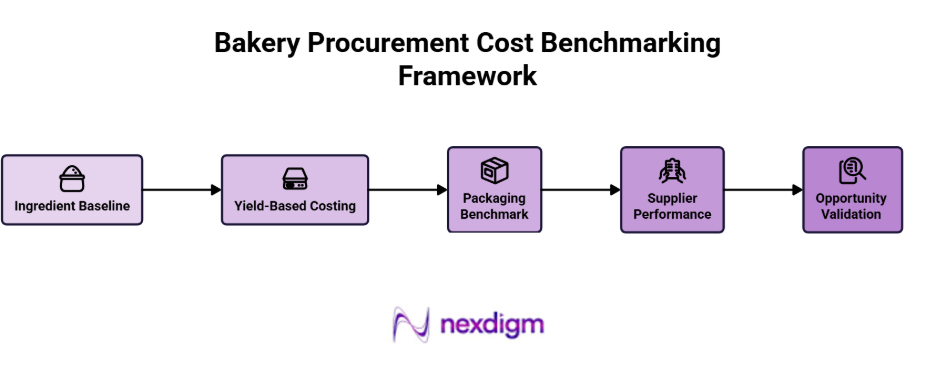
- Ingredient Baseline: Rank ingredients by spend, product line, supplier, and price volatility to identify material cost drivers.
- Yield-Based Costing: Link ingredient prices to recipes, batch yields, rejects, and waste to calculate cost per saleable unit.
- Packaging Benchmark: Compare materials, dimensions, print requirements, minimum runs, freight, and packaging consumption.
- Supplier Performance: Evaluate price, quality consistency, lead times, capacity, fill rates, and technical support.
- Opportunity Validation: Prioritise negotiation, order consolidation, packaging standardisation, and alternative sourcing based on savings potential and production risk.
Outlook: More Data, Fewer Assumptions
The strongest procurement programmes will combine market-price monitoring with production and supplier data. External indices can indicate pressure, but the business still needs to test whether the change applies to its ingredient specification, contract period, and sourcing market. That distinction supports more credible negotiation and avoids treating every supplier increase as either justified or excessive.
Nexdigm’s Case Study
In a representative bakery procurement assessment, ingredient and packaging spend was analysed across two production sites. The review identified price differences for comparable materials, inconsistent order quantities, and excess packaging variation. A plan combining rate negotiations, specification alignment, and revised ordering practices was developed to target savings while preserving recipe and packaging requirements.
To take the next step, simply visit our Request a Consultation page and share your requirements with us.
Harsh Mittal
+91-8422857704