

Bakery sourcing involves a diverse supplier market, ranging from industrial bakeries and frozen-dough manufacturers to regional bakeries and specialist producers. Their capabilities differ in production volume, product consistency, shelf life, packaging, and distribution reach. A supplier suited to a neighbourhood outlet may struggle to support a national foodservice chain with standardised products and strict delivery windows.
Supplier evaluation should establish which manufacturers can meet the required product specifications and commercial volumes without compromising consistency.
Map the Bakery Supply Base
Bakery suppliers can be segmented by product type, including bread, buns, cakes, biscuits, pastries, flatbreads, and frozen bakery products. Industrial manufacturers may offer automated production and consistent specifications, while regional suppliers can provide shorter delivery routes and greater flexibility for fresh products.
India’s food processing sector recorded an average annual growth rate of 6.55% over the nine years ending in 2023-24, according to the Ministry of Food Processing Industries. This broader industry trend provides context for supplier-market development, but bakery-specific capacity and competition must be assessed at the product and regional levels.
Assess Production and Product Fit
Supplier capability depends on more than installed production capacity. Buyers should examine recipe consistency, ingredient sourcing, batch controls, line availability, packaging formats, shelf life, and the ability to accommodate customised specifications.
For bakery supplier evaluation and research consulting, it is important to distinguish fresh-bakery supply from frozen or partially baked products. These models have different storage, transport, labour, and preparation requirements. A frozen product may extend distribution reach but require freezer capacity and suitable handling at every point in the chain.
Compare Cost and Delivery Economics
Bakery quotations should be compared using equivalent product weight, dimensions, recipe specifications, packaging, and delivery conditions. Additional costs can arise from short shelf life, rejected batches, unsold stock, delivery frequency, and minimum order quantities.
Distribution economics can determine which supplier is viable. A manufacturer with lower ex-factory prices may be less competitive when serving distant outlets, while a regional bakery may offer better economics for frequent replenishment.
Bakery Supplier Evaluation Framework
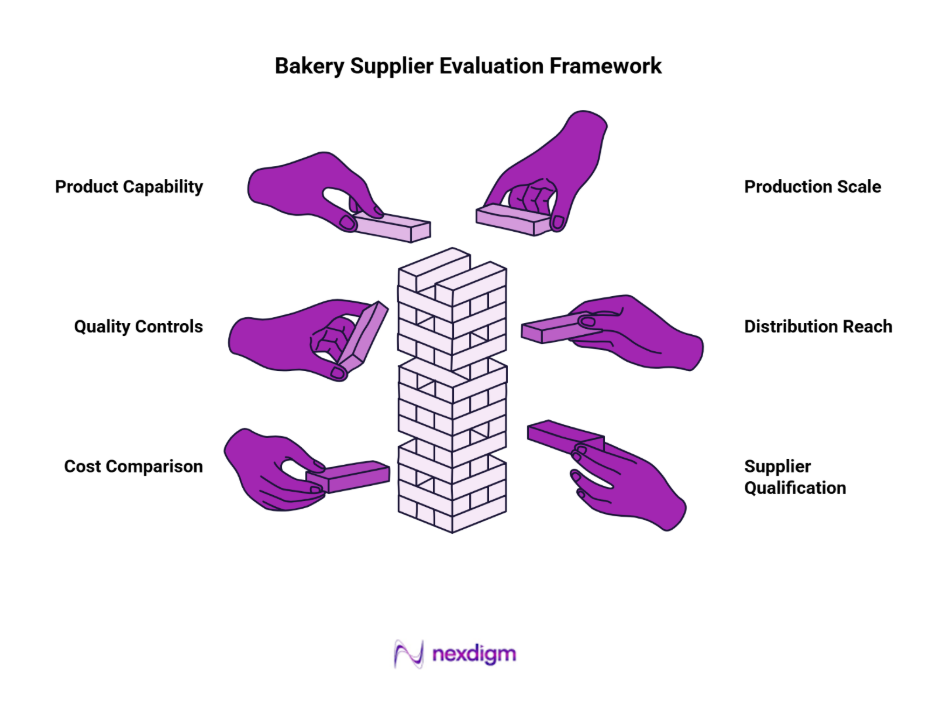
- Product Capability: Verify product range, recipe specifications, weight consistency, texture, shelf life, packaging, and the ability to meet customer-specific requirements.
- Production Scale: Assess line capacity, shift patterns, ingredient availability, batch consistency, and the ability to increase volumes during promotions or new-store launches.
- Quality Controls: Review ingredient traceability, hygiene procedures, batch testing, allergen management, complaint handling, and relevant food safety documentation.
- Distribution Reach: Evaluate delivery routes, transit time, cold-chain requirements for frozen products, delivery frequency, and service coverage across target outlets.
- Cost Comparison: Compare price per usable unit, packaging, freight, minimum orders, wastage, rejected batches, and inventory requirements under consistent assumptions.
- Supplier Qualification: Test samples, review production records, confirm available capacity, and conduct trial orders before making long-term sourcing commitments.
Select for Consistency and Scale
The right bakery supplier should match the product’s operational requirements as well as its target cost. Retailers and foodservice operators should use product trials, standard specifications, and regular performance reviews to ensure that supplier expansion does not introduce variation across outlets.
Nexdigm’s Case Study
A foodservice operator supplying 60 outlets assessed five bakery vendors for buns and sandwich bread. Product trials and route-cost analysis identified two suppliers with more consistent dimensions and better delivery coverage. Revised sourcing reduced rejected deliveries by 22% and lowered combined procurement and distribution costs by 4.5% over the following quarter.
To take the next step, simply visit our Request a Consultation page and share your requirements with us.
Harsh Mittal
+91-8422857704