

Bakery manufacturers depend on a combination of agricultural inputs, processed ingredients and specialised packaging. Flour, sugar, edible oils, fats, yeast, cocoa, dairy ingredients and food additives each have different sourcing patterns and storage requirements. A disruption affecting one category can influence production schedules, product consistency and the ability to meet retailer orders.
Supplier risk becomes more difficult to manage as manufacturers expand their product portfolios. A business producing bread, biscuits, cakes and frozen bakery products may work with dozens of suppliers, each operating under different quality systems and regional market conditions. Understanding where dependencies are concentrated is therefore an important part of production planning.
Wheat Supply and Ingredient Availability Shape Bakery Risk
India produced approximately 117.94 million tonnes of wheat in 2024–25, according to the government’s final agricultural estimates. This makes the country a major source of the principal ingredient used across bread, biscuits and other flour-based products. However, national production does not guarantee uniform availability across all manufacturing regions. Procurement depends on crop quality, storage, milling capacity, transport connectivity and the specifications required by individual products.
Edible oils create a different exposure. India’s edible-oil supply remains significantly dependent on imports, leaving manufacturers exposed to international commodity prices, currency movements and shipping conditions. Bakery fats and oils may also require specific functional properties, so replacing one supplier or material can involve product trials and reformulation.
The risk profile consequently varies by ingredient. Wheat flour may be available from multiple regional mills, while specialised fats, cocoa ingredients or functional additives may have fewer qualified sources.
Three Areas Where Bakery Supply Risk Can Build Up
Agricultural Input Concentration
Seasonality and regional production patterns can affect the availability and quality of wheat, sugar, oilseeds and other agricultural inputs. A bakery manufacturer sourcing from a narrow geographic area may face higher exposure to crop variability, local transport disruption and storage constraints.
Supplier mapping should identify where inputs originate, how many intermediaries are involved and whether alternative production regions can meet the required specifications. It should also distinguish between suppliers that trade commodities and those that process or mill them.
Ingredient Quality and Product Consistency
Bakery production is sensitive to ingredient characteristics. Flour protein content, moisture, ash levels and milling consistency can influence dough behaviour and finished-product quality. Fats and oils affect texture, shelf life and processing performance, while yeast and other ingredients require appropriate storage and handling.
Supplier assessment should therefore examine specifications, batch testing, laboratory arrangements, rejection history and the procedures used to investigate deviations. A vendor’s ability to provide a certificate of analysis is useful, but manufacturers should also understand how samples are collected and how results are verified.
Packaging and Delivery Dependencies
Packaging materials can become a production bottleneck even when ingredients are readily available. Printed films, laminates, cartons and specialised barrier materials may require longer lead times and additional qualification before a replacement can be used.
Delivery risk also varies by product. Bulk flour and sugar require suitable dry storage and transport, while temperature-sensitive ingredients may need controlled conditions. Suppliers serving multiple manufacturing facilities should be assessed on delivery coverage, vehicle availability and their ability to manage sudden order changes.
Quality Controls and Regulatory Documentation
Bakery suppliers need to maintain documentation relevant to the materials they provide. This can include applicable FSSAI licences, ingredient specifications, test reports, allergen declarations, traceability records and product safety documentation.
The scale of food safety enforcement in India makes these controls commercially relevant. During FY2024–25, food safety authorities analysed 170,535 food samples, with 34,388 found non-conforming. The figures cover multiple food categories and are not a direct measure of bakery supplier performance. They indicate why manufacturers should verify the quality systems behind incoming materials rather than relying solely on vendor declarations.
For manufacturers supplying organised retail chains, export markets or institutional customers, inconsistent documentation can also complicate customer audits and product approvals.
Mapping Bakery Supplier Exposure with Nexdigm
A bakery supplier risk assessment consulting engagement can help manufacturers examine ingredient supply markets, regional production capacity, supplier concentration and relevant compliance conditions. Nexdigm’s market intelligence capabilities can support comparisons across flour mills, ingredient processors, packaging manufacturers and other market participants.
The analysis can also identify where alternative suppliers are commercially accessible and where switching may require additional product qualification, testing or logistics investment.
Bakery Ingredient Supply and Supplier Risk Assessment Framework
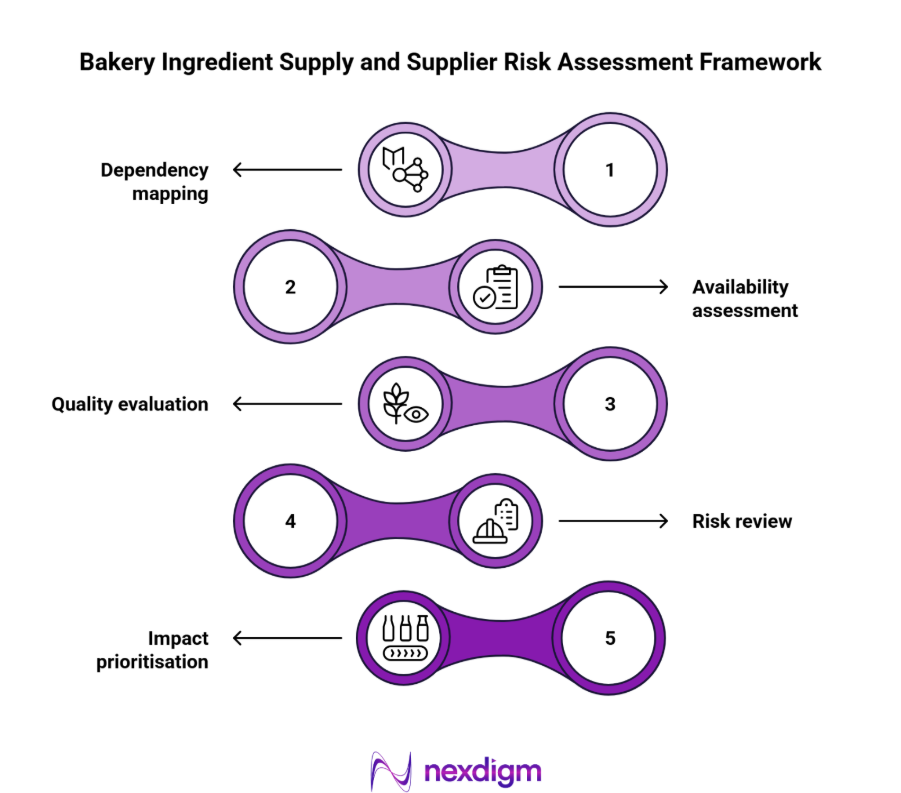
- Ingredient Dependency Mapping: Identify critical ingredients, supplier concentration and dependence on specific agricultural or processing regions.
- Supply Availability Assessment: Evaluate production volumes, seasonal fluctuations, import exposure and alternative sourcing markets.
- Ingredient Quality Evaluation: Compare product specifications, batch consistency, testing procedures and quality documentation.
- Packaging and Delivery Risk Review: Assess packaging availability, supplier lead times, storage conditions and delivery reliability.
- Production Impact Prioritisation: Rank supplier risks according to material criticality, substitutability and potential production disruption.
This method helps manufacturers focus attention on dependencies that can affect production continuity, rather than treating every vendor gap as equally serious.
Nexdigm’s Case Study
A bakery manufacturer operating 2 production facilities reviewed 38 suppliers across flour, fats, sugar, yeast and packaging. The assessment identified 9 high-dependency relationships and 5 vendors with recurring quality documentation gaps. The client qualified 6 alternate sources, reducing critical ingredient concentration from 41% to 27%.
To take the next step, simply visit our Request a Consultation page and share your requirements with us.
Harsh Mittal
+91-8422857704