

As retail banks compete for increasingly informed customers, conducting a bank account pricing competitiveness study is essential for evaluating fees, interest rates, minimum balances, rewards, and digital benefits across institutions. Comprehensive pricing analysis helps banks understand market positioning, identify pricing gaps, and align account propositions with customer expectations.
By combining competitor benchmarking, customer behavior insights, and profitability assessment, financial institutions can refine account structures, improve transparency, strengthen acquisition and retention, and create differentiated offerings that support sustainable growth while serving millions of retail banking customers across diverse markets and channels.
In first-quarter 2026, FDIC-insured institutions generated $80.5 billion in net income, up 3.6% quarter over quarter, while majority of U.S. adults held bank accounts in 2025, supporting investment in pricing analysis, accessible products, and customer-focused account strategies.
Strategic Pricing Analysis for Retail Bank Account Portfolios
Strategic pricing analysis helps banks strengthen account portfolios by aligning fees, rates, features, and customer value, improving competitiveness, profitability, transparency, retention, and sustainable growth across diverse retail banking customer segments. Key elements in focus during analytical process are:
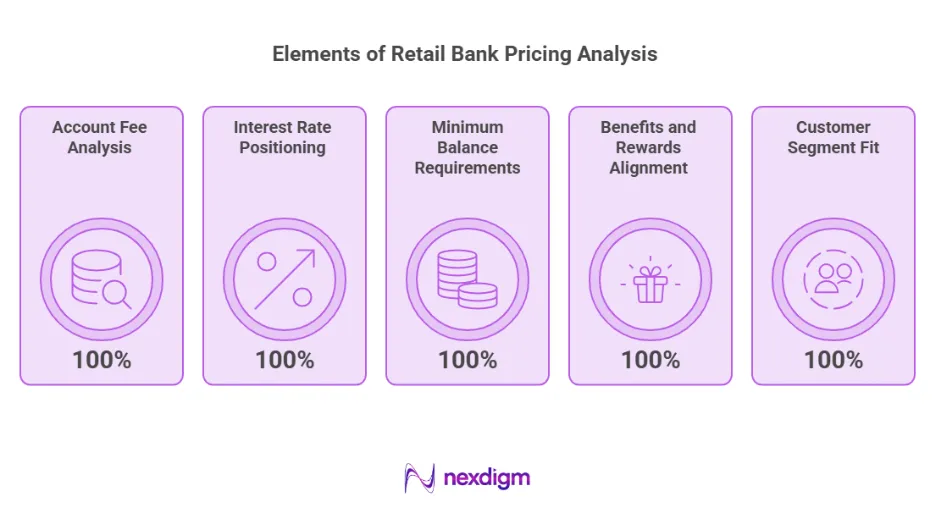
- Account Fee Analysis: Review monthly charges, transaction fees, overdraft costs, waivers, and penalties to ensure account pricing remains understandable, competitive, commercially viable, and aligned with customer expectations.
- Interest Rate Positioning: Assess savings yields, tiered interest structures, and balance-based returns against competitors to strengthen account attractiveness while protecting funding costs, margins, and overall portfolio economics.
- Minimum Balance Requirements: Evaluate balance thresholds and fee-waiver conditions to prevent customer exclusion, improve account accessibility, encourage deposit growth, and maintain suitable economics across different customer segments.
- Benefits and Rewards Alignment: Compare cashback, loyalty rewards, bundled services, digital tools, and relationship benefits to determine whether each feature creates meaningful differentiation and supports customer acquisition and retention.
- Customer Segment Fit: Examine pricing suitability across mass-market, affluent, youth, senior, salaried, and digital-first customers to develop account propositions reflecting distinct needs, behaviors, and profitability levels.
Nexdigm’s Data-Driven Approach to Bank Account Pricing Analysis
Nexdigm applies advanced bank account pricing analysis, competitive benchmarking, customer segmentation, and market intelligence to help financial institutions optimize fees, interest rates, balance requirements, and account benefits. This data-driven approach strengthens bank account pricing competitiveness, improves portfolio profitability, enhances customer value, supports pricing transparency, and enables retail banks to develop market-aligned account strategies for sustainable growth and stronger customer retention.
Nexdigm’s Strategic Blueprint for Bank Account Pricing Analysis
Nexdigm’s strategic blueprint combines market intelligence, customer economics, and portfolio insights to help banks optimize account pricing, strengthen competitiveness, improve profitability, and deliver sustainable customer value across retail segments. Major strategies of the blueprint in-use are:
- Diagnose Portfolio Performance: Nexdigm reviews account revenues, servicing costs, balances, fee realization, and profitability to identify underperforming products, pricing inefficiencies, and priority areas for portfolio improvement.
- Refine Interest Rate Tiers: Interest bands are redesigned using balance behavior, funding priorities, and competitor benchmarks to improve deposit attraction while protecting margins and portfolio economics.
- Strengthen Product Bundling: Accounts are combined with cards, payments, lending, or digital services to improve proposition value, deepen customer relationships, and create stronger cross-selling opportunities.
- Rationalize Fee Structures: Nexdigm identifies overlapping, outdated, or inconsistent fees and restructures them to improve simplicity, customer understanding, revenue realization, and alignment across account categories.
Nexdigm’s Case
Nexdigm supported a regional bank by benchmarking account fees against leading competitors and refining pricing models using market and customer intelligence. Within six months, the bank reduced customer churn by 18%, increased satisfaction by 25%, and improved retention by 15%, strengthening account competitiveness, customer value, and sustainable portfolio performance.
To take the next step, simply visit our Request a Consultation page and share your requirements with us.
Harsh Mittal
+91-8422857704