

Banking automation is moving from isolated robotic workflows toward AI-enabled, end-to-end process orchestration. In 2026, 86% of surveyed financial-services firms reported using AI, while 80% reported having AI agents deployed. Operations and IT accounted for approximately 31% of reported AI systems, making internal operations a major area of adoption. Respondents also identified operational efficiency, automation, and productivity as the strongest current benefits of AI.
The use cases are already broad. The 2026 Global AI in Financial Services report found 79% adoption for process automation, 72% for data visualization and 69% for data and knowledge management. In risk and compliance, fraud detection and credit-risk applications are also among the more established use cases.
As banks expand automation across operations, comparing suppliers only on technology features is insufficient. Bank automation technology supplier comparison can help institutions understand which providers offer stronger process coverage, integration, scalability, governance, and potential for measurable efficiency gains.
Automation Is Moving From Individual Tasks to End-to-End Processes
Banks increasingly need automation that can connect multiple steps, systems, and teams rather than simply eliminate individual manual tasks. Customer onboarding, loan processing, servicing, fraud monitoring, compliance, and back-office operations can involve numerous handoffs and legacy applications. This makes supplier selection more complex. The strongest provider is not necessarily the one with the largest automation portfolio, but the one capable of orchestrating relevant processes while maintaining control, resilience, security, and human oversight.
Efficiency Potential Depends on Three Core Factors
A practical comparison can begin with three dimensions:
- Process Coverage: Assess the breadth of banking workflows supported, including onboarding, servicing, lending, payments, fraud, compliance, and back-office operations.
- Integration & Orchestration: Examine APIs, legacy-system connectivity, workflow orchestration, data exchange, and the ability to coordinate automation across multiple applications.
- Scalability & Control: Evaluate deployment flexibility, transaction volumes, resilience, monitoring, governance, security, and human-in-the-loop controls.
Together, these dimensions help determine whether a supplier can support isolated automation initiatives or broader operational transformation.
Nexdigm’s View of the Automation Supplier Market
Nexdigm can combine financial-services expertise, supplier intelligence, technology research, process analysis, and market benchmarking to compare automation providers. Through bank automation technology supplier comparison, experts can assess providers across RPA, workflow automation, intelligent automation, AI agents, process orchestration, analytics, and automation-as-a-service models. This provides banks with a broader perspective on supplier capabilities and helps distinguish between vendors offering tactical automation tools and those capable of supporting more integrated transformation programs.
How Nexdigm’s Experts Identify Automation Efficiency Potential
Nexdigm’s experts can assess automation opportunities by looking beyond the availability of technology and examining where automation can create measurable operational improvements. The assessment can consider:
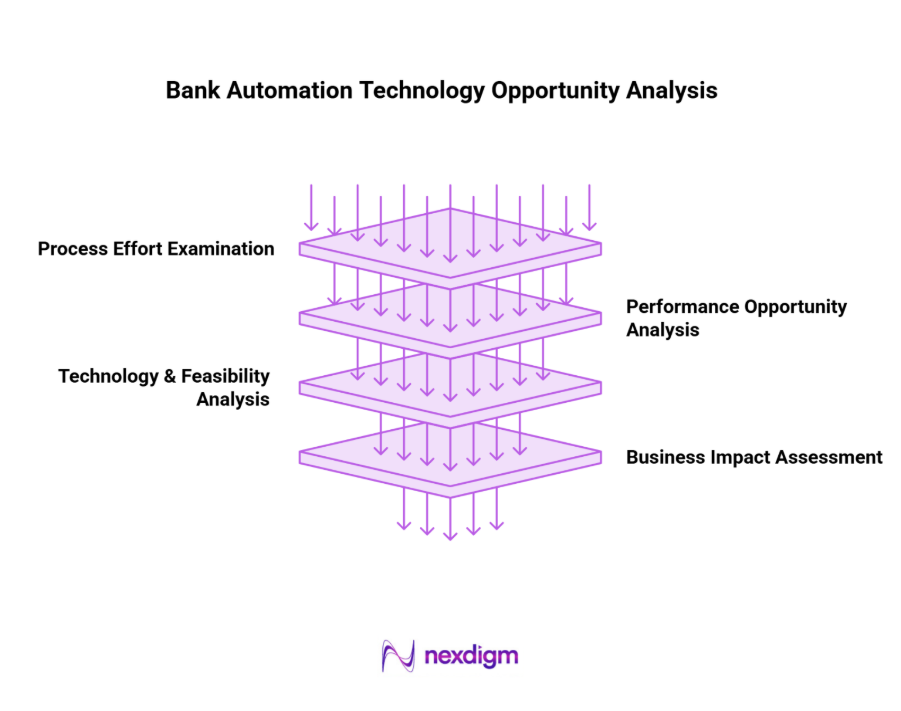
- Process Effort: Examine transaction volumes, manual touchpoints, processing time, repetitive activities, and resource intensity to identify processes with greater automation potential.
- Performance Opportunity: Evaluate error rates, turnaround times, bottlenecks, rework, and service-level challenges to determine where automation could improve operational performance.
- Technology & Feasibility: Assess system connectivity, data availability, workflow complexity, implementation requirements, and scalability to determine whether automation can be practically deployed.
- Business Impact: Connect potential automation with outcomes such as lower manual effort, faster processing, improved accuracy, greater throughput, stronger controls, and better scalability.
This approach helps Nexdigm distinguish processes that are merely suitable for automation from those with stronger potential to deliver measurable efficiency gains, creating a more informed basis for prioritization and supplier assessment.
Matching Automation Opportunities With Supplier Capabilities
Once high-potential processes are identified, Nexdigm can map them against supplier capabilities to determine which vendors are best positioned to address specific automation needs. The comparison can consider process coverage, technology maturity, integration capability, implementation experience, scalability, and relevant banking use cases.
This helps banks move from a broad automation supplier universe toward providers with stronger alignment to priority processes and expected efficiency outcomes, creating a more focused basis for shortlisting and deeper evaluation.
Nexdigm’s Assessment Supporting Targeted Automation Decisions
Nexdigm’s experts translate supplier comparisons into practical decision inputs by assessing the following areas against the bank’s prioritized automation processes to help them with decision making process:
- Best-Fit Providers: Identify suppliers whose capabilities, banking experience, and technology maturity align closely with priority automation requirements.
- Implementation Considerations: Highlight integration complexity, legacy dependencies, scalability, governance, and operational requirements that could influence deployment.
- Efficiency Opportunities: Connect supplier capabilities with potential improvements in processing time, manual effort, accuracy, throughput, and operational control.
These insights can support vendor shortlisting, RFP development, proof-of-concept selection, and commercial evaluation, helping banks make automation decisions based on business impact and operational fit rather than technology features alone.
Nexdigm’s Case
Nexdigm assessed automation technology suppliers for a financial institution across process coverage, integration, scalability, governance, and banking use cases. 23% demonstrated strong alignment with priority processes, 18% showed advanced orchestration capabilities, and 13% required additional validation around production scalability. The assessment helped the institution prioritize suppliers for deeper technical, commercial, and implementation evaluation.
To take the next step, simply visit our Request a Consultation page and share your requirements with us.
Harsh Mittal
+91-8422857704