

Bank branches are no longer judged only by how many customers walk through their doors. Digital adoption is changing where and how people manage money, while branches still matter for lending, wealth management, business banking, and complex financial needs.
The World Bank reported that 76% of adults globally had an account with a financial institution or mobile money provider in 2021, compared with 68% in 2017. As financial access expands, banks are reassessing the role of physical networks alongside digital channels.
For banking executives and investors, this creates an important capital-allocation question. A Bank branch network market assessment can reveal which locations remain commercially important, where digital migration is reducing physical demand, and where network changes could improve efficiency.
Nexdigm supports this analysis by combining location intelligence, customer behavior, branch economics, and market trends.
Nexdigm in Assessing the Changing Role of Branches
Digital banking has reduced the need for branch visits for routine activities such as balance checks, transfers, and payments. At the same time, customers may still prefer branches for high-value or complicated financial decisions.
Nexdigm analyzes this changing behavior to determine which services remain branch-dependent, which activities are moving online and where physical demand remains strong. This helps banks develop location strategies based on actual customer behavior.
Nexdigm in Finding Physical Demand Areas
A branch with declining transaction volumes may still serve an important customer population. Nexdigm combines branch activity with demographic, geographic, and market data to identify the reasons behind local demand.
Its analysis helps identify:
- High-demand locations: Areas with strong customer activity and growth potential, making them suitable for branch expansion, service enhancement, or investment.
- Underused branches: Branches experiencing low transaction volumes or customer engagement, indicating opportunities for optimization, consolidation, or resource reallocation.
- Digitally mature areas: Regions where customers actively use digital banking channels, supporting increased adoption of online and mobile services.
- Underserved communities: Locations with limited access to banking services, presenting opportunities to improve financial inclusion and expand market reach.
This gives banks a more complete understanding of branch value rather than relying only on visit numbers.
Understanding the Role of Digital Migration
As more customers move routine banking activities online, banks can reconsider the role and size of their physical networks.
Nexdigm measures this transition by comparing digital engagement with branch activity. This involves evaluation of:
- Mobile and online banking adoption: Measuring how customers use mobile apps and online platforms to access banking services and perform transactions.
- Digital transaction volumes: Analyzing the frequency and value of digital transactions to understand customer engagement with digital channels.
- Branch visit patterns: Tracking customer visits to branches to assess changing service needs and opportunities for network optimization.
- Customer channel preferences: Understanding whether customers prefer digital, branch, ATM, or hybrid banking channels for different banking activities.
These insights help banks determine where consolidation may be practical and where physical access remains important.
How Nexdigm Helps Design the Right Branch Format
Branch strategy does not have to mean choosing between a large branch and no branch. Nexdigm helps financial institutions assess different formats based on local demand.
Potential models include:
- Full-service branches: Traditional branches offering a complete range of banking services, including account management, loans, investments, and customer support.
- ATM-focused locations: Compact banking points centered on ATM services, enabling cash withdrawals, deposits, and basic transactions with lower operating costs.
- Digital-first branches: Technology-driven branches that emphasize self-service tools, digital banking assistance, and minimal teller interactions for faster, convenient customer experiences.
Nexdigm may identify a market where routine transactions have moved online, but demand for wealth or business banking remains strong. Such a market could be supported by a framework assessment to understand the market conditions.
Nexdigm’s Bank Branch Network Market Assessment
Nexdigm evaluates branch network opportunities through four connected areas:
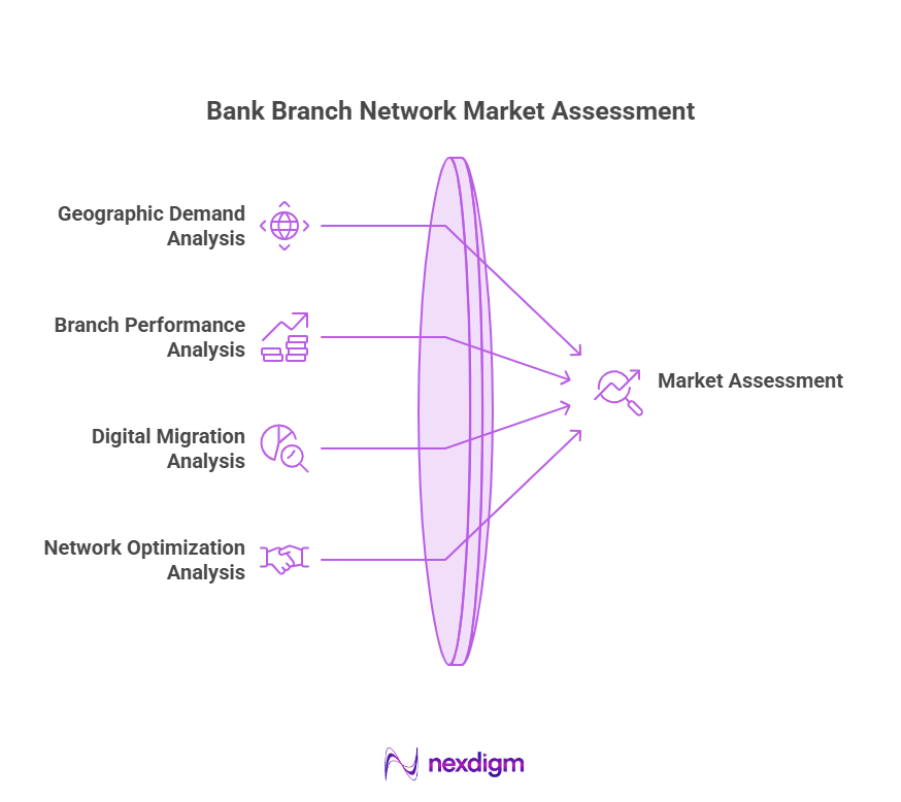
- Geographic Demand Analysis: Nexdigm studies population growth, customer concentration, competition, and service demand to identify markets requiring physical banking access.
- Branch Performance Analysis: Nexdigm examines customer activity, service utilization, revenue contribution, and operating costs to assess individual branch performance.
- Digital Migration Analysis: Nexdigm measures online adoption, digital transactions, and channel preferences to understand how quickly customers are moving away from branches.
- Network Optimization Analysis: Nexdigm compares branch performance, market demand, and digital adoption to support expansion, consolidation, relocation, and format decisions.
This framework helps banks connect customer demand with network economics before committing capital.
How Nexdigm Turns Branch Data into Decisions
Nexdigm helps financial institutions translate branch and customer data into practical network decisions.
- Smarter Network Planning: Identifies locations where continued physical investment is supported by customer demand.
- Better Cost Management: Highlights branches where operating expenses may not align with activity or revenue.
- Targeted Expansion: Finds markets where population growth and unmet banking demand support additional physical presence.
- Balanced Channel Strategy: Shows where digital services can take a larger role without weakening customer access.
Nexdigm’s Case
A regional bank used Nexdigm’s Bank branch network market assessment framework to evaluate branch performance, customer demand, and digital migration. Within 12 months, the bank reduced underperforming branch costs by 22%, increased digital service adoption by 31%, and improved network productivity by 26% through targeted location and format decisions.
To take the next step, simply visit our Request a Consultation page and share your requirements with us.
Harsh Mittal
+91-8422857704