

Bank competitor pricing analysis enables financial institutions to understand how rival banks structure interest rates, fees, service charges, product bundles, and promotional offers across retail and commercial banking markets. Through Pricing Analysis Services, banks can combine competitive benchmarking, customer segmentation, price elasticity modeling, willingness-to-pay analysis, demand forecasting, and profitability assessment to identify market gaps and strengthen value propositions.
These insights support informed pricing decisions that improve product positioning, customer acquisition, retention, revenue growth, and margin protection. Competitor pricing analysis also helps banks respond to market changes, differentiate financial products, and maintain sustainable profitability without weakening customer value or competitiveness.
Pricing Analysis Services and bank competitor pricing analysis supported product repricing, contributing to a 16% increase in customer acquisition, 13% revenue growth, 11% margin improvement, and 14% stronger retention across targeted banking segments.
Pricing Analysis Strategies to Strengthen Bank Product Positioning and Profitability
Pricing Analysis Services provide structured steps for benchmarking competitors, understanding customer value, optimizing rates and fees, differentiating banking products, protecting margins, and supporting sustainable revenue growth across target markets.
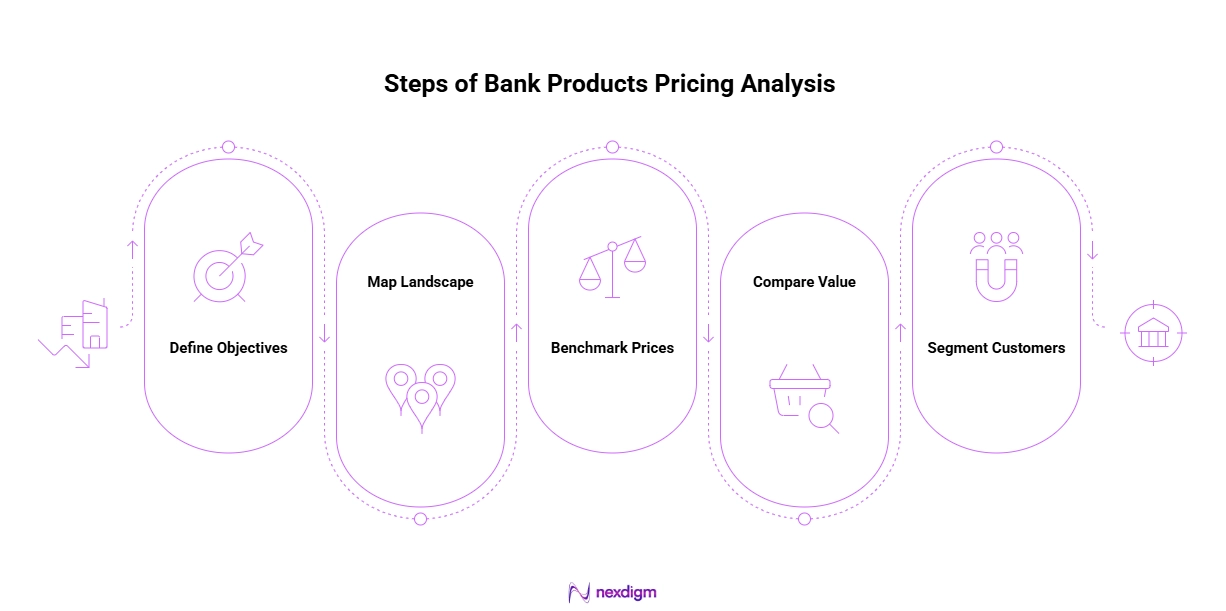
Steps to Strengthen Bank Product Positioning and Profitability
- Define Strategic Pricing Objectives: Banks should establish clear objectives for market positioning, customer acquisition, revenue growth, margin protection, retention, and product adoption before conducting detailed pricing analysis.
- Map the Competitive Landscape: Identifying direct, digital, regional, and emerging competitors helps banks understand market structures, alternative propositions, pricing pressures, and potential threats across relevant product categories.
- Benchmark Competitor Prices: Bank competitor pricing analysis compares interest rates, account fees, service charges, penalties, promotional offers, and bundled benefits to establish accurate market reference points.
- Compare Product Value Propositions: Banks should evaluate competitor features, service quality, digital capabilities, rewards, convenience, and relationship benefits to determine whether pricing reflects the product’s perceived customer value.
- Segment Customers by Price Sensitivity: Customer segmentation identifies differences in willingness to pay, financial behavior, product needs, and switching likelihood, supporting targeted pricing strategies for distinct banking audiences.
Nexdigm’s Role in Strengthening Banking Product Pricing and Profitability
Nexdigm supports banks in strengthening product pricing and profitability through Pricing Analysis Services. Its approach combines bank competitor pricing analysis, competitive benchmarking, customer segmentation, willingness-to-pay assessment, price elasticity modeling, demand forecasting, profitability analysis, and portfolio optimization. These insights help banks refine fees, interest rates, product bundles, and value propositions to improve positioning, customer acquisition, retention, margins, and sustainable revenue growth.
Nexdigm’s Pricing Analysis Framework for Banking Product Positioning and Margin Growth
Nexdigm’s structured framework applies multiple pricing analysis types to benchmark competitors, assess customer value, optimize banking products, strengthen market positioning, protect margins, and support sustainable portfolio profitability across segments.
Types of Pricing Analysis Within Nexdigm’s Framework
- Competitor Pricing Analysis: Compares rival banks’ interest rates, fees, service charges, promotional offers, and product features to identify competitive gaps and positioning opportunities.
- Customer Segmentation Analysis: Groups customers by financial behavior, income, product needs, relationship value, and price sensitivity to support targeted banking pricing strategies.
- Willingness-to-Pay Analysis: Determines acceptable customer price thresholds and perceived product value, helping banks set competitive rates and fees that encourage adoption and retention.
- Price Elasticity Analysis: Measures how customer demand responds to changes in interest rates, fees, and charges, supporting balanced decisions across revenue and volume objectives.
- Value-Based Pricing Analysis: Aligns banking product prices with customer-perceived benefits, service quality, convenience, rewards, and digital capabilities rather than relying solely on costs.
Nexdigm’s Case
Nexdigm applied competitor benchmarking and Pricing Analysis Services to reposition banking products, contributing to a 17% increase in customer acquisition, 14% revenue growth, 12% margin improvement, and 15% stronger retention across priority segments.
To take the next step, simply visit our Request a Consultation page and share your requirements with us.
Harsh Mittal
+91-8422857704