

Banking customers are changing how they manage money, and the shift is visible across deposits, credit, payments, and investments. The World Bank’s Global Findex 2025 found that 79% of adults globally now own a financial account, while 86% own a mobile phone. Digital access is making financial services easier to use and compare.
For banks, fintech companies, and investors, these changes can affect deposit growth, lending demand, payment activity, and wealth opportunities. A Bank customer behavior market analysis helps identify where these behaviors are moving and what they mean for future revenue.
Nexdigm helps financial institutions analyze these changes through customer segmentation, transaction data, product usage, and market intelligence. Its approach connects customer behavior with product demand, competitive pressure, and commercial opportunities.
Nexdigm Maps How Customers Manage Money
Nexdigm looks across saving, borrowing, payments, and investing to understand the complete financial relationship. This helps institutions identify changes that may be missed when each product is analyzed separately.
Nexdigm studies:
- Transaction patterns: Analyzing customer spending, saving, borrowing, and payment behaviors to identify trends, needs, risks, and growth opportunities.
- Customer segments: Grouping customers by demographics, behaviors, and financial needs to deliver targeted products, services, and experiences.
- Digital engagement: Evaluating customer interactions across digital platforms to understand preferences, improve experiences, and strengthen relationships.
This gives banks a clearer view of changing customer behavior and emerging demand.
Nexdigm Tracks Changing Saving Patterns
Savings behavior can directly affect a bank’s deposit base and funding position. Nexdigm examines how customers choose savings products and how digital access is influencing those decisions.
Nexdigm evaluates:
- Deposit Preferences: Identifies demand for savings accounts, term deposits, and other deposit products.
- Digital Saving: Tracks online and mobile activity related to account management and savings.
- Customer Segments: Identifies groups with stronger savings potential.
- Product Switching: Examines movement between deposit products and financial providers.
The World Bank reported that formal saving in low- and middle-income economies reached its highest level in more than a decade, with mobile technology supporting wider saving activity.
Nexdigm combines these market trends with customer data to help banks identify deposit opportunities.
Nexdigm Finds New Investment Opportunities
Investment products are becoming easier to access through digital platforms, creating opportunities to reach customers earlier in their wealth journey.
Nexdigm studies:
- Investment adoption: Analyzing customer participation in investment products to identify growth trends, adoption drivers, and market opportunities.
- Product preferences: Understanding customer preferences across investment products to align offerings with financial goals and changing demand.
- Customer risk profiles: Evaluating risk tolerance and investment behavior to recommend suitable products and improve portfolio alignment.
- Cross-selling potential: Identifying opportunities to offer complementary investment products that increase customer value, engagement, and long-term relationships.
Nexdigm helps financial institutions identify customers who may be ready to move from basic banking products toward investments, insurance, or wealth-management services.
This can help banks expand their relationship with existing customers instead of relying entirely on new customer acquisition.
Nexdigm Connects Behavior With Market Opportunity
Nexdigm looks beyond transaction numbers to understand what is driving customer decisions and where those changes could create commercial opportunities.
The analysis connects:
Customer Profile → Financial Need → Product Choice → Channel → Opportunity
This helps Nexdigm identify why customers change products, channels, or providers and what banks can do in response.
For example, a customer who regularly uses digital payments but maintains limited savings may represent an opportunity for a targeted savings product. Nexdigm can identify such behavioral patterns through customer and transaction analysis.
Nexdigm’s Bank Customer Behavior Market Analysis
Nexdigm evaluates customer behavior through four areas, providing a comprehensive view of how customers save, borrow, pay, and invest across their financial journey. This integrated approach helps institutions identify evolving customer needs, emerging opportunities, and shifts in financial behavior.
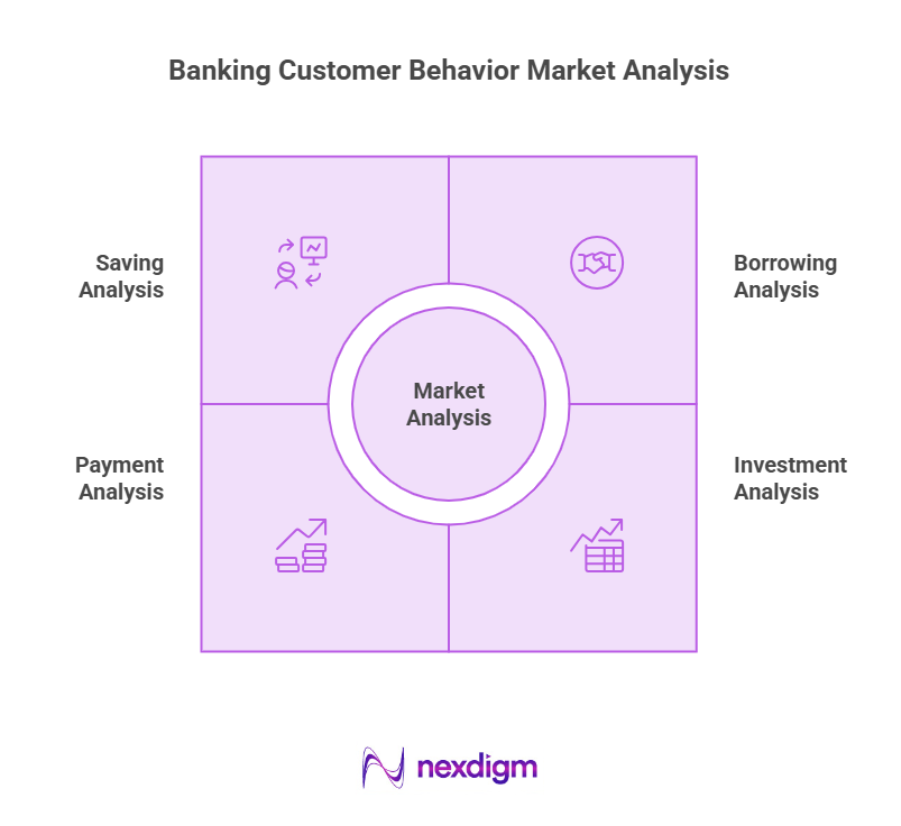
- Saving Analysis: Nexdigm studies deposits, saving frequency, product preferences, and customer segments to identify changes in savings demand and potential deposit opportunities.
- Borrowing Analysis: Evaluation of credit demand, loan activity, digital lending adoption, and borrowing preferences to identify emerging lending opportunities and competitive pressure.
- Payment Analysis: Study of transaction activity, payment channels, digital usage, and merchant behavior to understand changing payment patterns and engagement opportunities.
- Investment Analysis: Assessment of investment adoption, wealth segments, product choices, and digital investment activity to identify opportunities in wealth and investment services.
Together, these analyses show how customer financial decisions are changing across the banking relationship.
Nexdigm Helps Guide Banking Investment Decisions
Customer behavior can provide useful signals for investors assessing future banking opportunities. Changes in deposits can affect funding, borrowing patterns can influence credit growth, payment activity can indicate engagement, and investment adoption can create new wealth-management opportunities.
Nexdigm connects these behavioral signals with market intelligence and competitive analysis.
By connecting behavioral data with market intelligence, Nexdigm provides a practical foundation for product planning, customer targeting, digital investment, and identifying growth opportunities as banking behavior continues to evolve.
Nexdigm’s Case
A regional bank used Nexdigm’s Bank customer behavior market analysis to study saving, borrowing, payment, and investment patterns. Within 12 months, the bank increased digital engagement by 33%, improved cross-product adoption by 25%, reduced customer churn by 18%, and identified high-value segments for targeted growth initiatives.
To take the next step, simply visit our Request a Consultation page and share your requirements with us.
Harsh Mittal
+91-8422857704