

Cybersecurity has become a core resilience concern for financial institutions as attackers increasingly exploit identities, public-facing applications, third-party ecosystems, and AI-enabled techniques. FS-ISAC reported a 15% year-on-year increase in cyberattacks across Asia Pacific in 2024, with organizations experiencing an average of 1,963 attacks per week; the financial sector was the region’s fourth-most targeted sector for ransomware.
The threat environment continues to evolve. IBM’s 2026 X-Force Threat Intelligence Index recorded a 44% increase in attacks beginning with exploitation of public-facing applications, while large supply-chain and third-party compromises have nearly quadrupled since 2020. Financial services and insurance remained among the sectors most targeted.
Against this backdrop, bank cybersecurity vendor analysis can help institutions compare security providers based on coverage, integration, compliance readiness, response capability, resilience, and their ability to address evolving cyber risks.
Cybersecurity Requirements Are Becoming More Interconnected
As banking environments become more distributed, security effectiveness increasingly depends on how different controls work together. A provider’s value therefore needs to be considered beyond an individual security product or function.
- Connected Security Controls: Assess how providers connect identity, endpoint, network, cloud, application, and data-security capabilities across the broader environment.
- Continuous Visibility: Evaluate monitoring, threat intelligence, analytics, and detection capabilities that help security teams identify risks across interconnected technology environments.
- Coordinated Response: Examine how effectively providers support alert management, incident investigation, containment, recovery, and collaboration across different security functions.
Together, these factors help institutions determine whether a supplier can contribute to integrated cyber resilience rather than address isolated security requirements.
Security Supplier Selection Requires a Broader View
As banks expand their digital and third-party ecosystems, cybersecurity supplier selection increasingly involves balancing security coverage, technology compatibility, compliance requirements, response capabilities, and operational resilience. A provider may be strong in one security domain but less suitable for the institution’s wider environment. Comparing these dimensions together can therefore provide a more practical view of supplier relevance and potential implementation requirements.
Nexdigm’s Expert-led Cybersecurity Supplier Evaluation Approach
Nexdigm can evaluate cybersecurity providers through a combination of financial-services expertise, supplier intelligence, technology assessment, and risk analysis. The approach considers the following areas:
- Business & Risk Context: Align supplier capabilities with the bank’s security priorities, regulatory requirements, risk exposure, operating model, and resilience objectives.
- Technology Context: Examine integration, architecture compatibility, scalability, data requirements, automation, and interaction with existing security tools and platforms.
- Supplier Context: Compare provider capabilities, areas of specialization, delivery strengths, market positioning, and potential limitations across the cybersecurity landscape.
This contextual approach helps institutions identify providers that offer the right combination of security capability, integration, response strength, resilience, and strategic fit, rather than relying on product features alone.
How Nexdigm Identifies Supplier Capability Value
Through bank cybersecurity vendor analysis, experts of Nexdigm use a structured sequence to identify where each provider can create the greatest security and business value. These steps are:
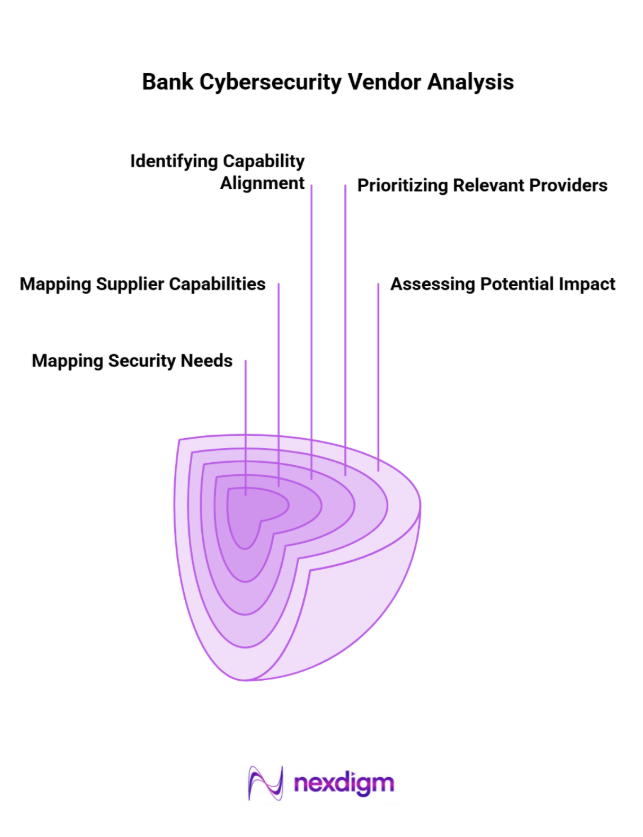
- Mapping Security Needs: Identifying the bank’s critical assets, security priorities, technology gaps, compliance requirements, and resilience objectives.
- Mapping Supplier Capabilities: Examining each provider’s coverage across security operations, cloud, identity, data, threat detection, response, and other relevant areas.
- Identifying Capability Alignment: Comparing supplier strengths with the bank’s specific security requirements to determine where capabilities can address priority needs.
- Assessing Potential Impact: Considering how the provider could improve protection, monitoring, response, compliance, or operational resilience within the existing environment.
- Prioritizing Relevant Providers: Using the findings to identify suppliers that warrant deeper technical evaluation, proof-of-concept testing, or commercial consideration.
This approach helps Nexdigm turn bank cybersecurity vendor analysis into a practical view of where supplier capabilities can deliver the greatest relevance and security impact.
Strategic Impact of Nexdigm’s Supplier Capability Analysis
Nexdigm’s approach can help banks move from broad supplier comparison to more focused cybersecurity decisions. By connecting security requirements with supplier capabilities, the assessment can support clearer provider prioritization, better identification of security gaps, more targeted technology investments, and stronger alignment between cybersecurity initiatives and resilience objectives. This enables institutions to evaluate suppliers based on practical security impact and business relevance, rather than capability breadth alone.
Nexdigm’s Case
Nexdigm assessed cybersecurity suppliers across security coverage, integration, compliance readiness, response capability, and third-party resilience. The assessment was informed by the broader risk environment, including findings that large supply-chain and third-party compromises have nearly quadrupled since 2020 and that active ransomware groups increased 49% year over year. These insights helped the institution prioritize suppliers for deeper technical validation, resilience assessment, and commercial evaluation.
To take the next step, simply visit our Request a Consultation page and share your requirements with us.
Harsh Mittal
+91-8422857704