

Bank competitiveness increasingly depends on more than rates and fees, as customers also evaluate convenience, service quality, rewards, and digital experience. Effective bank pricing competitiveness analysis compares product charges, interest spreads, bundles, channel economics, and customer value propositions across peers.
Integrated with Pricing Analysis, it helps institutions identify pricing gaps, refine segment-specific offers, protect margins, and improve acquisition and retention. This structured approach enables banks to compete on value rather than price alone, while aligning profitability, customer expectations, and digital-service investments across evolving retail and commercial banking markets worldwide today.
A recent banking study found that 55% of customers want improved digital support across apps, websites, and chatbots. This signals opportunity for banks using pricing analysis to combine competitive fees, stronger digital experiences, and clearer value propositions to improve retention.
Customer Value-Based Pricing Analysis for Financial Institutions
Customer value-based pricing analysis helps financial institutions align fees, rates, rewards, and service benefits with customer needs, improving competitiveness, profitability, loyalty, and perceived value across banking relationships and digital channels. Major focus areas include:
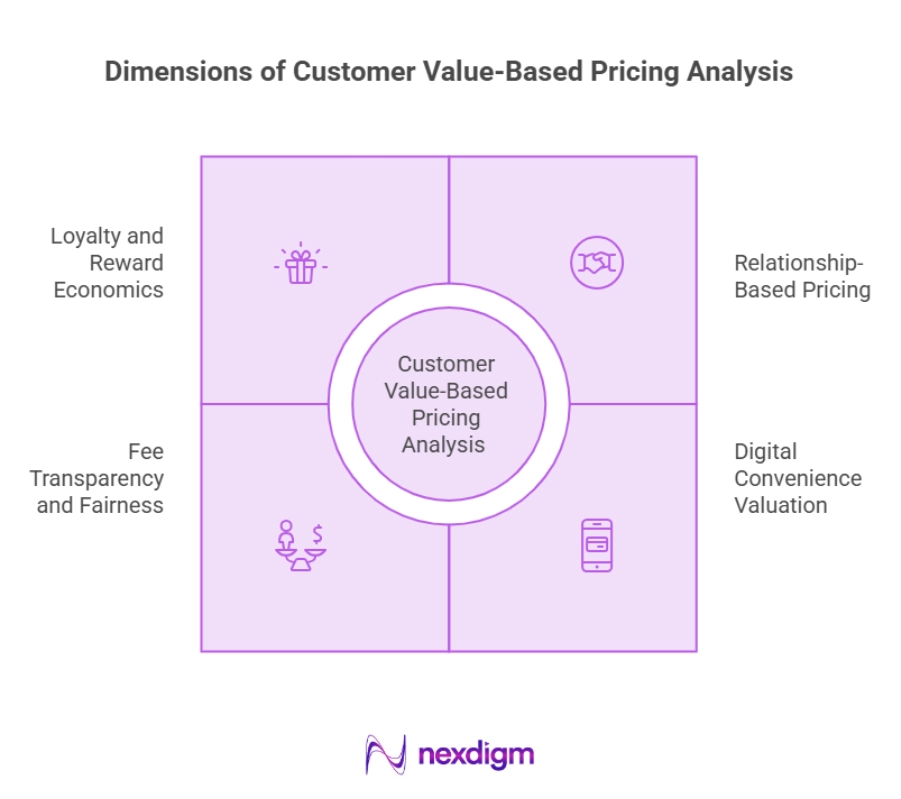
- Relationship-Based Pricing: Use total deposits, borrowing activity, product holdings, tenure, and engagement to offer preferential rates that reward deeper relationships and improve customer retention over time.
- Digital Convenience Valuation: Assess how customers value instant onboarding, self-service tools, real-time support, and seamless transactions to price digital banking features without weakening overall accessibility or trust.
- Fee Transparency and Fairness: Review charges, disclosures, waivers, and service conditions to ensure pricing remains understandable, defensible, and aligned with customer expectations, regulatory standards, and long-term trust.
- Loyalty and Reward Economics: Evaluate reward costs, redemption behavior, usage frequency, and retention impact to design loyalty benefits that increase engagement while preserving sustainable customer-level profitability over time.
Nexdigm’s Expertise in Customer Value-Based Pricing Analysis
Nexdigm helps financial institutions design customer-centric prices by assessing perceived value, relationship profitability, willingness to pay, digital convenience, and competitive positioning. Its customer value-based pricing analysis, bank pricing strategy consulting, financial services pricing analysis, and pricing optimization services support differentiated rates, fees, bundles, and rewards that strengthen acquisition, retention, customer experience, sustainable margins, and long-term relationship value across diverse banking segments.
Nexdigm’s Banking Pricing Analysis and Value Proposition Blueprint
Nexdigm’s blueprint helps banks align pricing, customer value, digital experience, and profitability through structured analysis, segmented propositions, disciplined governance, and continuous market-led refinement across products, channels, and customer relationships. Strategic blueprint steps are:
- Map Customer Value Perceptions: Identify how customers evaluate convenience, trust, rewards, advisory support, digital access, and service responsiveness to determine which benefits justify differentiated banking prices across segments.
- Quantify Product and Services: Calculate funding, servicing, technology, channel, reward, and compliance costs to understand profitability drivers and establish sustainable pricing boundaries for banking products and services offered.
- Build Integrated Value Bundles: Combine accounts, cards, loans, digital tools, rewards, and advisory benefits into propositions that increase convenience, encourage cross-selling, and strengthen perceived customer value and loyalty.
- Define Pricing Governance Rules: Establish discount limits, approval authorities, exception criteria, review cycles, and documentation standards to maintain pricing consistency, transparency, accountability, and commercial discipline across banking operations.
- Measure Relationship-Level Outcomes: Evaluate revenue, retention, product penetration, service usage, complaints, and lifetime value to determine whether pricing propositions improve customer relationships and institutional profitability over time consistently.
Nexdigm’s Case
Nexdigm helped a retail bank redesign its customer value-based pricing model by benchmarking fees, digital service value, and relationship profitability. Within nine months, customer retention increased 15%, cross-sell conversion improved 18%, fee-income growth reached 11%, and digital product adoption rose 24%.
To take the next step, simply visit our Request a Consultation page and share your requirements with us.
Harsh Mittal
+91-8422857704