

Bank procurement expenditure is typically concentrated in technology, outsourced operations, infrastructure, professional services and physical banking support. The relative importance of these categories varies according to the bank’s size, branch network, digital maturity, business mix and operating model. A large public sector bank with an extensive branch footprint will have a different procurement profile from a digitally focused private bank.
Meaningful spend benchmarking therefore requires comparisons between banks with similar operating characteristics. Looking at total expenditure alone can be misleading because differences in employee costs, business volumes and accounting classifications may distort the picture.
Technology Spend Reflects the Bank’s Operating Model
Technology procurement includes core banking platforms, software licences, cybersecurity, cloud infrastructure, network services, hardware, application development and system maintenance.
Banks with extensive legacy environments may carry higher maintenance and integration expenditure. Institutions expanding digital products may allocate more to application development, data infrastructure, customer platforms and security capabilities.
The relevant comparison is not simply how much each bank spends on technology. It is how that expenditure relates to the institution’s scale and operating requirements. Useful indicators include technology spend relative to total operating expenses, digital transaction volumes, branch count, customer base and IT employee strength.
A bank with higher technology expenditure may be investing in infrastructure modernisation or resilience rather than operating inefficiently. Benchmarking must therefore consider the purpose and maturity of the investment.
Outsourced Services and Operational Support
Banks purchase a wide range of external services, including contact centre operations, document processing, cash management support, facilities services, security, technology maintenance and selected back-office activities.
These categories are influenced by the bank’s delivery model. An institution with more in-house operations may report higher employee costs and lower outsourced service expenditure. Another may rely on external providers for customer operations and technology support.
The comparison should distinguish between outsourced service costs and internal operating expenditure. It should also identify whether similar services are classified differently across institutions, particularly where technology and business process contracts contain bundled components.
Supplier concentration and contract duration can affect commercial flexibility. A bank with a small number of large service providers may have limited sourcing alternatives, even when its total procurement expenditure appears competitive.
Infrastructure and Branch-Related Categories
Physical infrastructure continues to contribute to bank procurement requirements. These include branch premises, ATM networks, POS devices, connectivity, power systems, physical security and equipment maintenance.
The expenditure profile depends on the size and geographic distribution of the bank’s network. Banks with larger branch footprints may have greater premises, utilities and maintenance requirements. Institutions with extensive self-service infrastructure may incur higher equipment servicing and cash management-related expenses.
Comparisons should account for branch count, ATM deployment, geographic spread and the proportion of transactions handled through physical channels. Without these adjustments, a bank with a larger network may appear more expensive even when its unit costs are lower.
Reading the Financial Data Correctly
RBI data for FY2024-25 shows that scheduled commercial banks recorded total operating expenses of approximately ₹6.30 lakh crore, up from ₹5.93 lakh crore in FY2023-24. Public sector banks accounted for around ₹3.03 lakh crore, while private sector banks recorded approximately ₹2.61 lakh crore.
The figures show the scale of the cost base, but they should not be mistaken for procurement expenditure. Operating expenses include wage bills and other costs that may not be externally sourced. For procurement benchmarking, the data must be broken down further using bank disclosures, contract information and category-level expenditure records.
This distinction is essential when using bank procurement spend benchmarking services to compare institutions. Nexdigm’s research can help structure category-level comparisons, map supplier markets and interpret differences in sourcing models, rather than treating total operating expenditure as a proxy for procurement spend.
Why Peer Group Selection Changes the Benchmark
A useful benchmark should compare banks with similar business and operational characteristics. Public sector and private sector banks may differ in branch networks, workforce structures, technology architectures and outsourcing strategies. Foreign banks operating in India may have different group-level procurement arrangements and global technology contracts.
Benchmarking should therefore use more than one reference point. Category expenditure can be assessed as a share of addressable external spend, relative to business scale or against comparable operating units. Where possible, unit-level measures such as cost per account, cost per transaction or cost per branch can provide additional context.
Bank Procurement Spend Benchmarking Framework
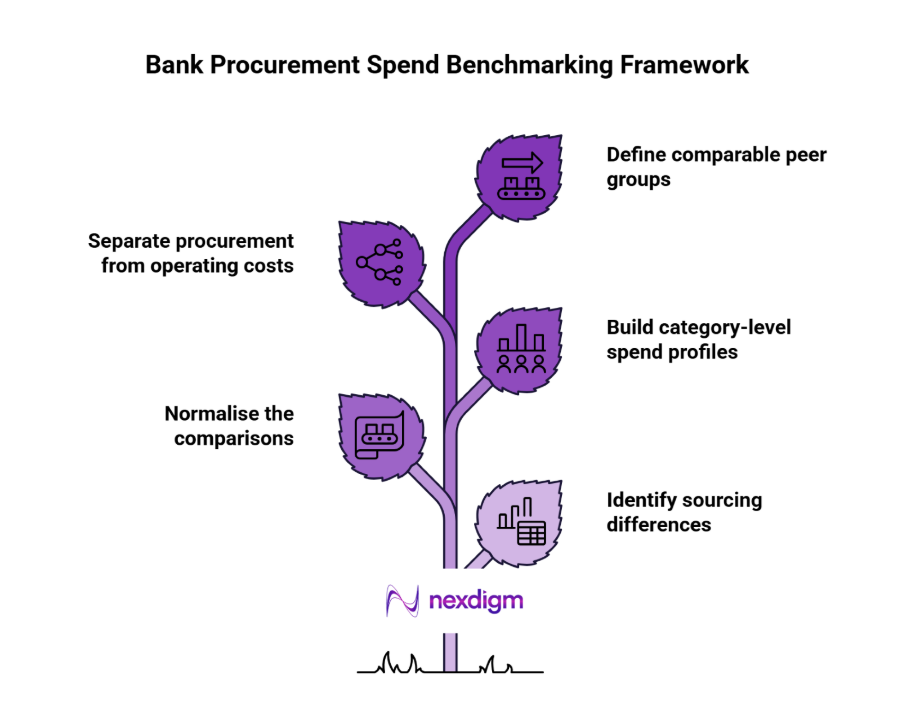
- Define comparable peer groups: Segment banks by ownership, scale, business mix, branch footprint and digital operating model.
- Separate procurement from operating costs: Identify external supplier expenditure and exclude employee costs and other non-procurement items.
- Build category-level spend profiles: Classify technology, outsourcing, infrastructure, professional services and branch-related procurement.
- Normalise the comparisons: Use relevant measures such as spend per branch, per account, per transaction and share of external expenditure.
- Identify sourcing differences: Examine supplier concentration, contract structures, category pricing and opportunities for competitive benchmarking.
Nexdigm’s Case: Bank Procurement Spend Benchmarking
A bank compared external procurement across 10 categories against a peer group of six institutions. Normalisation by branch count and digital transaction volumes revealed higher relative expenditure in application maintenance and facilities services, creating a focused review of contracts representing ₹76 crore in annual spend.
To take the next step, simply visit our Request a Consultation page and share your requirements with us.
Harsh Mittal
+91-8422857704