

Banks increasingly rely on third-party suppliers for cloud infrastructure, cybersecurity, payment processing, technology platforms, and outsourced operations. While these relationships improve efficiency, they also introduce interconnected risks that can affect financial stability, customer trust, and regulatory compliance.
The Reserve Bank of India’s 2026 cybersecurity survey found that 93% of surveyed financial institutions depend on external vendors for cybersecurity functions, while three-fourths report moderate to very high dependence on third-party technology providers for critical applications.
Furthermore, another 2026 Global Third-Party Risk Management Survey identified regulatory compliance (48%) and cybersecurity (37%) as leading drivers of third-party risk management strategies. These developments make bank third party supplier risk analysis essential for identifying vulnerabilities and strengthening supplier oversight.
Why Supplier Dependencies Require Greater Attention
Third-party relationships can create risks that extend beyond individual supplier contracts. Banks must consider how vendor failures, cyber incidents, regulatory gaps, and service disruptions could affect interconnected operations. Greater dependence on external providers also increases concentration risk, particularly when multiple institutions rely on the same critical suppliers. Effective supplier oversight therefore requires continuous evaluation rather than one-time procurement checks.
Critical Areas Banks Must Evaluate in Supplier Risk Analysis
A comprehensive supplier risk review should examine the following interconnected areas:
- Dependency and Concentration Risk: Assess reliance on critical suppliers, identify single-provider dependencies, and evaluate alternative service arrangements to reduce exposure to disruptions.
- Cybersecurity and Compliance Risk: Examine vendor security controls, data protection practices, regulatory obligations, and access management to prevent breaches and compliance failures.
- Operational Continuity and Resilience Risk: Evaluate disaster recovery capabilities, incident response procedures, backup arrangements, and exit strategies to maintain essential banking services during disruptions.
Proactive supplier risk analysis helps banks identify third-party vulnerabilities, strengthen compliance, and protect critical operations.
Nexdigm’s Approach to Building Resilient Supplier Relationships
Managing third-party risks requires more than identifying supplier vulnerabilities; it involves building stronger, more accountable vendor relationships. Nexdigm helps financial institutions strengthen bank third party supplier risk analysis by examining supplier dependencies, improving procurement governance, and strengthening sourcing strategies. This approach supports better supplier oversight, reduced dependency risks, and greater resilience across banking procurement networks.
Nexdigm’s Structured Process to Strengthen Supplier Risk Evaluation
Nexdigm supports financial institutions in improving supplier risk management through a structured evaluation process:
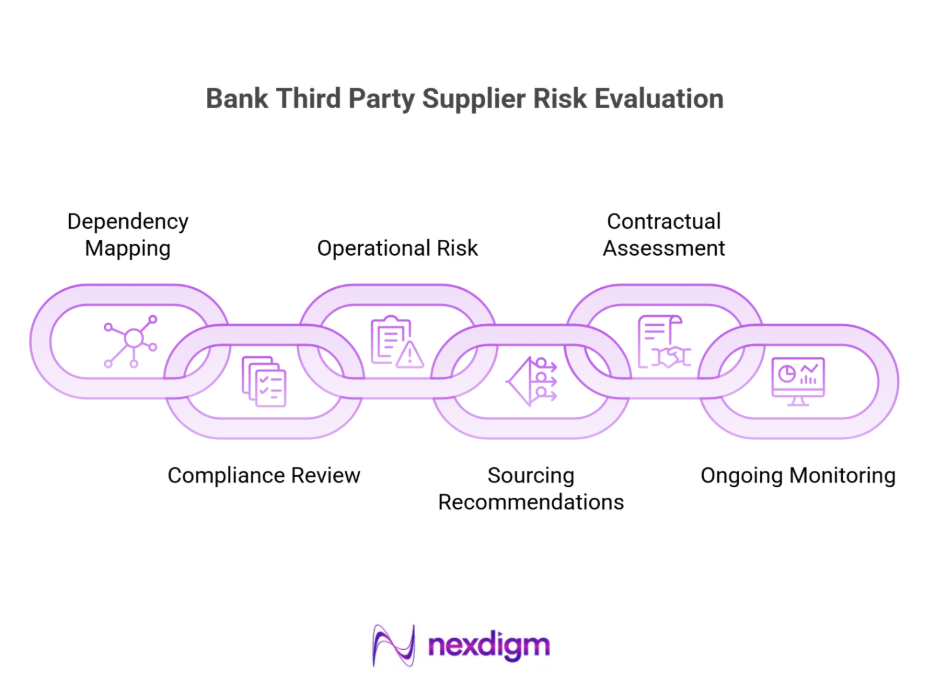
- Supplier Dependency Mapping: Identify critical vendors, assess service dependencies, and highlight concentration risks across procurement networks.
- Compliance and Governance Reviewing: Examine supplier compliance practices, contractual obligations, and governance frameworks to identify potential gaps.
- Operational Risk Evaluation: Review vendor service delivery, continuity arrangements, and contingency measures to identify operational vulnerabilities.
- Strategic Sourcing Recommendations: Develop recommendations to improve supplier diversification, strengthen vendor accountability, and support resilient procurement decisions.
- Contractual Risk Assessment: Review supplier agreements, service-level commitments, liability provisions, and exit clauses to identify potential contractual exposures.
- Ongoing Supplier Monitoring: Establish performance review mechanisms and periodic assessments to track changing vendor risks and maintain accountability.
With Nexdigm’s procurement and supplier management expertise, financial institutions can strengthen vendor oversight, reduce third-party exposure, and build more resilient banking operations.
Impact Delivered by Nexdigm’s Supplier Risk Evaluation Initiative
Through a structured supplier risk management approach, Nexdigm helps financial institutions improve procurement governance, strengthen third-party oversight, and manage supplier dependencies. Key outcomes can include:
- Improved Supplier Risk Visibility: Gain clearer insights into vendor dependencies, vulnerabilities, and potential operational exposures.
- Faster Risk Identification: Streamline supplier assessments to identify emerging cybersecurity, financial, and compliance risks earlier.
- Stronger Vendor Compliance: Improve monitoring of supplier obligations, regulatory requirements, and contractual commitments.
- Enhanced Operational Resilience: Strengthen continuity planning and reduce dependence on individual critical suppliers.
- Better Procurement Governance: Establish consistent vendor evaluation, accountability, and performance monitoring practices.
These improvements help financial institutions build stronger supplier relationships, reduce third-party exposure, and maintain resilient procurement operations.
Nexdigm’s Case
A banking institution partnered with Nexdigm to improve third-party supplier management across critical technology and service categories. By reviewing vendor dependencies, evaluating contractual risks, and strengthening supplier monitoring, the initiative delivered 22% improved vendor performance visibility, 17% fewer supplier-related compliance gaps, and 28% better risk monitoring efficiency, supporting more accountable and resilient procurement operations.
To take the next step, simply visit our Request a Consultation page and share your requirements with us.
Harsh Mittal
+91-8422857704