

Banks increasingly rely on external providers for cloud infrastructure, core banking platforms, cybersecurity, payments, data management, and digital services. While these partnerships enable innovation and operational efficiency, excessive dependence on a limited number of suppliers can create concentration risks.
The Bank of England’s 2026 financial-services AI survey found that the three largest providers accounted for 79% of reported cloud and compute relationships. Separately, a 2026 financial-services third-party risk survey found that 53% of institutions managed at least 300 vendors, while 63% had only one or two dedicated third-party risk employees.
These findings highlight why a structured bank vendor diversification strategy is important for reducing dependencies and strengthening operational resilience.
Why Vendor Diversification Matters for Banking Resilience
Vendor diversification is essential for reducing concentration risks and maintaining continuity across critical banking operations. Banks should consider:
- Reduced Single-Supplier Dependence: Avoid excessive reliance on one provider for critical technology services that could create operational disruption if the supplier becomes unavailable.
- Greater Operational Resilience: Maintain suitable alternative providers and compatible technology arrangements to support service continuity during supplier failures or disruptions.
- Better Dependency Management: Identify shared infrastructure, interconnected subcontractors, and common service providers that may create hidden concentration risks across multiple technology categories.
A balanced diversification approach helps banks strengthen resilience while managing technology compatibility, security requirements, and the complexity of maintaining multiple supplier relationships.
What Should Banks Consider When Diversifying Vendors?
Banks should evaluate diversification across critical technology categories, including cloud, payments, cybersecurity, core banking, data platforms, and infrastructure. They should examine supplier and subcontractor dependencies, shared infrastructure, ownership, and geographic exposure. Alternative providers must also demonstrate technical compatibility, scalability, security maturity, service quality, and implementation readiness to ensure diversification reduces concentration without introducing additional operational risks.
How Nexdigm Connects Vendor Diversification With Technology Priorities
Nexdigm helps banks translate vendor dependency insights into practical diversification opportunities through bank vendor diversification strategy which involves assessing:
- Category-Level Opportunities: Identify technology categories where additional suppliers could reduce concentration and improve sourcing flexibility.
- Relevant Market Alternatives: Evaluate established providers and specialist vendors based on capabilities, industry experience, and service offerings.
- Strategic Supplier Alignment: Match potential alternatives with banking requirements, technology priorities, operational needs, and long-term resilience objectives.
This approach helps banks make targeted diversification decisions, expanding supplier options where they can create meaningful value without adding unnecessary complexity.
Nexdigm’s Framework for Building a Diversified Vendor Base
Nexdigm can help banks structure vendor diversification around four interconnected areas:
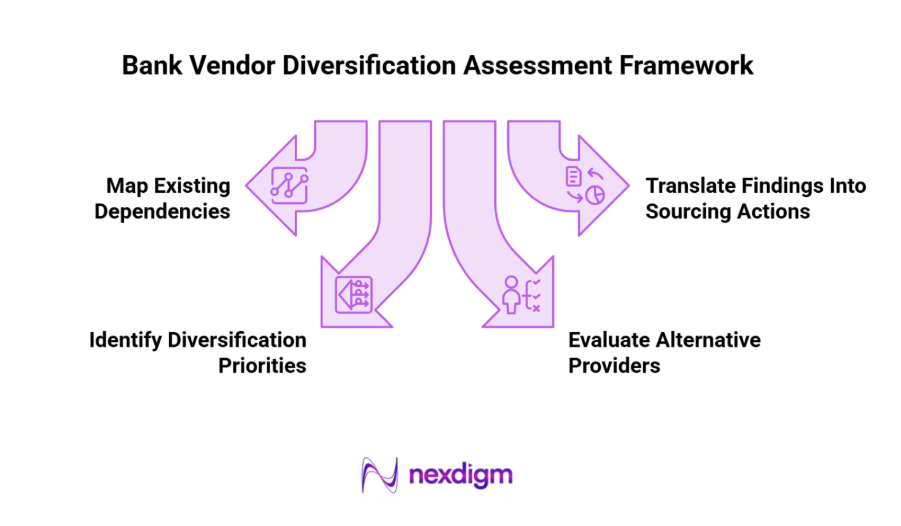
- Map Existing Dependencies: Identify critical technology suppliers, service relationships, subcontractors, and concentration points across key categories.
- Identify Diversification Priorities: Determine where supplier dependence, limited market alternatives, or interconnected service arrangements warrant attention.
- Evaluate Alternative Providers: Compare potential suppliers based on technology capabilities, industry experience, scalability, service models, and operational suitability.
- Translate Findings Into Sourcing Actions: Develop category-level recommendations, supplier shortlists, and opportunities for broader sourcing flexibility.
This framework connects market intelligence with actionable procurement priorities, helping banks build a more balanced vendor ecosystem without compromising technology requirements or operational resilience.
Nexdigm’s Framework in Building a Balanced Vendor Ecosystem
Applying this framework helps banks move towards a vendor ecosystem that balances supplier choice with operational reliability. Nexdigm’s market intelligence and supplier assessment framework can support this transition through:
- Category-Level Balance: Maintain appropriate supplier options across critical technology categories rather than relying heavily on a limited set of providers.
- Capability-Based Allocation: Align suppliers with specific technology requirements, service criticality, and operational needs.
- Reduced Dependency Overlap: Identify shared subcontractors, infrastructure, or service relationships that may create hidden concentration risks.
- Continuous Market Visibility: Track emerging providers, changing capabilities, and market developments to identify future diversification opportunities.
With these considerations, banks can develop a more diversified and resilient vendor base while retaining the control, compatibility, and service quality required for critical operations.
Nexdigm’s Case
A banking institution sought to reduce its dependence on a concentrated technology supplier base across critical categories. Nexdigm conducted supplier landscape research and comparative assessments to identify viable alternatives. The analysis found that 32% of evaluated providers demonstrated strong alignment with the bank’s requirements, while 24% offered differentiated capabilities. These insights helped establish a more focused supplier pipeline and supported a balanced vendor diversification approach.
To take the next step, simply visit our Request a Consultation page and share your requirements with us.
Harsh Mittal
+91-8422857704