

Banking analytics is moving from reporting and dashboards toward real-time decision support, automation, predictive models, and AI-enabled workflows. A 2026 global study found that 81% of surveyed financial-services firms were adopting AI at some level, while 40% had reached scaling or transforming stages. Data analytics is also expected to reach 88% deployment across financial services by 2030, highlighting its growing role in technology and business strategies.
The use cases are already broad. Current financial-services deployments include process automation at 79%, data visualization at 75%, software engineering at 75%, and data and knowledge management at 69%. Fraud detection and credit-risk modelling are also among the leading risk applications.
As analytics becomes embedded across banking functions, vendor selection increasingly requires more than comparing dashboards or AI features. Banking analytics platform vendor intelligence can help institutions understand differences in functionality, integration, scalability, use-case maturity, and practical banking relevance.
Analytics Platforms Are Becoming Decision Infrastructure
Modern analytics platforms increasingly sit between raw enterprise data and business decisions. They may support customer insights, fraud detection, credit risk, financial planning, regulatory reporting, operational optimization, and AI-enabled workflows. This means platform value depends not only on analytical features but also on data accessibility, integration, scalability, governance, and the ability to translate insights into business action. For banks, the challenge is therefore to distinguish between vendors offering broad analytics functionality and those capable of supporting specific, high-value banking use cases at enterprise scale.
Vendor Strength Can Be Viewed Through Core Lenses
A practical assessment can begin with three interconnected dimensions:
- Platform Functionality: Evaluate analytics, visualization, predictive modelling, AI capabilities, data preparation, reporting, and decision-support features against banking requirements.
- Integration & Data Readiness: Examine APIs, data connectivity, architecture, interoperability, governance, real-time access, and compatibility with existing enterprise data environments.
- Scalability & Use-Case Strength: Assess performance, deployment flexibility, transaction volumes, industry use cases, implementation maturity, and ability to extend analytics across business functions.
Together, these dimensions provide a more complete view of whether an analytics platform can move from individual use cases to scalable enterprise adoption.
Understanding the Differences Across Analytics Vendor Models
Analytics providers can differ substantially in how they deliver value. Some offer broad enterprise platforms covering multiple analytical workloads, while others specialize in areas such as fraud, risk, customer intelligence, or advanced AI. Nexdigm can assess these differences through banking analytics platform vendor intelligence. This helps institutions understand not only what each vendor offers, but also how its delivery model and capabilities align with specific analytical requirements.
Nexdigm’s Comparative Assessment for Vendor Differences
Nexdigm can bring individual vendor findings together through a structured comparison across various areas. Each provider can be assessed against common benchmarks, while greater weight can be assigned to the criteria most important to the institution. This comparative assessment can help identify:
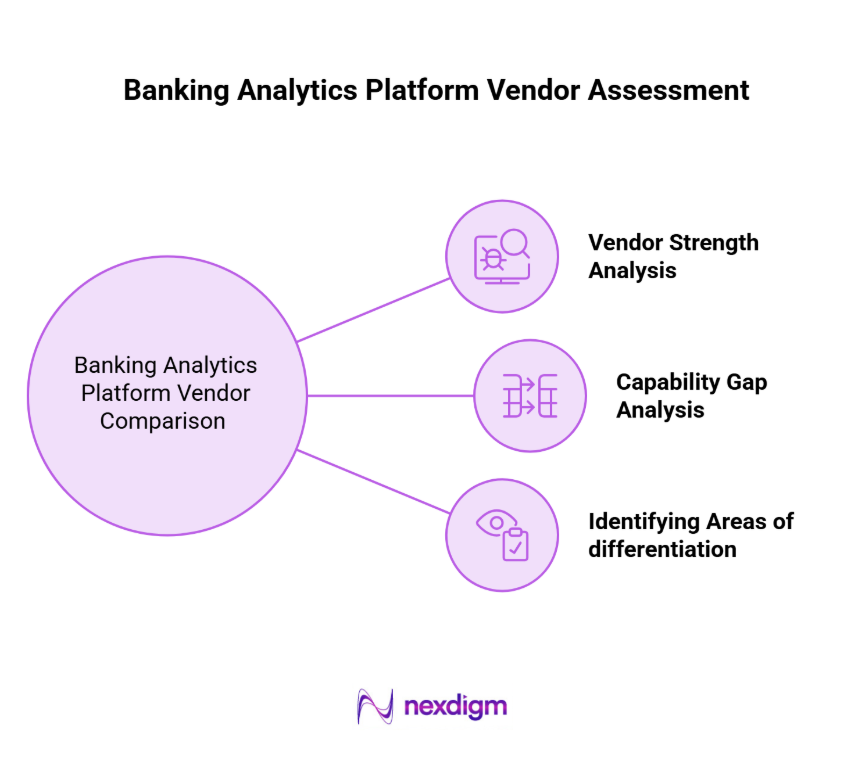
- Vendor strengths: Identify the areas where a supplier performs particularly well—for example, advanced analytics, strong integration, scalability, or proven banking use cases.
- Capability gaps: Highlight areas where a vendor may fall short of the bank’s requirements, such as limited integration, weaker scalability, fewer relevant use cases, or insufficient implementation support.
- Areas of differentiation: Identify capabilities that make one provider meaningfully different from others. For example, a specialist vendor may have deeper fraud analytics capabilities than broader enterprise platforms.
By bringing vendor strengths, gaps, differentiation, and trade-offs into one comparative view, Nexdigm can help banks move beyond feature-based comparisons and understand the relative strategic fit of each analytics platform.
Why the Comparison Matters
A structured comparison helps banks move beyond individual vendor claims and understand how analytics platforms perform relative to one another. The value lies in identifying which capabilities are genuinely differentiated, where gaps or trade-offs exist, and which providers offer stronger alignment with the institution’s priorities. For Nexdigm, this comparative view can help translate vendor intelligence into practical insights for technology and procurement stakeholders.
Significant Impact of Nexdigm’s Vendor Assessment
Nexdigm’s assessment can turn a broad analytics vendor market into a more focused decision framework by connecting supplier capabilities with the institution’s technology environment, use cases, and strategic priorities.
- Sharper Vendor Prioritization: Comparative insights help narrow the vendor universe and focus detailed evaluation on providers with stronger overall relevance.
- Clearer Capability Gaps: The assessment highlights functionality, integration, scalability, and use-case gaps that may require mitigation, additional validation, or alternative solutions.
- Stronger Strategic Alignment: Connecting vendor strengths with analytics priorities helps stakeholders identify platforms that can support immediate needs and longer-term transformation.
Overall, Nexdigm’s assessment can help banks move from market intelligence to practical decision support, creating a more focused basis for vendor evaluation, analytics planning, and platform selection.
Nexdigm’s Case
Nexdigm assessed analytics platform vendors for a financial institution as AI adoption accelerated across banking. The assessment considered that 86% of surveyed financial-services firms were already using AI, while 80% reported AI agents in deployment. Third-party AI systems represented 39% of reported AI systems, highlighting the importance of supplier capability, integration, governance, and scalability when evaluating analytics platforms.
To take the next step, simply visit our Request a Consultation page and share your requirements with us.
Harsh Mittal
+91-8422857704