

Banking operations are becoming more demanding as financial institutions manage increasing transaction volumes, regulatory requirements, and customer expectations for faster services. Automation helps banks improve efficiency, reduce repetitive manual work, and create smoother operational workflows.
However, identifying the right processes for automation requires more than technology adoption. Banks need to understand which activities have high costs, large workloads, complex workflows, and strong potential for improvement.
A Banking automation market demand assessment helps financial institutions evaluate automation opportunities across different banking functions. Nexdigm helps banks identify automation-ready processes to determine where automation can deliver measurable value.
Understanding the Automation Need
Not every banking process requires the same level of automation. Some activities involve high repetition and large volumes, while others require human judgment and specialized expertise. Nexdigm helps banks create a clear view of their operational environment by analyzing:
- Process frequency and workload: Analyzing how often processes are performed and the volume of transactions involved to identify activities that are suitable for automation.
- Manual effort involved: Evaluating the time, resources, and human intervention required to complete tasks, helping identify processes with significant automation potential.
- Cost impact: Assessing operational costs associated with current processes to identify areas where automation can improve efficiency and reduce expenses.
- Improvement opportunities: Identifying process bottlenecks, delays, and inefficiencies to uncover opportunities for automation, enhanced productivity, and better operational performance.
This helps organizations understand which workflows are best suited for automation and where technology investments can deliver stronger returns.
Nexdigm in Assessing the Automation Need
Nexdigm helps banks identify processes where automation can deliver the greatest operational value. By evaluating transaction volumes and operations, organizations can prioritize automation initiatives that improve efficiency, reduce costs, and enhance service delivery.
High-Volume Transaction Operations
Payment processing, reconciliation, reporting, and transaction monitoring involve thousands of daily activities. Even small inefficiencies can create significant operational costs.
Nexdigm analyzes transaction workflows to identify repetitive activities, processing delays and automation opportunities. By identifying high-volume processes, Nexdigm helps banks improve speed, accuracy, and operational control.
Lending and Credit Operations
Loan processing requires document collection, eligibility checks, verification, and approval workflows. These processes often involve multiple departments and significant manual effort.
Nexdigm helps banks assess lending automation opportunities by analyzing loan application volumes, processing timelines and operational costs. This allows financial institutions to identify areas where automation can improve lending efficiency and customer experience.
Nexdigm’s Framework for Assessing Automation Demand
Nexdigm uses a comprehensive framework to assess automation demand across banking operations, enabling organizations to identify suitable processes, evaluate readiness, and develop scalable automation strategies. This involves:
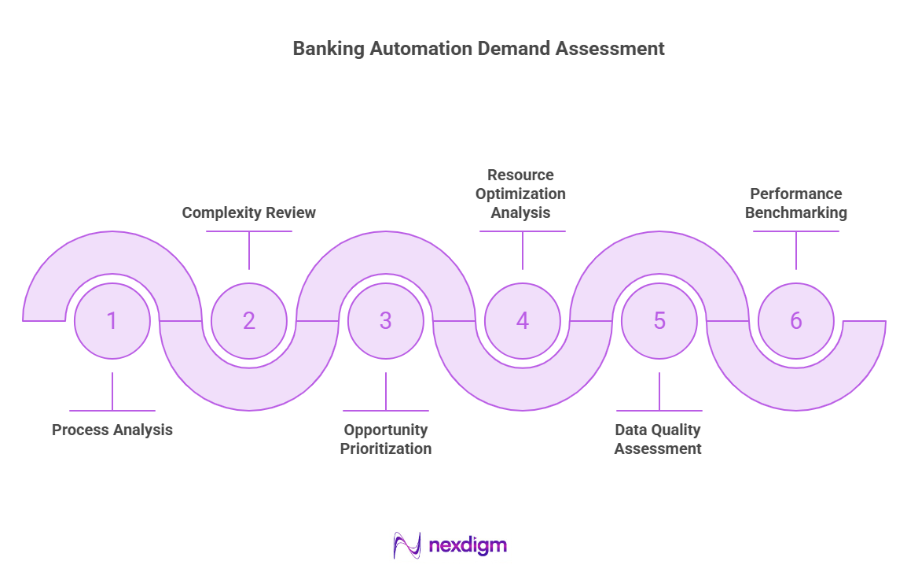
- Process Analysis: Assessment of manual processing costs, resource requirements, and potential efficiency improvements.
- Complexity Review: Examining of process dependencies, technology requirements, and implementation challenges.
- Opportunity Prioritization: Ranking automation initiatives based on business value, feasibility, and expected impact.
- Resource Optimization Analysis: Identifying opportunities to reallocate resources from manual activities to higher-value strategic initiatives.
- Data Quality Assessment: Reviewing data accuracy, availability, and consistency to ensure reliable automation outcomes and decision-making.
- Performance Benchmarking: Comparing current process performance against industry standards to identify automation opportunities with the greatest impact.
This framework helps banks focus on automation investments on processes with stronger potential outcomes.
Strategic Impact of Nexdigm’s Framework
Nexdigm’s banking automation market demand assessment approach supports financial institutions by helping them identify, evaluate, and prioritize automation opportunities across banking operations. This enables banks to:
- Identify priority automation areas: Pinpoint high-impact processes where automation can deliver significant efficiency gains, accuracy improvements, and operational value.
- Understand operational improvement opportunities: Analyze workflows to uncover bottlenecks and identify opportunities for faster, more streamlined banking operations.
- Evaluate technology investments: Assess automation technologies to determine their potential benefits, feasibility, and alignment with business objectives.
- Build practical automation strategies: Develop realistic automation roadmaps that align technology capabilities with operational goals and business priorities.
With thorough assessment conducted by Nexdigm, banks can use these valuable insights to create structured plans aligned with business goals.
Nexdigm’s Case
A regional bank used Nexdigm’s Banking automation market demand assessment framework to evaluate process readiness across lending, payments, and compliance operations. Within 12 months, the organization achieved a 28% reduction in manual processing efforts, improved workflow efficiency by 32%, and accelerated automation implementation decisions by 25% through Nexdigm’s operational insights.
To take the next step, simply visit our Request a Consultation page and share your requirements with us.
Harsh Mittal
+91-8422857704