

Cybersecurity investments are increasing across financial institutions as banks, insurers, fintechs, and payment providers face more frequent and complex cyber threats. Rising risks from ransomware, phishing, data breaches, identity theft, payment fraud, and cloud vulnerabilities are pushing firms to strengthen security infrastructure and response capabilities.
Competitive intelligence institutions need to track how competitors invest in cybersecurity tools, partnerships, governance, and resilience strategies. Banking cybersecurity intelligence helps benchmark threat preparedness, technology adoption, compliance readiness, vendor capabilities, and security gaps across the financial services sector.
Financial institutions are increasing cybersecurity investments as breach costs and attack frequency rise. IBM reported that financial-sector data breaches cost an average USD 6.08 million in 2024, which is 22% higher than the global average. The IMF noted that cyberattacks have more than doubled since the pandemic, while the BFSI cybersecurity market is projected to grow from USD 37.46 billion in 2025 to USD 60.43 billion by 2030.
Impact of Competitive Benchmarking on Cyber Risk Reduction
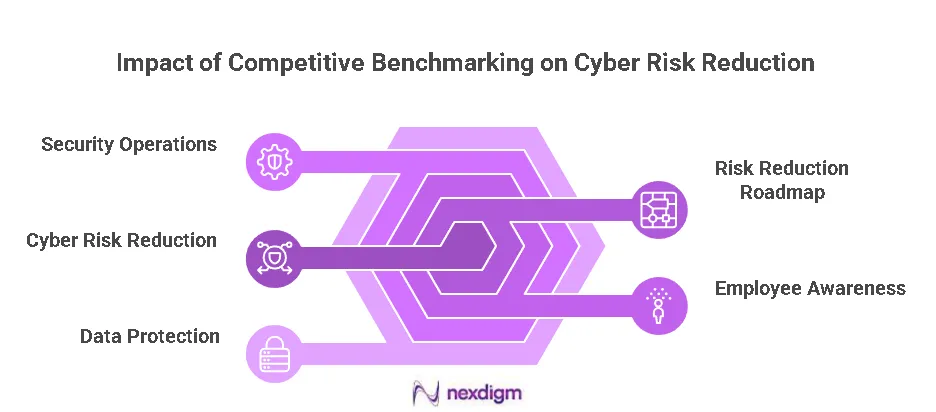
Impact of Competitive Benchmarking on Cyber Risk Reduction shows how financial institutions compare security controls, threat response, vendor tools, and incident readiness to identify gaps, reduce vulnerabilities, and strengthen resilience:
-
Third-Party Risk Evaluation
Benchmarks vendor risk controls, supplier monitoring, due diligence, and outsourcing exposure against industry standards.
-
Data Protection Benchmarking
Compares data classification, encryption, backup, privacy controls, and breach prevention practices across competitors.
-
Security Operations Efficiency
Reviews SOC performance, alert handling, automation, escalation speed, and analyst productivity against peer institutions.
-
Employee Awareness Benchmarking
Compares phishing training, cyber hygiene programs, access discipline, and internal risk reduction practices.
-
Risk Reduction Roadmap
Converts benchmarking findings into prioritized actions for reducing cyber exposure, improving resilience, and strengthening security investments.
Nexdigm Strategic Advisory for Cyber Risk Management
Nexdigm Strategic Advisory for Cyber Risk Management helps financial institutions identify cyber threats, assess security gaps, and build stronger risk management strategies. It supports cybersecurity maturity assessment, vendor evaluation, compliance readiness, incident response planning, and investment prioritization. These insights help banks, fintechs, and insurers reduce vulnerabilities, protect customer data, strengthen resilience, and improve regulatory confidence.
Nexdigm Competitive Gap Analysis in Cybersecurity Capabilities
Nexdigm Competitive Gap Analysis in Cybersecurity Capabilities helps financial institutions compare cyber maturity, threat response, vendor tools, compliance controls, and security investments to identify gaps and strengthen resilience.
-
Cyber Maturity Benchmarking
Nexdigm compares cybersecurity maturity across governance, technology, processes, monitoring, and response capabilities against financial-sector competitors.
-
Threat Detection Gap Review
Nexdigm evaluates detection speed, monitoring tools, alert quality, and response workflows to identify cyber defense weaknesses.
-
Security Technology Assessment
Nexdigm benchmarks firewalls, endpoint protection, encryption, cloud security, IAM, and SOC tools against peer institutions.
-
Incident Response Capability Review
Nexdigm assesses escalation processes, recovery plans, breach response readiness, and business continuity practices.
-
Compliance Control Benchmarking
Nexdigm reviews cybersecurity alignment with regulatory requirements, audit standards, data protection rules, and risk governance practices.
Nexdigm’s case:
Nexdigm helped a global digital trade finance platform using blockchain technology improve its cybersecurity setup. The company worked in supply chain and trade finance but did not have a full-time CISO or dedicated cybersecurity team. Nexdigm supported the client as a Virtual CISO, helping improve security governance, incident response, API security, compliance, and threat monitoring.
This approach helped the client achieve around 70% annual cost savings compared with hiring a full-time CISO. This is highly relevant as financial-sector data breaches cost an average USD 6.08 million. Cyberattacks have more than doubled since the pandemic, and financial firms account for nearly one-fifth of reported cyber incidents.
To take the next step, simply visit our Request a Consultation page and share your requirements with us.
Harsh Mittal
+91-8422857704