

Banking is becoming more connected through digital channels, cloud infrastructure, and instant payments, increasing the number of systems that need protection. The Verizon 2026 Data Breach Investigations Report recorded 3,809 incidents and 1,300 confirmed breaches in the financial and insurance sector. Vulnerability exploitation accounted for 22% of breaches, followed by phishing at 20%.
For banks and financial investors, the challenge is understanding where cybersecurity demand is strongest and which technologies can address the biggest risks. A Banking cybersecurity market analysis helps evaluate exposure, technology adoption, competitive solutions, and investment opportunities.
Nexdigm helps financial institutions assess these areas through cybersecurity market intelligence, technology evaluation, and risk analysis. By connecting threat patterns with banking operations, Nexdigm helps organizations identify security priorities and make more informed technology decisions.
How Nexdigm Maps the Banking Cybersecurity Landscape
Cybersecurity exposure differs across banking environments. Nexdigm helps financial institutions understand how threats affect identity systems, payment infrastructure, cloud environments, and sensitive data.
Nexdigm evaluates:
- Emerging cybersecurity threats: Identifying evolving attack methods targeting banking systems, including ransomware, phishing, fraud, and advanced persistent threats.
- Technology adoption: Assessing new technologies such as cloud, AI, and digital banking platforms and their associated security implications.
- Security gaps: Detecting weaknesses in controls, processes, and infrastructure that could expose banking systems to cyber risks.
- Investment opportunities: Recommending strategic security investments that strengthen resilience, improve compliance, and reduce long-term cybersecurity risks.
This givesbanks a broader view of where security requirements are increasing and which solutions may offer the strongest value.
Nexdigm’s Cybersecurity Insights
Nexdigm Cybersecurity Insights highlights key cybersecurity demands across identity, payments, cloud, and data security, helping financial institutions identify emerging opportunities, in the following ways:
- Identity: Nexdigm analyzes identity security demand by evaluating authentication technologies and credential risks. By usings these market and threat signals, this helps banks identify opportunities for stronger identity security.
- Payments: Nexdigm assesses payment cybersecurity requirements by studying transaction security risks and fraud detection technologies. This helps financial institutions identify where additional cybersecurity investment can strengthen payment protection.
- Cloud: Nexdigm helps organizations understand how this transition affects cybersecurity requirements. Its analysis considers cloud infrastructure risks, data protection, access management, and security integration which helps banks compare their cloud security requirements with market capabilities, supporting more focused technology planning.
- Data: Nexdigm evaluates data security opportunities across encryption, monitoring, access controls, and governance. This helps organizations determine where data protection investments can reduce exposure.
These insights support Nexdigm’s banking cybersecurity market analysis process, enabling organizations to evaluate security needs, identify opportunities, and make informed technology investment decisions.
Nexdigm Framework for Banking Cybersecurity Market Analysis
Nexdigm evaluates banking cybersecurity opportunities through four connected areas. This involves evaluation of cybersecurity market dynamics, threat evolution, and technology adoption trends to help banks align security investments with business objectives through:
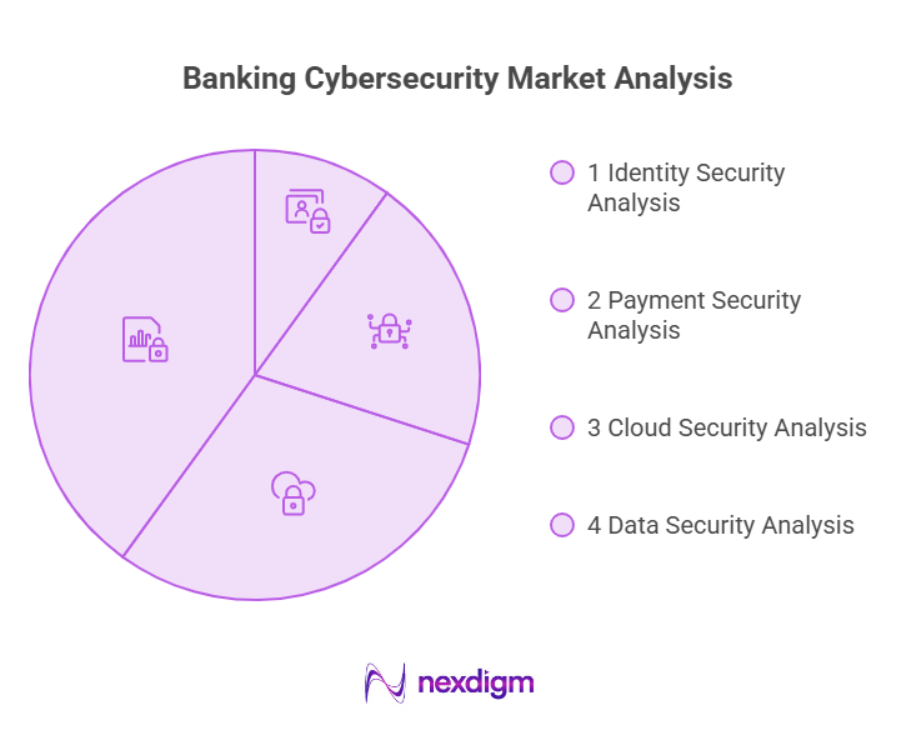
- Identity Security Analysis: Evaluation of authentication, credential risks, access controls, and identity technologies to identify vulnerabilities and security investment priorities. This helps banks strengthen user authentication and reduce unauthorized access risks.
- Payment Security Analysis: Assessment of transaction risks, monitoring capabilities, fraud technologies, and real-time protection requirements across digital payment environments. This enables secure transactions and enhances fraud detection capabilities.
- Cloud Security Analysis: Analysis of cloud adoption, infrastructure exposure, data protection, and integration requirements to identify emerging security priorities. This supports secure cloud transformation and improved infrastructure resilience.
- Data Security Analysis: Evaluation of sensitive data exposure, governance, access controls, and protection technologies to strengthen financial information security. This helps safeguard customer data and ensure regulatory compliance.
This framework enables financial institutions to prioritize security initiatives, identify growth opportunities, strengthen resilience against evolving threats, and make informed technology investment decisions aligned with long-term business objectives.
How Nexdigm Helps Banks Turn Risk Into Action
Identifying cybersecurity risks is only the starting point. Banks also need to know which risks matter most, which technologies can address them, and where investment should be directed.Nexdigm helps banks assess the following factors:
- Identify: Mapping exposure across identity, payments, cloud, and data to highlight key security gaps.
- Evaluate: Comparing available cybersecurity technologies, market trends, adoption levels, and solution capabilities.
- Prioritize: Ranking opportunities based on risk, business impact, technology readiness, and potential value.
- Invest: Using market and technology insights to help banks focus on cybersecurity spending on solutions with stronger strategic and commercial potential.
This approach gives financial institutions a clearer path from identifying vulnerabilities to selecting solutions and making focused cybersecurity investments.
Nexdigm’s Case
A regional financial institution used Nexdigm’s Banking cybersecurity market analysis framework to assess identity, payment, cloud, and data security risks. Within 12 months, the organization improved threat-prioritization efficiency by 33%, reduced security assessment time by 29%, and identified priority technology investments that strengthened its cybersecurity roadmap.
To take the next step, simply visit our Request a Consultation page and share your requirements with us.
Harsh Mittal
+91-8422857704