

Banking fee structure benchmarking helps financial institutions compare service charges, waivers, account conditions, and customer value across markets where pricing directly affects loyalty. Integrated with robust pricing analysis, it reveals fee inconsistencies, competitive gaps, and opportunities to simplify propositions without weakening profitability.
Banks can use these insights to align charges with customer expectations, improve transparency, protect revenue, and reduce avoidable attrition. A structured benchmarking approach also supports stronger product positioning, regulatory awareness, and faster pricing decisions across diverse retail and commercial banking segments in rapidly changing market conditions globally today.
In 2025, more than one million UK current accounts were switched, while the majority of the user reported satisfaction with the switching service. U.S. banks earned $80.5 billion in first-quarter 2026, reinforcing the value of transparent, competitive fee benchmarking and pricing analysis.
Pricing Intelligence for Balanced Banking Fees and Customer Value
Pricing intelligence helps banks balance service fees, customer expectations, and profitability by combining market benchmarks, behavioral insights, and portfolio economics for sustainable value creation and retention. Some major benefits of the same are:
- Lower Churn Risk: Early identification of fee sensitivity and dissatisfaction, using pricing analysis, allows banks to intervene before customers leave, supporting retention strategies that protect valuable relationships and recurring revenue.
- Greater Cross-Selling Potential: Balanced pricing and bundled benefits encourage customers to adopt additional accounts, cards, payments, lending, and digital services, increasing relationship depth and lifetime value.
- Faster Response to Market Changes: Continuous competitor and customer monitoring through pricing analysis enables banks to adjust fees quickly when market expectations, regulations, service costs, or competitive propositions change.
- Reduced Fee-Related Customer Friction: Analyzing complaints, disputes, and transaction behavior using pricing analysis, helps banks remove confusing charges, redesign fee triggers, and create smoother customer experiences across accounts and services.
Nexdigm’s Pricing Analysis Expertise for Balanced Banking Fees and Customer Value
Nexdigm combines banking fee structure benchmarking, competitive intelligence, customer segmentation, and advanced pricing analysis to help financial institutions design balanced service charges. With strategic and data-driven approach, Nexdigm supports bank fee optimization, pricing transparency, customer retention, revenue growth, and stronger market positioning, enabling banks to align fee structures with customer value while maintaining profitability, compliance, and long-term competitiveness across banking markets.
Nexdigm’s Strategic Framework for Banking Fee Pricing Analysis
Nexdigm’s strategic framework combines market, customer, profitability, and governance models to help banks design balanced fee structures that strengthen transparency, competitiveness, retention, and sustainable revenue performance across banking portfolios. Major framework models used by Nexdigm’s experts are:
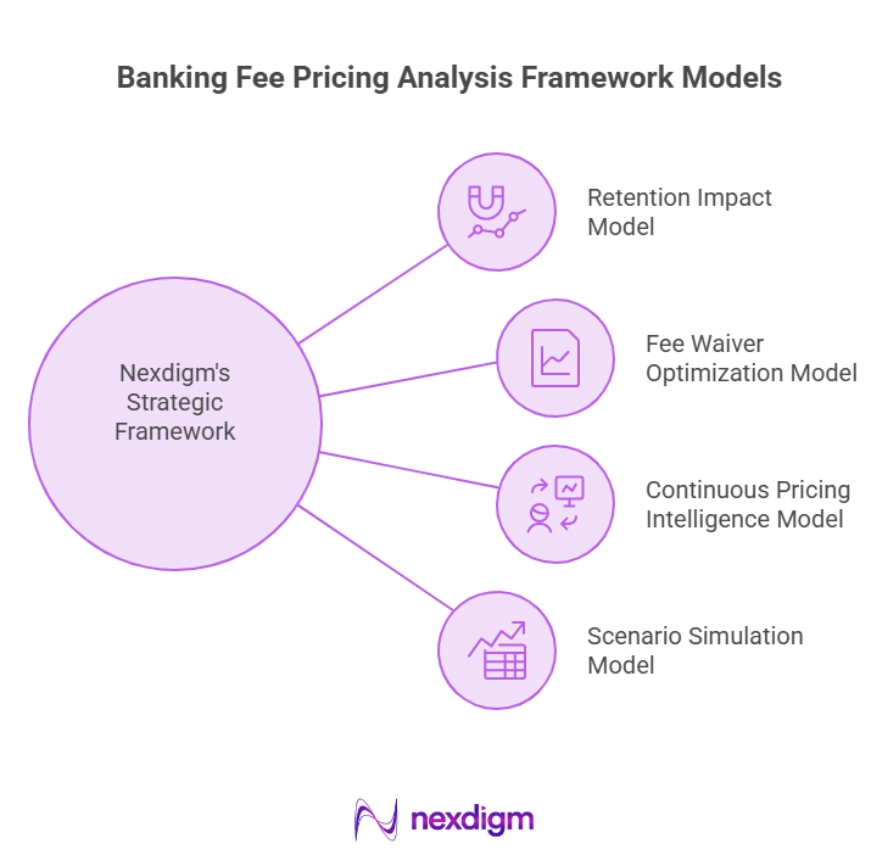
- Retention Impact Model: This model evaluates how fees, waivers, complaints, and competitor offers influence churn, enabling banks to redesign charges that strengthen loyalty and recurring customer value.
- Fee Waiver Optimization Model: Waiver thresholds, relationship conditions, and transaction requirements are assessed to encourage profitable behavior while reducing unnecessary exceptions, revenue leakage, and operational complexity.
- Continuous Pricing Intelligence Model: Competitor actions, customer feedback, market shifts, and portfolio performance are monitored regularly, enabling timely fee adjustments and sustained alignment between profitability and customer value.
- Scenario Simulation Model: Alternative fee levels, bundles, exemptions, and rewards are modelled to estimate revenue, customer response, retention, and competitive impact before broader implementation.
Nexdigm’s Case
Nexdigm supported a retail bank with fee benchmarking, customer sensitivity analysis, and waiver optimization. The engagement identified pricing gaps and redesigned service charges around customer value. Illustrative outcomes included a 12% increase in fee realization, 17% fewer pricing-related complaints, and a 9% improvement in customer retention within six months.
To take the next step, simply visit our Request a Consultation page and share your requirements with us.
Harsh Mittal
+91-8422857704