

Banking infrastructure is evolving as institutions balance cloud adoption, legacy environments, cybersecurity, data growth, and resilience requirements. A 2026 survey found that 98.3% of financial institutions use some form of cloud, with 46% operating hybrid environments and only 1.7% remaining entirely on-premises. The same research found that 64% already store or process regulated financial data in public cloud environments, while another 18% plan to do so within 18 months.
The supplier ecosystem supporting this infrastructure is also becoming more complex. In India, information-security spending is forecast to reach $3.4 billion in 2026, with security software spending growing 12.4%. Meanwhile, financial-services firms increasingly operate hybrid and multi-cloud environments, with 79% reporting either a hybrid or multi-cloud strategy in a global survey.
This makes banking IT infrastructure supplier research increasingly important for understanding the providers supporting cloud, data centers, networks, cybersecurity, and related technology foundations.
Infrastructure Is Becoming a Portfolio of Interconnected Capabilities
Banks rarely rely on a single infrastructure supplier. Cloud providers, data-center operators, network specialists, cybersecurity vendors, data-platform providers, and managed-service partners can each support different parts of the technology environment. Their capabilities also need to work together across legacy and modern architectures. As infrastructure becomes more distributed, institutions need greater visibility into which suppliers operate in each category, how their capabilities differ, and where dependencies or concentration may exist.
Four Infrastructure Categories Shape the Supplier Landscape
A practical landscape can begin by separating suppliers according to the infrastructure capabilities they provide:
- Cloud & Compute: Assess providers supporting public, private, hybrid, multi-cloud, compute, storage, and scalable infrastructure requirements.
- Data Center & Hosting: Examine facilities, colocation, managed hosting, disaster recovery, availability, geographic coverage, and physical resilience.
- Network & Connectivity: Evaluate connectivity, network management, software-defined networking, performance, availability, and integration across distributed environments.
These categories provide a foundation for understanding the broader infrastructure ecosystem and identifying where specialist or multi-capability suppliers may be relevant.
Nexdigm’s Industry-Led Infrastructure Supplier Research Service Offerings
Nexdigm can combine financial-services expertise, supplier intelligence, market research, technology assessment, and commercial analysis to map providers across the infrastructure ecosystem. Through banking IT infrastructure supplier research, our experts can assess suppliers across cloud, data centers, networks, cybersecurity, hosting, managed infrastructure, and related technology services. The analysis can consider capability depth, market presence, financial-services experience, geographic reach, scalability, resilience, and areas of specialization. This provides institutions with a structured view of infrastructure suppliers rather than a simple list of technology companies.
How Nexdigm Assesses Suppliers by Infrastructure Role
Supplier relevance can vary depending on the provider’s role within the bank’s technology environment. Nexdigm can use different assessment lenses to understand both supplier capability and strategic relevance:
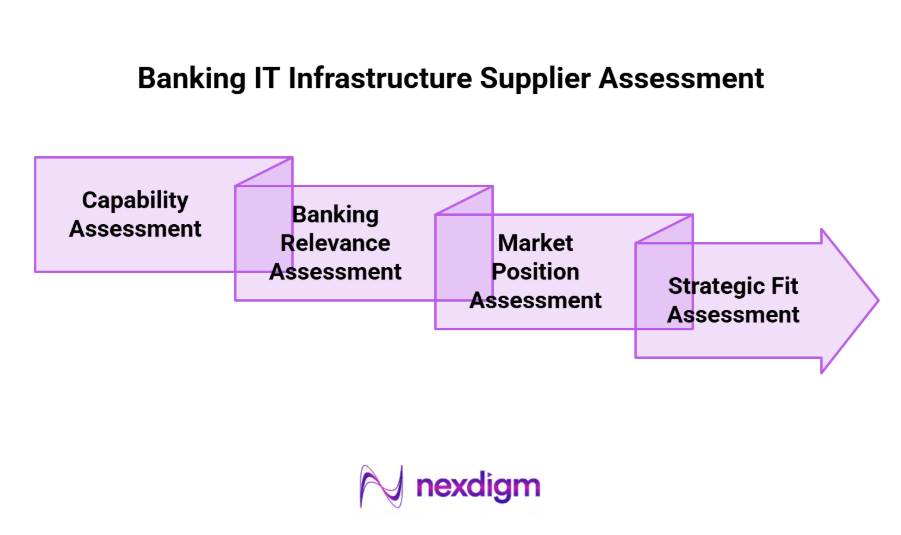
- Capability Assessment: Evaluate technical coverage, infrastructure maturity, scalability, resilience, performance, and specialist expertise to determine whether the supplier can meet current and future requirements.
- Banking Relevance Assessment: Examine experience with financial institutions, critical workloads, sensitive data, regulatory expectations, and complex banking environments to establish sector-specific suitability.
- Market Position Assessment: Review supplier presence, category strength, specialization, geographic reach, ecosystem relationships, and competitive positioning to understand where the provider stands within its market.
- Strategic Fit Assessment: Compare supplier capabilities with the bank’s existing architecture, operating model, transformation priorities, risk considerations, and infrastructure roadmap to determine practical relevance.
Together, these assessments help Nexdigm distinguish market visibility from genuine supplier suitability, giving banks a structured basis for identifying providers that align with their infrastructure strategy.
Nexdigm’s Supplier Assessment Supporting Infrastructure Strategy
Nexdigm can connect supplier assessment findings with the bank’s broader infrastructure strategy by considering various needs. This helps determine where each supplier can create the most value within the infrastructure environment. The assessment can help banks identify:
- Immediate-Fit Providers: Suppliers capable of addressing current infrastructure requirements with minimal alignment or implementation gaps.
- Transformation Partners: Providers whose capabilities support longer-term modernization, cloud adoption, scalability, or infrastructure transformation objectives.
- Specialist Providers: Vendors offering deeper expertise in specific areas such as cybersecurity, networking, cloud, data centers, or managed infrastructure.
- Strategic Alternatives: Providers that can address supplier concentration, capability gaps, resilience requirements, or the need for greater sourcing flexibility.
By connecting supplier capabilities with infrastructure priorities, Nexdigm can help ensure that banking IT infrastructure supplier research informs actual technology and sourcing decisions, rather than remaining a standalone market-mapping exercise.
Nexdigm’s Case
Nexdigm assessed infrastructure suppliers across cloud, data centers, networks, cybersecurity, and managed infrastructure for a financial institution. 28% demonstrated strong overall infrastructure fit, 21% showed differentiated capabilities in priority categories, and 16% provided viable alternatives for reducing supplier concentration. The assessment helped the institution prioritize suppliers for technical, commercial, and risk-focused evaluation.
To take the next step, simply visit our Request a Consultation page and share your requirements with us.
Harsh Mittal
+91-8422857704