

Entering a commercial banking market requires more than sufficient capital and a banking licence. Established banks already benefit from low-cost deposits, extensive distribution networks, long customer relationships, and transaction histories that strengthen credit underwriting.
A new entrant must therefore find a segment where incumbents are less effective and build a balance sheet capable of generating acceptable returns before its initial capital is absorbed by operating and regulatory costs.
Demand Exists, But It Is Not Evenly Distributed
Headline banking penetration can conceal meaningful differences between customer segments and regions. Opportunity is more likely to emerge where conventional banking models struggle to serve customers profitably.
Three segments can present potential:
- Micro-entrepreneurs and mid-sized enterprises: Businesses with fragmented financial records may be better served through cash-flow-based underwriting rather than traditional collateral-led lending.
- Emerging affluent households: Growing secondary industrial centres can generate wealth faster than standardized banking infrastructure expands.
- Digital retail savers and micro-merchants: High transaction activity can create useful financial data even when average account balances remain modest.
For a new bank, the commercial test is whether customer lifetime value can justify acquisition and capital costs. The supplied research uses a 3x LTV-to-cost threshold over five years as a useful benchmark for market viability.
A New Bank Has to Build Its Liability Franchise
Customer acquisition is particularly challenging on the deposit side. Without an established franchise, a new bank may need to offer deposit rates 100–200 basis points above incumbent banks, increasing its cost of funds and putting pressure on net interest margins.
Branches can remain relevant despite high digital adoption because they help establish trust and attract high-value current accounts and term deposits.
A commercial branch in a secondary urban centre can require ₹40 lakh–₹75 lakh in capital expenditure and ₹4 lakh–₹7 lakh in monthly operating costs.
Branch-level break-even may require ₹25 crore–₹35 crore of deposits and take 18–24 months.
Digital onboarding can reduce account-opening costs by 60%–75% but digitally acquired customers may maintain lower balances and show higher attrition.
The strongest entry model will therefore combine digital acquisition with targeted physical distribution rather than treating either channel as sufficient on its own.
Regulation Shapes the Economics of Entry
For private-sector universal banks in India, regulatory requirements directly influence the amount of capital, distribution infrastructure, and operating capacity an entrant need. Nexdigm’s research identifies initial paid-up voting equity capital of ₹500 crore–₹1,000 crore, alongside a minimum CRAR requirement of approximately 13%–15%.
Promoters must maintain at least 40% of paid-up voting equity capital during the first five years, followed by a dilution path toward 26% within 15 years. Universal banks are also subject to a 40% Priority Sector Lending target based on ANBC and must maintain at least 25% of their branch network in unbanked rural centres.
For Small Finance Banks considering conversion into universal banks, the requirements include a minimum net worth of ₹1,000 crore, a satisfactory five-year track record, listing requirements, profitability over the preceding two fiscal years, and GNPA and NNPA of no more than 3% and 1%, respectively.
These requirements need to be incorporated into the entry economics rather than treated as a separate compliance exercise.
Incumbents Have Structural Advantages
A new bank must compete against more than established brands. Incumbents benefit from:
- Lower funding costs supported by longstanding salary and business-account relationships.
- Extensive branch networks that reinforce customer trust and access.
- Longitudinal transaction data supporting credit underwriting and collections.
- Multi-product relationships that increase customer switching costs.
A new entrant therefore needs a defensible proposition, whether based on a specific customer segment, superior underwriting, distribution access, product specialization, or a structurally different operating model.
Nexdigm’s Banking Market Entry Assessment Framework
Nexdigm evaluates entry viability across four interconnected dimensions:
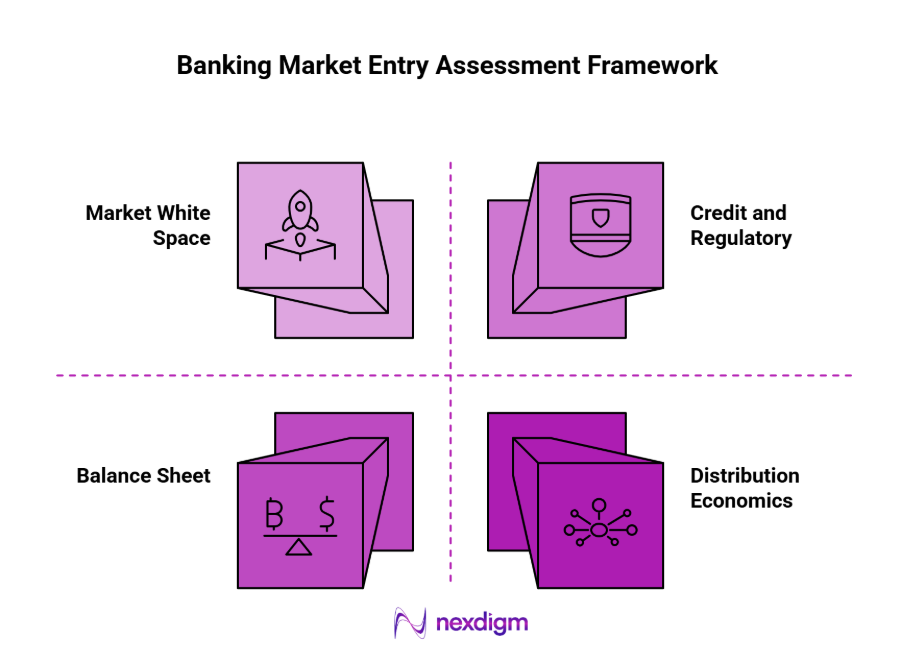
- Market White Space: Identify customer segments and geographies with sufficient unmet deposit and credit demand.
- Balance Sheet Economics: Model deposit acquisition, CASA growth, funding costs, lending yields, credit losses, capital requirements, and NIM.
- Distribution Economics: Compare branch, digital, assisted, partnership, and hybrid models based on CAC, deposit mobilisation, customer retention, and cost-to-serve.
- Credit and Regulatory Viability: Stress-test target portfolios against expected losses, PSL requirements, capital consumption, regulatory obligations, and economic cycles.
Banking Market Entry Assessment then converts these findings into a five-year entry case covering required capital, target customers, geographic footprint, balance-sheet trajectory, break-even period, and expected ROE. The resulting decision can be to enter, defer, partner, or acquire, depending on the economics.
How Nexdigm Determines Whether a New Bank Can Win
Nexdigm assessed banking entry for a diversified NBFC across six regional urban and industrial markets, evaluating four customer segments and an addressable deposit opportunity of ₹54,000 crore. The analysis showed a standard retail model reaching break-even only after 6.2 years. An asset-led strategy targeting manufacturing MSMEs and supply-chain ecosystems reduced projected CAC by 26%, bringing break-even forward to 4.1 years and supporting a projected Year-5 ROE of 15.2%.
To take the next step, simply visit our Request a Consultation page and share your requirements with us.
Harsh Mittal
+91-8422857704