

Entering a new banking market is an exercise in sequencing. A bank can identify attractive customer demand and still destroy value if its licensing pathway takes longer than expected, deposits cost too much to acquire, or its distribution model requires years to reach scale.
The entry decision therefore needs to connect regulatory requirements with customer economics and operating design from the outset. Before committing capital, management needs to establish what it can legally build, which customers can generate viable returns, and how those customers should be reached.
Regulation Defines What the Bank Can Build
Market entry begins with establishing the regulatory perimeter; whether via a universal bank, SFB, foreign-bank branch, acquisition, or partnership.
Analysis must extend beyond licensing eligibility to evaluate capital requirements, ownership caps, PSL obligations, rural mandates, and approval timelines (or conversion criteria for SFBs).
Determining these regulatory boundaries upfront is essential, as they govern balance-sheet capitalization, branch footprint, and scaling speed.
Customer Economics Come Before Distribution
A new bank does not begin with the economics of an established franchise. It has to acquire deposits, establish customer relationships, build lending history, and absorb the fixed costs of regulatory and technology infrastructure simultaneously.
The critical variables include:
- Deposit acquisition cost and expected CASA mix
- Lending yields and net interest margins
- Customer acquisition cost by segment
- Credit losses and provisioning requirements
- Fee-income potential and cross-sell
- Capital consumed by incremental lending
- Cost-to-income trajectory
- Time required to reach portfolio break-even
New entrants risk margin compression when offering premium deposit rates before loan books achieve scale. Rather than competing on price, banks should target high-value niches like mid-market commercial or sector-specific MSME banking to secure sticky deposits and healthier credit economics.
The Entry Model Determines the Capital Burden
The route into a market can fundamentally change the investment case.
- Greenfield entry provides control over technology, product architecture, culture, and asset quality. It also requires substantial investment before the franchise generates meaningful revenue.
- Brownfield acquisition can provide immediate access to customers, branches, deposits, employees, and operating infrastructure. The trade-off is exposure to legacy credit portfolios, technology systems, compliance issues, and integration complexity.
- Partnership-led models can provide faster access to customers while reducing initial infrastructure requirements. However, the institution gives up some control over customer relationships and economics and remains exposed to counterparty and regulatory dependencies.
The appropriate model depends on the institution’s strategic objective, available capital, desired speed to market, and willingness to assume legacy risk.
Channel Fit Determines How the Franchise Scales
Physical and digital channels must complement each other based on customer economics. Flagship branches anchor institutional relationships, corporate deposits, and high-value commercial clients. Meanwhile, smaller outlets support local MSME origination, and Business Correspondent networks deliver basic services in lower-density markets.
Digital channels efficiently absorb high-volume onboarding, payments, and routine retail servicing. This hub-and-spoke setup balances reach and cost: physical hubs manage high-touch relationships while digital and assisted touchpoints scale low-value transactions.
The Entry Plan Must Become an Investment Case
A market-entry strategy becomes actionable only through a sequenced financial plan. The five-year model should define:
- Regulatory milestones: Licensing stages, approvals, and compliance requirements.
- Capital deployment: Upfront funding, phased equity injections, technology, and infrastructure spend.
- Balance-sheet growth: Deposit mobilization, loan expansion, asset mix, NIM, and capital consumption.
- Operating trajectory: Branch productivity, digital acquisition, headcount costs, and cost-to-income ratios.
- Stress-tested returns: Break-even horizons, asset-quality downside cases, CRAR paths, and target ROE.
This provides leadership with clear criteria on entry timing, scale velocity, and capital releases tied to operational milestones.
Nexdigm’s Bank Market Entry Strategy Framework
Nexdigm structures a banking market entry strategy consulting engagement around five connected workstreams:
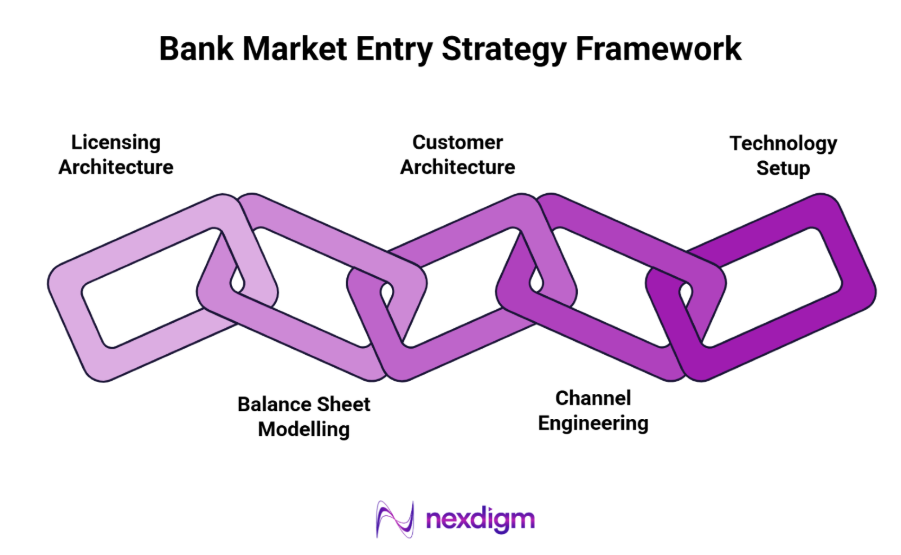
- Licensing Architecture and Regulatory Roadmapping: Define the viable regulatory route, approval requirements, compliance obligations, and implementation sequence.
- Balance Sheet and Asset-Liability Modelling: Model deposits, funding costs, lending yields, statutory requirements, capital consumption, credit losses, and NIM under multiple scenarios.
- Customer and Product Architecture: Identify priority segments and build product, pricing, underwriting, collateral, and fee structures around their economics.
- Channel and Distribution Engineering: Determine the right combination of branches, banking outlets, Business Correspondents, partnerships, and digital channels by customer segment and geography.
- Technology and Operating Setup: Assess core banking, AML and fraud systems, data infrastructure, vendors, talent, and operational capabilities required before launch.
These workstreams are integrated into a five-year investment roadmap that links capital deployment to regulatory milestones, customer acquisition, balance-sheet growth, and financial break even.
How Nexdigm Builds a Bank Entry Roadmap
An international banking institution assessing entry into India compared acquisition, greenfield wholesale banking, and a full retail-commercial subsidiary across four priority regions.
Nexdigm found the wholesale model unable to generate sufficient returns and traditional branch deployment too capital-intensive. A targeted WOS model required ₹2,200 crore of phased capital, reduced projected operating expenses by 29%, reached break-even by month 42, and maintained CRAR above 16%.
To take the next step, simply visit our Request a Consultation page and share your requirements with us.
Harsh Mittal
+91-8422857704