

Financial institutions are under continued pressure to improve productivity while funding technology, cybersecurity, resilience, and regulatory requirements. Recent research estimates that 40–50% of operating expenses at many banks flows through external vendors and contractors, making third-party spending one of the largest controllable cost pools. Leading procurement teams can deliver 7–10% savings across addressable third-party spending, according to a 2026 research analysis.
At the same time, technology spending remains strategically important, with banks balancing modernization against legacy costs and regulatory obligations. Another 2026 banking survey found that 71% of banking leaders believe their organizations need to modernize platforms to bring new or enhanced products and services to market.
The challenge is therefore not simply to reduce procurement expenditure. It is to identify where costs can be removed, renegotiated, consolidated, or better managed without weakening service quality, resilience, security, or compliance. A structured banking procurement optimization strategy can help institutions make that distinction.
Cost Optimization Needs to Protect What the Bank Cannot Afford to Disrupt
Procurement savings can become counterproductive when they reduce service levels, weaken controls, create excessive supplier dependency, or disrupt critical technology and operations. The strongest opportunities often come from understanding what drives spending before attempting to reduce it. Organizations estimate that demand management can account for 30–40% of the value at stake in financial-services procurement, indicating that savings do not always come from negotiating lower supplier rates. A more effective approach is to identify savings levers according to category economics, business criticality, supplier conditions, and risk exposure.
Savings Opportunities Can Differ Across Procurement Categories
Not every procurement category offers the same path to cost improvement. Technology, professional services, cloud, facilities, and operational services can have different supplier markets, pricing structures, demand patterns, and switching considerations. Nexdigm can help financial institutions assess these category-specific characteristics to identify where commercial negotiation, demand optimization, supplier competition, consolidation, or contract restructuring may offer savings without unnecessarily affecting critical banking activities.
How Nexdigm’s Experts Identify Actionable Procurement Levers
Once category-specific opportunities are understood, Nexdigm can assess the underlying drivers of spend to determine which interventions are most practical. This can include reviewing:
- Supplier pricing: Check whether current rates, discounts, or pricing structures are competitive and whether renegotiation could improve economics.
- Contract structures: Review renewal terms, volume commitments, minimums, escalation clauses, and service conditions that may be increasing costs.
- Consumption: Determine whether the bank is paying for unused licenses, excess capacity, unnecessary services, or inefficient utilization.
- Specifications: Assess whether service requirements are more extensive than necessary and whether appropriate standardization could reduce costs.
- Market alternatives: Examine whether credible alternative suppliers or sourcing models could introduce competition without creating unacceptable operational or compliance risks.
By reviewing these areas, Nexdigm’s experts can help banks focus on savings opportunities that are both commercially meaningful and practically achievable.
Nexdigm’s Analysis of Banking Procurement Optimization
A structured banking procurement optimization strategy requires more than identifying high-spend categories or potential savings. Nexdigm’s experts can follow a structured process to understand what is driving procurement costs and which interventions can be implemented:
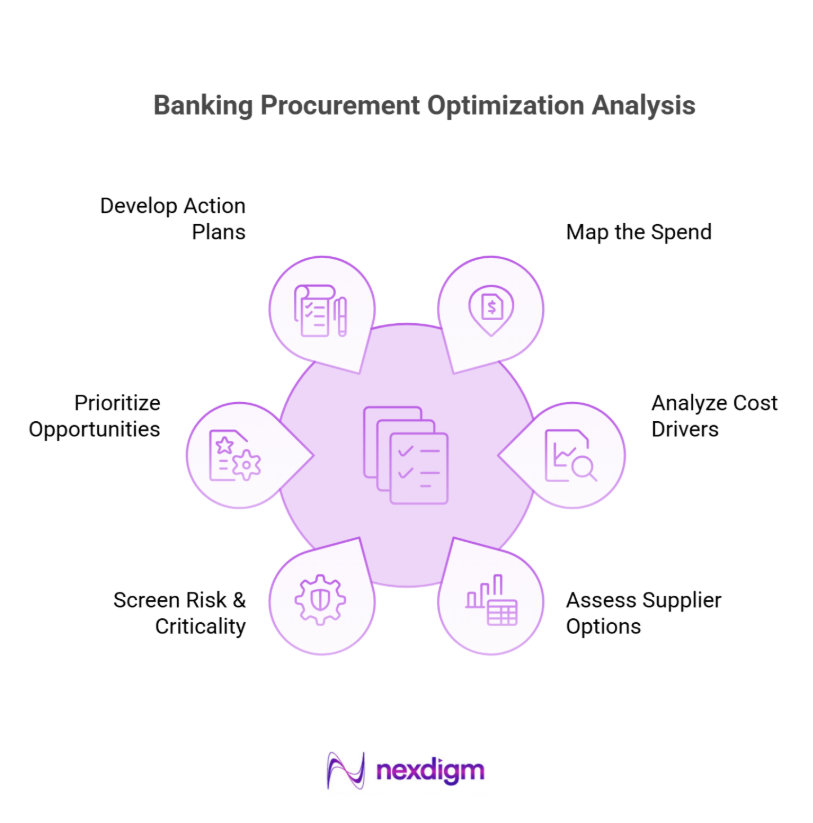
- Map the Spend: Identify major cost pools, suppliers, contracts, purchasing patterns, and category-level expenditure to establish a clear procurement baseline.
- Analyze Cost Drivers: Examine supplier pricing, contract structures, demand, consumption, specifications, and market conditions to understand what is influencing current costs.
- Assess Supplier & Market Options: Evaluate supplier competition, alternative providers, concentration, switching feasibility, and relevant market benchmarks to identify sourcing possibilities.
- Screen Risk & Criticality: Consider regulatory requirements, business dependency, service criticality, resilience, and potential disruption before recommending any cost intervention.
- Prioritize Opportunities: Rank identified opportunities according to financial potential, feasibility, implementation complexity, business impact, and associated risk.
- Develop Action Plans: Translate prioritized opportunities into practical actions such as negotiation, demand optimization, competitive sourcing, consolidation, or contract restructuring.
By following these steps, Nexdigm can help banks distinguish theoretical savings from commercially viable opportunities and build a more informed basis for procurement decisions.
Strategic Benefits of Nexdigm’s Procurement Analysis
Nexdigm’s analysis can help financial institutions turn procurement data into clear, risk-aware actions. Key benefits include:
- Identify High-Value Opportunities: Pinpoint categories, suppliers, contracts, and demand areas where meaningful savings potential exists, helping teams focus on the largest value pools.
- Protect Critical Operations: Assess business criticality, supplier dependency, and operational requirements before pursuing savings, reducing the likelihood of cost initiatives disrupting essential services.
- Strengthen Commercial Outcomes: Use supplier intelligence, market benchmarks, pricing analysis, and contract insights to support more informed negotiations and sourcing decisions.
- Improve Procurement Prioritization: Rank opportunities according to value, feasibility, risk, and implementation complexity, enabling procurement teams to direct resources toward initiatives with stronger potential returns.
Together, these benefits help banks pursue cost optimization without treating savings as the only measure of procurement success, balancing financial impact with operational resilience, compliance, and business requirements.
Nexdigm’s Case
Nexdigm assessed procurement for a financial-services organization, identifying 19% of spend with demand-optimization potential, 17% with commercial renegotiation opportunities, and 11% with supplier-rationalization potential. After considering operational and compliance requirements, the organization prioritized initiatives that could improve procurement economics while protecting critical services and maintaining appropriate risk controls.
To take the next step, simply visit our Request a Consultation page and share your requirements with us.
Harsh Mittal
+91-8422857704