

Regulatory strategy plays a critical role in reducing delays during banking market expansion initiatives by helping firms understand licensing requirements, compliance obligations, capital norms, governance standards, and supervisory expectations before entering a new market. In highly regulated financial sectors, incomplete planning can lead to approval delays, operational risks, and increased costs.
Market entry strategy ensures that regulatory assessment is integrated early into expansion planning. A well-defined Banking regulatory market entry strategy helps banks and financial institutions align business objectives with local laws, manage documentation efficiently, engage regulators effectively, and launch services with greater speed and compliance confidence.
Financial institutions globally spend an estimated USD 206 billion annually on financial crime compliance, while 98% reported increased compliance costs in 2023. Bank IT budgets allocated to compliance also rose from 9.6% in 2016 to 13.4% in 2023. These figures show why a strong Banking regulatory market entry strategy can reduce delays, manage risks, and support faster approvals.
Assessing Banking Regulatory Requirements Before Banking Market Entry
Assessing Regulatory Requirements Before Banking Market Entry involves reviewing licensing rules, capital norms, AML/KYC obligations, data privacy laws, governance standards, and approval timelines to reduce expansion delays:
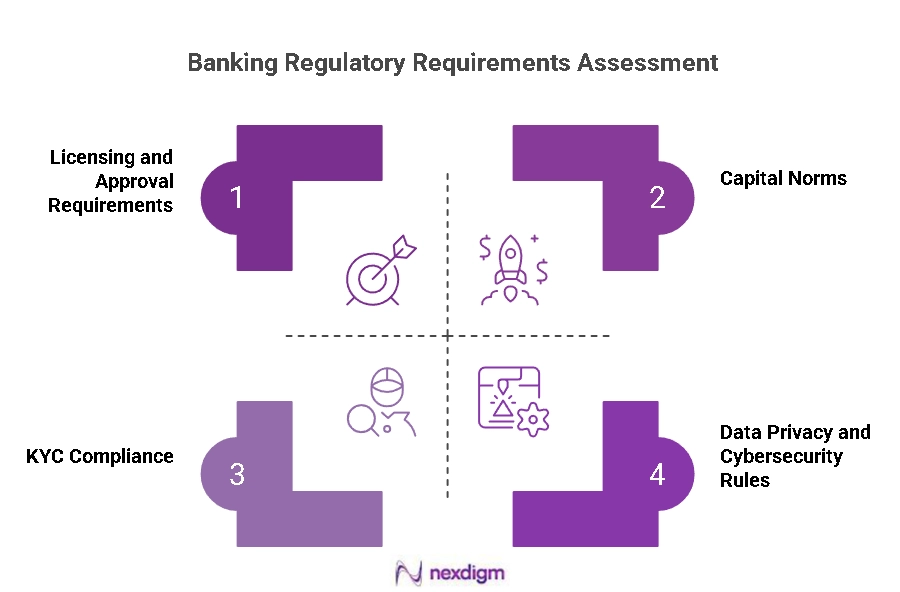
- Licensing and Approval Requirements: Review banking licenses, regulator approvals, eligibility criteria, documentation needs, and expected timelines before entering a new market.
- Capital Norms: Assess minimum capital, liquidity standards, risk-weighted assets, reserve requirements, and financial stability obligations for banking operations.
- KYC Compliance: Evaluate anti-money laundering rules, customer verification processes, transaction monitoring, suspicious activity reporting, and sanctions screening requirements.
- Data Privacy and Cybersecurity Rules: Review data protection laws, customer consent requirements, storage rules, cybersecurity controls, and breach reporting obligations.
Nexdigm’s Regulatory Advisory Support for Banking Market Entry Strategy
Nexdigm’s Regulatory Advisory Support for Banking Market Entry Strategy helps firms assess licensing requirements, compliance obligations, approval timelines, AML/KYC rules, governance standards, and regulatory risks before expansion. This enables banks and financial institutions to prepare documentation, engage regulators effectively, reduce delays, and launch operations with stronger compliance readiness.
Nexdigm’s Compliance Gap Assessment Before Entering New Banking Markets
Nexdigm’s Compliance Gap Assessment Before Entering New Banking Markets helps firms identify regulatory, AML/KYC, governance, reporting, tax, and operational gaps before launch, reducing approval delays and compliance risks.
- Operational Compliance Review: Nexdigm identifies gaps in processes, controls, workflows, documentation, and compliance ownership before launching banking operations.
- Regulatory Reporting Assessment: Nexdigm reviews reporting obligations, filing timelines, disclosure requirements, audit trails, and supervisory communication processes for compliance readiness.
- Risk and Control Gap Mapping: Nexdigm identifies compliance, operational, technology, financial crime, and governance risks that could delay banking market entry.
- Remediation Roadmap Development: Nexdigm converts gap findings into prioritized corrective actions, ownership plans, timelines, and implementation steps for smoother market entry.
Nexdigm’s case:
Nexdigm engaged with a banking institution to conduct a compliance gap assessment before entering a new market. Nexdigm reviewed 120 regulatory requirements, assessed 45 internal policies, mapped 30 AML/KYC controls, and identified 18 compliance gaps across governance, reporting, and operational processes. The remediation roadmap helped the company reduce regulatory submission rework by 35%, improve documentation readiness, and shorten expected market entry preparation time by 28%.
To take the next step, simply visit our Request a Consultation page and share your requirements with us.
Harsh Mittal
+91-8422857704