

Banking access is expanding, but customer usage remains uneven across products. The World Bank’s Global Findex 2025 found that 79% of adults globally owned a financial account in 2024, up from 74% in 2021. At the same time, 86% of adults owned a mobile phone, creating a larger foundation for digital financial-service adoption.
Mobile engagement is also becoming a major driver of banking activity. McKinsey found that the share of consumers using mobile devices for banking increased from 41% in 2020 to 63% in 2024.
Yet account ownership does not necessarily mean customers are actively using savings, credit, investments, insurance, or other services. For banks, fintech companies, and investors, the opportunity is to understand the difference between access, usage, and relationship depth.
A Banking service adoption analysis helps identify which products customers actively use, which remain underpenetrated, and what prevents customers from developing broader financial relationships.
Nexdigm connects customer behavior, product usage, digital engagement, market trends, and competitive intelligence to reveal these adoption patterns.
Understanding Customer Adoption across Banking Sector
Nexdigm plays an important role in healping organizations to understand the customer adoption across banking sector. This starts with the entire customer relationship rather than one individual banking product. The assessment covers current accounts, savings, payments, credit cards, personal loans and mortgages.
Nexdigm separates customers into different adoption levels, including account holders, active users, repeat users, and multi-product customers. This makes it easier to identify whether a service has genuine customer traction or simply high account ownership.
Nexdigm in Finding Investment Gaps
Nexdigm’s approach focuses on identifying underserved customer segments and understanding the factors influencing investment readiness and participation.
- Income Assessment: Nexdigm evaluates customer income levels and earning capacity to identify segments with the financial ability to allocate funds toward investment products and long-term wealth creation.
- Account Balances: Nexdigm analyzes average balances, surplus funds, and liquidity patterns to determine whether customers have investable assets that could be redirected into suitable investment solutions.
- Savings Behavior: Nexdigm assesses savings frequency, balance accumulation trends, and financial discipline to identify customers who demonstrate a propensity for future investment activity.
By understanding these areas, this helps organizations identify untapped investment opportunities and develop targeted strategies that improve product adoption, customer engagement, and long-term wealth management outcomes.
How Nexdigm Finds the Reasons Behind Low Adoption
Low adoption does not always mean low demand. Customers may avoid a service because of friction, pricing, complexity, limited awareness, or stronger competitor propositions. Nexdigm examines barriers such as:
- Complicated onboarding: Nexdigm evaluates account opening, registration, verification, and activation processes to identify steps that create friction, increase drop-offs, or discourage customers from completing enrollment.
- Limited awareness: Nexdigm examines customer understanding of available products, features, and benefits to identify gaps in communication, marketing effectiveness, and customer education.
- Poor digital experience: Nexdigm evaluates platform usability, navigation, transaction journeys, performance, and accessibility to identify digital experience issues that may hinder customer engagement.
- Eligibility restrictions: Nexdigm reviews product qualification criteria, documentation requirements, credit conditions, and other restrictions that may unnecessarily limit access for potential customers.
The analysis combines customer feedback with actual behavior. This helps institutions understand why a product remains underused instead of simply measuring that it is underused.
The Nexdigm Banking Service Adoption Framework
Nexdigm’s Banking service adoption analysis framework can be organized around four simple measures. The process assesses banking service adoption to help organizations understand customer behavior, relationship depth, and opportunities for growth. This framework provides a structured view of how effectively banking products are reaching, engaging, and creating value for customers.
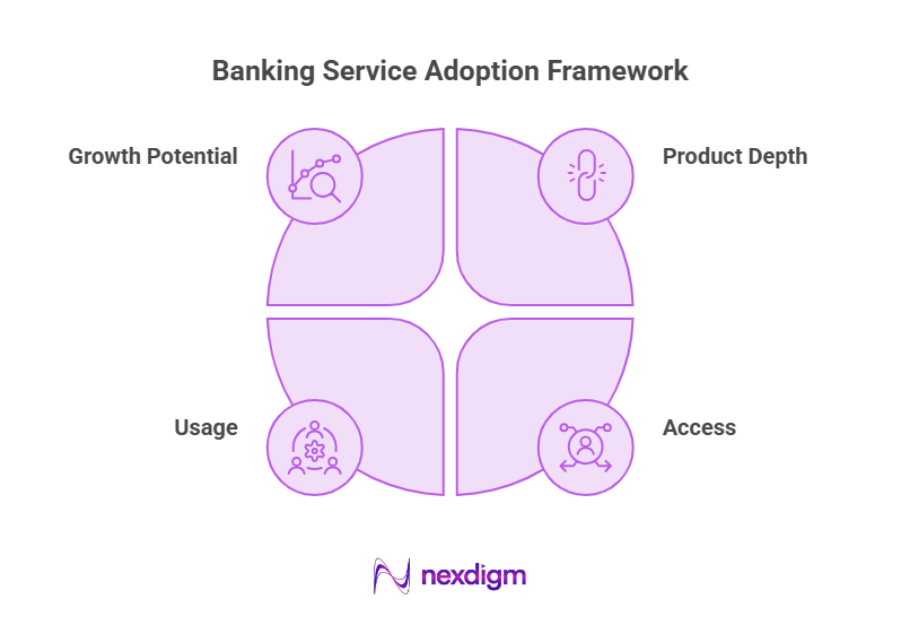
- Access: Nexdigm measures customer reach, product availability, eligibility criteria, onboarding effectiveness, and product ownership levels to evaluate how successfully banking services are being delivered to target customer segments.
- Usage: Nexdigm assesses transaction frequency, active account utilization, repeat customer behavior, channel preferences, and digital engagement levels to understand how regularly customers interact with banking products and services.
- Product Depth: Nexdigm evaluates the number, type, and combination of products used by each customer to measure relationship strength, customer dependency, and overall engagement across the banking portfolio.
- Growth Potential: Nexdigm identifies underutilized products, unmet customer needs, competitor-held relationships, and cross-selling opportunities to uncover areas where deeper engagement and additional value can be created.
These measures show where customers are active, where relationships remain shallow, and where stronger product adoption could create value.
Nexdigm’s Case
A retail bank used Nexdigm’s Banking service adoption analysis to identify underused products and customer cross-selling opportunities. Within 12 months, multi-product adoption increased 27%, digital service usage rose 33%, cross-selling conversions improved 21%, and inactive-customer reactivation increased 18%, strengthening customer engagement and relationship value.
To take the next step, simply visit our Request a Consultation page and share your requirements with us.
Harsh Mittal
+91-8422857704