

Banking institutions increasingly need evidence-based pricing strategies to balance customer expectations, competitive positioning, and profitability. Banking services pricing feasibility research helps assess willingness to pay, demand sensitivity, competitor benchmarks, and the commercial potential of proposed fees or service packages.
Through Pricing Analysis, banks can identify acceptable price ranges, evaluate customer segment responses, and test whether new offerings can achieve sustainable margins. This approach reduces uncertainty and enables institutions to align pricing models with market demand and long-term growth objectives across increasingly competitive financial markets.
Industry research indicates that data-led pricing initiatives can improve revenue realization by 5–10%, while targeted customer segmentation may lift conversion rates by 15–20%. Robust pricing analysis also helps reduce launch risk, strengthen product adoption, and improve profitability across banking services.
Banking Services Pricing Analysis for Demand Validation and Market Feasibility
Banking services pricing analysis evaluates customer demand, competitive positioning, and revenue potential, helping institutions design commercially viable offerings aligned with market expectations and profitability. Key characteristics of the same are:
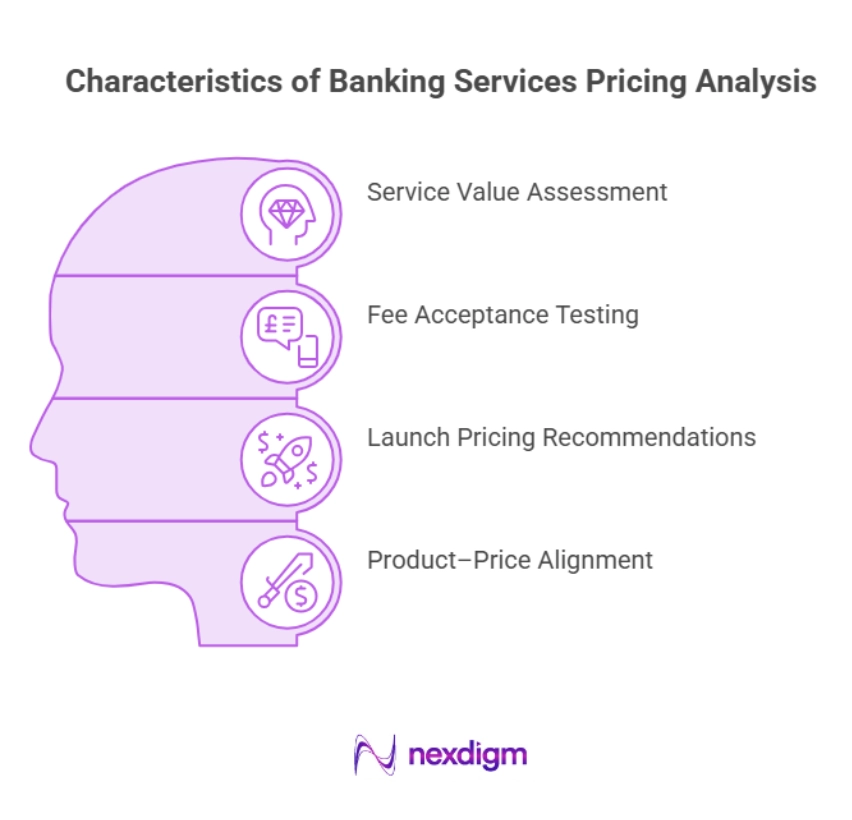
- Service Value Assessment: Examines how customers perceive service benefits relative to proposed charges. It mostly focuses on utility, convenience, trust, differentiation, perceived fairness, and payment of readiness.
- Fee Acceptance Testing: Tests customer reactions to alternative price points before market launch. Main focus areas rely on acceptable range, rejection threshold, adoption probability, price resistance, preferred structure.
- Launch Pricing Recommendations: Defines an actionable pricing approach for market introduction. Core elements include introductory pricing, bundles, tiers, discounts, review triggers, and implementation of roadmap.
- Product–Price Alignment: Ensures fees reflect service features, delivery costs, and customer expectations. This characteristic focuses on feature relevance, cost-to-serve, service quality, benefit hierarchy, and pricing logic.
Nexdigm’s Expertise in Building Viable Banking Pricing Strategies
Nexdigm supports banks in developing commercially viable pricing strategies through structured pricing analysis, competitor pricing benchmarking, customer willingness-to-pay research, and demand validation. Its advisory approach evaluates price elasticity, service value, operating costs, and revenue potential to design sustainable fee structures. These insights help banking institutions strengthen market positioning, improve profitability, reduce launch risk, and optimize customer-focused pricing decisions effectively.
Nexdigm’s Integrated Pricing Strategy Model for Banking Market Feasibility
Nexdigm’s integrated pricing strategy model helps banks evaluate demand, customer value, competitive positioning, and profitability before launching or restructuring services across target markets with confidence. Key strategies referred by Nexdigm’s experts are:
- Behavior-Based Pricing: Using transaction frequency, channel usage, account activity, and service preferences to develop differentiated pricing for distinct customer behaviors.
- Dynamic Pricing Strategy: Adjusting charges according to demand, transaction value, service complexity, risk exposure, and changing competitive conditions.
- Relationship-Based Pricing: Offering preferential fees to customers maintaining higher balances, multiple products, regular transactions, or long-standing banking relationships.
- Penetration Pricing Strategy: Introducing competitive initial fees to accelerate adoption, build market share, and gather customer-response data before gradual price revisions.
- Price Migration Strategy: Planning gradual movement from existing fees to revised prices while minimizing customer dissatisfaction, attrition, and revenue disruption.
Nexdigm’s Case
Nexdigm supported a leading bank in redesigning its service pricing through customer research, competitor benchmarking, and price-elasticity analysis. The revised pricing architecture increased product adoption by 24%, improved fee-based revenue by 11%, reduced customer attrition by 8%, and strengthened the commercial viability of newly introduced banking services.
To take the next step, simply visit our Request a Consultation page and share your requirements with us.
Harsh Mittal
+91-8422857704