

Banking technology is becoming a larger and more interconnected part of financial institutions’ operating models. Research from the Federal Reserve Bank of Kansas City shows that the share of bank spending devoted to IT and marketing more than doubled from 4% in 2004 to 19% in 2025, reflecting the growing importance of technology and data capabilities. AI adoption is also accelerating: 86% of financial-services firms surveyed in 2026 reported using AI, up from 75% in 2024, while 80% reported having AI agents deployed.
The ecosystem is expanding across digital platforms, data and AI, cloud infrastructure, cybersecurity, payments, and core systems. In India, UPI processed 2,365.8 crore transactions worth ₹29.88 lakh crore in July 2026, with 741 banks live on the platform, illustrating the scale at which digital financial infrastructure now operates.
This growing technology footprint is creating a broader and more specialized supplier universe. A structured banking technology vendor landscape can help institutions understand which providers lead specific categories, where specialist capabilities are emerging, and how different vendors fit into their technology and transformation priorities.
Banking Technology Is Becoming a Broader Ecosystem
Banks increasingly operate through interconnected technology layers rather than isolated systems. Digital channels, cloud infrastructure, core platforms, data environments, cybersecurity, payments, and AI can involve different providers, creating a vendor ecosystem that is both broader and more specialized. As technology priorities evolve, institutions need visibility into how these supplier categories connect and where different providers bring distinctive capabilities.
A Broader Vendor View Can Support Better Technology Decisions
The growing supplier universe makes it difficult to assess every provider using the same criteria. A category-based view can help institutions understand:
- Digital & Customer Technology: Examine providers supporting mobile banking, digital onboarding, personalization, engagement, and omnichannel customer journeys.
- Data, AI & Analytics: Assess vendors across data platforms, analytics, artificial intelligence, automation, decision-support, and emerging intelligent applications.
- Infrastructure & Core Technology: Evaluate providers across cloud, core banking, cybersecurity, payments, integration, and enterprise technology infrastructure.
Segmenting the banking technology vendor landscape in this way gives institutions a clearer view of the ecosystem and creates a stronger foundation for deeper vendor comparison and technology planning.
Assessing Vendor Relevance Changes With Nexdigm
Vendor leadership is not uniform across the banking technology ecosystem. A provider may be highly relevant for cloud transformation but less suited to digital experience, while a specialist AI or cybersecurity vendor may offer deeper capabilities. Nexdigm can assess such providers against:
- Specific Technology Priorities: Identify what the bank is currently trying to improve, for example, digital banking, cloud migration, AI, cybersecurity, payments, data modernization, or core-system transformation.
- Existing Architecture: Examine the bank’s current technology environment, including legacy systems, core platforms, APIs, data infrastructure, and integrations. A vendor needs to work effectively within this existing ecosystem.
- Operating Models: Consider how the bank organizes technology and operations, including internal capabilities, outsourcing arrangements, shared services, and the balance between centralized and decentralized functions.
Together, these factors help Nexdigm determine whether a vendor’s capabilities are genuinely relevant to the bank’s situation.
Nexdigm’s Assessment of the Banking Technology Vendor Landscape
Nexdigm can assess the banking technology ecosystem through multiple focus areas to understand both vendor strength and market relevance. The assessment examines:
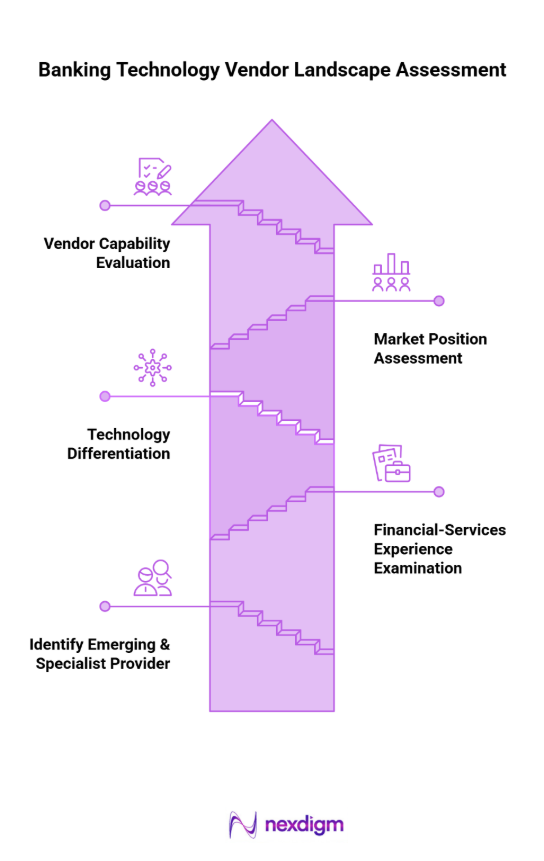
- Vendor Capability: Evaluate functional coverage, technology maturity, scalability, implementation capabilities, and depth of expertise across specific banking technology categories.
- Market Positioning: Assess vendor presence, category strength, specialization, competitive positioning, geographic reach, and relevance within financial-services markets.
- Technology Differentiation: Identify distinctive capabilities across digital platforms, data and AI, cloud, cybersecurity, payments, core banking, and enterprise technology.
- Financial-Services Experience: Examine banking use cases, relevant implementation experience, domain knowledge, and ability to address industry-specific technology requirements.
- Emerging & Specialist Providers: Identify newer or specialized vendors offering differentiated capabilities that may complement or compete with established technology providers.
Together, these focus areas help turn the banking technology vendor landscape into a more useful view of where vendors are strongest, where differentiation exists, and which providers may be relevant to specific transformation priorities.
Nexdigm’s Case
Nexdigm assessed 48 banking technology vendors across digital, data and AI, cloud, cybersecurity, payments, and core technology. 24% emerged as specialist providers, 16% demonstrated differentiated capabilities, and 10% represented emerging alternatives. The assessment helped the financial institution broaden its vendor universe, identify category-specific strengths, and prioritize providers for detailed evaluation.
To take the next step, simply visit our Request a Consultation page and share your requirements with us.
Harsh Mittal
+91-8422857704