

A battery electric vehicle launch strategy is critical for accelerating adoption in markets with rising EV penetration. As consumers shift toward cleaner mobility and governments strengthen electrification targets, companies need a structured approach to product positioning, pricing, distribution, charging access, after-sales support, and customer education. A strong market entry strategy helps manufacturers identify priority segments, localize offerings, build dealer or digital sales channels, and address adoption barriers such as range anxiety and ownership cost concerns.
By aligning the Battery electric vehicle launch strategy with market readiness and infrastructure growth, companies can improve acceptance, scale demand, and capture long-term EV market opportunities.
Global EV adoption is accelerating, creating a strong base for Battery electric vehicle launch strategy. Electric car sales exceeded 20 million units in 2025, growing by nearly 20% over the previous year and accounting for about 25% of total car sales. Sales are further projected to reach around 23 million units in 2026, representing nearly 28% of total car sales. These trends highlight the need for a market entry strategy aligned with rising EV penetration.
Prioritizing Customer Segments and Mapping Demand for Battery Electric Vehicle Adoption
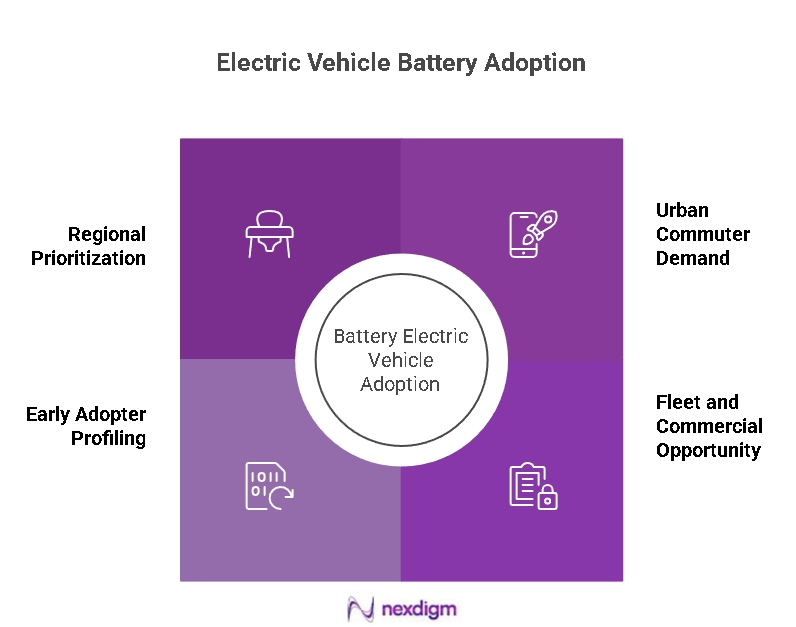
Prioritizing customer segments involves identifying high-potential buyers, such as urban commuters, fleet operators, businesses, and early adopters, while mapping demand patterns to support targeted battery electric vehicle launch planning:
-
Urban Commuter Demand Assessment
Evaluate daily travel patterns, charging access, income levels, and environmental awareness to identify strong BEV adoption potential among city commuters.
-
Fleet and Commercial Vehicle Opportunity Mapping
Assess logistics, taxi, delivery, and corporate fleet electrification needs to target high-utilization segments with stronger BEV business cases.
-
Early Adopter and Premium Buyer Profiling
Identify technology-focused, sustainability-driven, and premium customers likely to adopt BEVs earlier and influence wider market acceptance.
-
Regional Demand and City-Level Prioritization
Compare EV penetration, charging availability, traffic density, policy support, and income levels to prioritize cities for phased BEV launch.
Nexdigm After-Sales Service, Warranty, and Maintenance Readiness
Nexdigm After-Sales Service, Warranty, and Maintenance Readiness supports companies in preparing robust post-sale operations for battery electric vehicle launches. This includes assessing service network requirements, warranty structures, spare parts planning, technician readiness, customer support processes, and maintenance workflows. Nexdigm helps align after-sales capabilities with customer expectations, ensuring smoother ownership experience, stronger buyer confidence, and faster EV adoption.
Nexdigm Market Entry Risk Assessment and Mitigation Planning in Electric Vehicle Launch
Nexdigm Market Entry Risk Assessment and Mitigation Planning in Electric Vehicle Launch identifies regulatory, operational, competitive, supply chain, pricing, and adoption risks, while developing mitigation actions to support smoother EV launch execution.
-
Regulatory and Compliance Risk Assessment
Nexdigm assesses approval requirements, certification processes, EV policies, and compliance gaps that may delay or impact electric vehicle launch.
-
Competitive Positioning Risk Evaluation
Nexdigm reviews competitor pricing, product features, brand strength, and channel presence to identify risks affecting launch differentiation.
-
Supply Chain and Localization Risk Review
Nexdigm evaluates sourcing dependencies, import exposure, localization requirements, and vendor readiness to reduce launch and delivery risks.
-
Pricing and Profitability Risk Analysis
Nexdigm analyzes affordability, incentives, cost structures, and margin pressure to support commercially viable EV pricing decisions.
Nexdigm’s case:
Nexdigm assisted an electric vehicle manufacturer assess market entry risks before launching its BEV portfolio in a high-growth EV market. The company targeted 5 priority cities and planned to launch 3 vehicle models within 18 months. Nexdigm identified 25+ risks across regulatory approvals, pricing, supply chain, dealer readiness, charging access, and customer adoption. The mitigation roadmap helped reduce potential launch delays by 20% and improved launch preparedness across key operating functions.
To take the next step, simply visit our Request a Consultation page and share your requirements with us.
Harsh Mittal
+91-8422857704