

Battery electric vehicle pricing strategy is becoming a critical lever for automotive brands operating in a rapidly expanding market projected to reach heights. Effective pricing analysis enables manufacturers to evaluate BEV affordability, battery cost structures, competitor positioning, incentives, and total cost of ownership.
By leveraging battery electric vehicle pricing strategy frameworks, companies can optimize entry and premium EV pricing, improve adoption rates, and strengthen profitability. Structured pricing intelligence supports data-driven decisions in evolving electric mobility ecosystems.
Battery electric vehicle pricing strategies can improve adoption rates by 10–16%, enhance price realization, and reduce cost-to-value gaps across global markets. As battery efficiency improves and economies of scale expand, structured pricing analysis enables sustained growth in high-value electric mobility segments.
Battery Electric Vehicle Pricing Analysis for a Trillion-Dollar Market Opportunity
Battery Electric Vehicle Pricing Analysis enables automotive brands to optimize EV pricing strategies by evaluating battery costs, competitor benchmarks, incentives, and market demand. Its key elements and steps include:
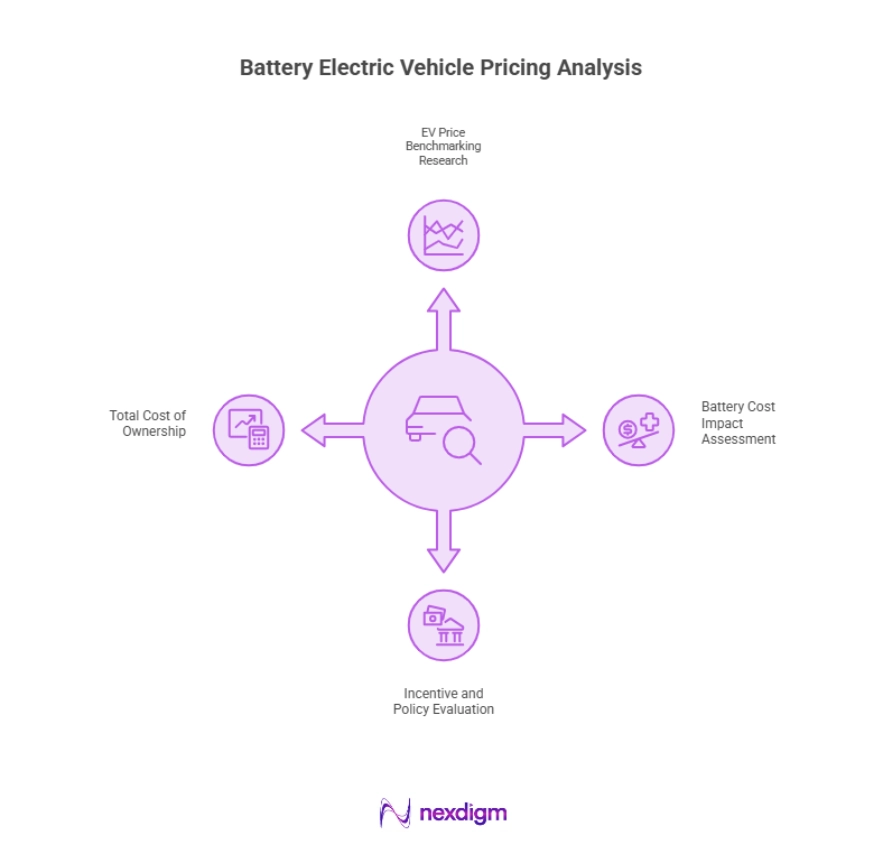
- EV Price Benchmarking Research: Comparing battery electric vehicle prices across competitors, segments, and regions to identify gaps and optimize positioning strategies.
- Battery Cost Impact Assessment: Evaluation of how battery pricing trends influence overall EV cost structures and consumer affordability perceptions.
- Incentive and Policy Evaluation: Analyzing subsidies, tax benefits, and regulatory frameworks shaping EV pricing and adoption rates.
- Total Cost of Ownership Analysis: Comparing long-term ownership costs including charging, maintenance, and resale value to strengthen EV value proposition.
Nexdigm’s Support in EV Price Benchmarking and Market Expansion
Nexdigm’s Advisory Role in EV Price Benchmarking and Market Expansion helps automotive companies refine electric vehicle pricing strategies through structured EV price benchmarking research, competitor analysis, and market intelligence. By evaluating battery cost structures, incentives, total cost of ownership, and regional demand patterns, Nexdigm enables data-driven EV pricing analysis that improves affordability positioning, strengthens market competitiveness, and supports accelerated electric vehicle adoption across expanding global mobility markets.
Nexdigm’s Integrated EV Pricing and Benchmarking Strategy Model
Nexdigm’s Integrated EV Strategy Model helps automotive brands align electric vehicle pricing decisions with competitor benchmarks, battery cost structures, and market demand dynamics. It focuses on the following areas:
- Variant-Level Pricing Structure: Defining pricing hierarchy across entry, mid, and premium EV models to ensure clear value segmentation.
- Lifecycle Pricing Optimization: Managing EV pricing across launch, growth, and maturity phases to maintain competitiveness and margin stability.
- Dealer Pricing and Margin Analysis: Evaluating dealer-level pricing structures, margin distribution, and discounting behavior to ensure pricing consistency across channels.
- Financing and Affordability Modelling: Assessing EMI structures, leasing options, and financing incentives to improve EV affordability and adoption.
- Customer Segmentation Pricing Strategy: Aligning pricing approaches with distinct buyer groups based on income levels, usage patterns, and value perception.
Nexdigm’s Case
Nexdigm assisted a global automotive manufacture to optimize pricing across multiple regions using EV price benchmarking research and cost analytics. The engagement delivered a 16% increase in EV sales, 11% improvement in pricing accuracy, 9% higher market penetration, and a 7% reduction in discount leakage, strengthening overall profitability within 12 months.
To take the next step, simply visit our Request a Consultation page and share your requirements with us.
Harsh Mittal
+91-8422857704