

Electric vehicle batteries are becoming larger, more connected, and more strategically important to vehicle performance. Global EV battery deployment reached 1.2 TWh in 2025, up almost 30% year-on-year and more than seven times the 2020 level. EVs accounted for more than 70% of total battery deployment, while global electric car sales exceeded 20 million, representing one in four new cars sold.
As battery architectures evolve toward higher voltage, faster charging, greater energy density, and software-defined vehicle platforms, the battery management system (BMS) has become a critical control layer. Suppliers must therefore deliver more than cell monitoring.
Accuracy, safety diagnostics, thermal control, balancing, communication, cybersecurity, functional safety, and integration capabilities increasingly influence supplier selection. Battery management system supplier analysis can help OEMs identify suppliers that combine technical capability with scalability and platform readiness.
Where BMS Suppliers Create Differentiation
Not all BMS suppliers offer the same value even when their core functions appear similar. Differences in sensing accuracy, software intelligence, safety systems, integration flexibility, development support, and scalability can materially influence battery and vehicle performance. For OEMs, identifying these differences can reveal which suppliers are best suited to specific battery architectures, platform strategies, and future technology requirements.
The Questions Behind a BMS Supplier Decision
Selecting a BMS supplier requires OEMs to look beyond product specifications and consider the broader implications for their battery and vehicle platforms. Key questions include whether a supplier can scale with planned volumes, adapt to evolving battery technologies, meet safety expectations, integrate with vehicle systems, and provide long-term software and engineering support. These considerations can help separate capable suppliers from those best positioned for future programs.
Nexdigm’s BMS Supplier Intelligence Services in Action
Nexdigm can translate fragmented suppliers and market information into practical insights for OEM decision-makers. Our battery management system supplier analysis can help OEMs assess:
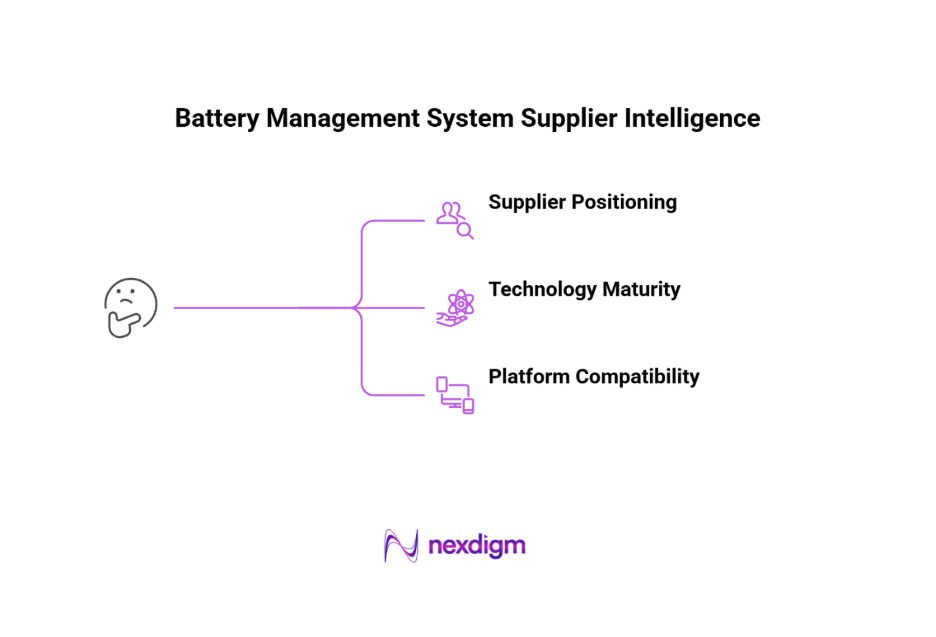
- Supplier Positioning: Map suppliers against relevant peers to understand their relative strengths, market presence, and areas of differentiation.
- Technology Maturity: Track BMS architectures, software capabilities, safety technologies, R&D investments, and emerging solutions shaping supplier competitiveness.
- Platform Compatibility: Assess how effectively supplier solutions can integrate with different battery architectures, vehicle systems, software environments, and future platforms.
Together, these insights can give OEMs a clearer understanding of where each supplier stands today and how well positioned it may be for tomorrow’s EV battery requirements.
Why BMS Supplier Analysis Matters
As BMS technologies and supplier capabilities evolve, OEMs need timely intelligence to distinguish meaningful differences across providers. A structured view of technology, safety, integration, scale, and strategic direction can reduce uncertainty in supplier decisions. Nexdigm’s battery management system supplier analysis can help OEMs identify relevant opportunities, anticipate potential risks, and align supplier choices with current battery requirements while maintaining flexibility for future EV platform development.
Nexdigm’s BMS Supplier Analysis Approach
Nexdigm can structure the supplier analysis through a step-by-step assessment designed to build a consistent and comparable view of the BMS landscape:
- Market Mapping: Identify relevant BMS suppliers, market participants, technology trends, geographic presence, and competitive dynamics.
- Supplier Profiling: Develop detailed profiles covering capabilities, product offerings, customers, manufacturing footprint, investments, and technology focus.
- Capability Benchmarking: Compare suppliers across BMS architecture, software, safety, diagnostics, integration, scalability, and technology maturity.
- Commercial Assessment: Evaluate cost positioning, business scale, partnerships, customer concentration, and other relevant commercial indicators.
- Opportunity and Risk Mapping: Consolidate findings to identify supplier strengths, capability gaps, potential risks, and areas requiring deeper evaluation.
This structured process enables Nexdigm to convert diverse supplier information into a consistent analytical view that can support informed BMS sourcing and strategic decisions.
Strategic Impact of Nexdigm’s BMS Supplier Analysis
Nexdigm’s structured analysis can translate supplier-level findings into broader strategic value for OEMs. The approach can help:
- Improve Supplier Selection: Align supplier capabilities with battery architecture, vehicle requirements, and future platform priorities.
- Strengthen Sourcing Decisions: Support allocation, negotiations, localization, and supplier development using evidence-based insights.
- Anticipate Future Needs: Identify suppliers with the technology, capacity, and investment direction to support evolving BMS requirements.
- Reduce Sourcing Risk: Surface capability, scalability, technology, and supply-chain concerns before they affect program execution.
By connecting detailed supplier analysis with strategic priorities, Nexdigm can help OEMs make BMS sourcing decisions with greater clarity and confidence.
Nexdigm’s Case
An EV OEM evaluating five BMS suppliers used Nexdigm’s analytical framework to assess technology, safety, integration, manufacturing, and commercial capabilities. The assessment identified 9 critical capability gaps, improved supplier comparison coverage by 35%, reduced the evaluation cycle by 25%, and shortlisted 3 suppliers for detailed technical and commercial evaluation.
To take the next step, simply visit our Request a Consultation page and share your requirements with us.
Harsh Mittal
+91-8422857704