

As electric mobility, energy storage systems, and advanced battery applications continue to expand globally, attention is rapidly shifting from individual battery cells to the battery pack itself. While cell chemistry often dominates industry discussions, the real opportunity for differentiation, performance enhancement, and profitability increasingly exists at the pack level. From thermal management and battery management systems (BMS) to sophisticated pack architecture and system integration, stakeholders are discovering multiple layers of value creation beyond the cell.
For organizations evaluating the Battery pack market opportunity analysis, understanding where value is generated within the battery pack ecosystem has become critical for strategic decision-making, investment planning, and competitive positioning.
The Shift from Cell-Centric to Pack-Centric Value Creation
Historically, battery manufacturers focused primarily on improving cell energy density, charging speed, and cycle life. However, as battery technologies mature and cell performance begins to converge, manufacturers are turning their attention to battery pack engineering as a major source of innovation. Today battery pack represents far more than a collection of cells. It is a highly engineered system that combines:
- Cell integration
- Thermal management
- Battery management systems (BMS)
- Safety mechanisms
- Structural design
- Electrical architecture
- Software intelligence
These elements collectively determine the battery’s real-world performance, reliability, safety, and total cost of ownership. From a Battery pack market opportunity analysis perspective, companies that excel in pack-level innovation can unlock substantial competitive advantages even when utilizing commercially available battery cells.
Where Is Battery Pack Value Being Created?
The value within battery packs is increasingly being generated through four primary domains:
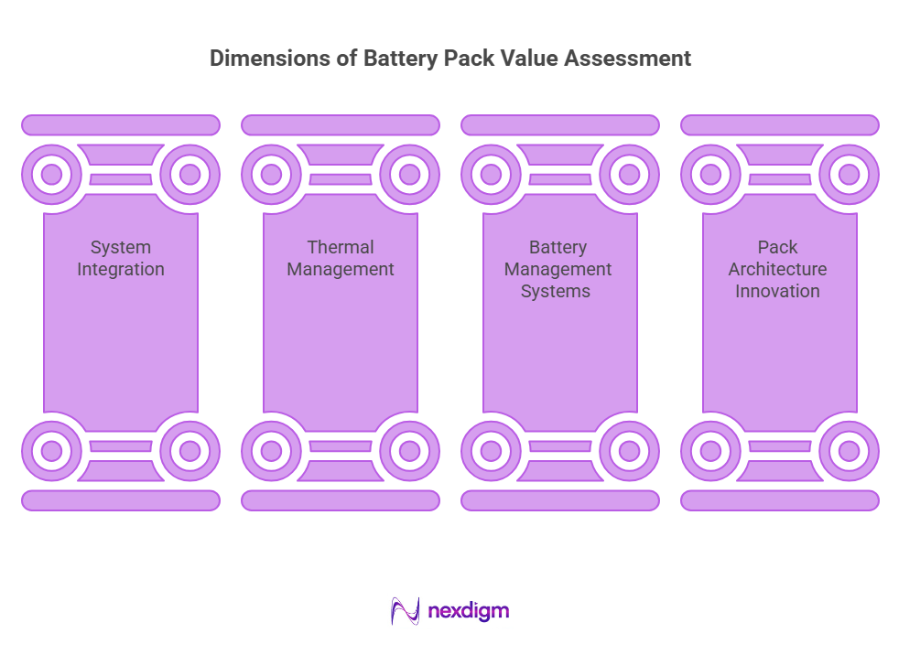
System Integration
System integration involves efficiently combining cells, electronics, cooling systems, and mechanical structures into a unified architecture. Value is created through:
- Reduced manufacturing complexity
- Improved energy density at pack level
- Lower component count
- Enhanced safety performance
- Faster production scalability
Modern battery pack manufacturers are focusing on cell-to-pack (CTP) and cell-to-chassis (CTC) designs that eliminate redundant modules and maximize energy utilization. The ability to integrate multiple technologies into a streamlined system is becoming one of the most significant profit drivers in the battery value chain.
Thermal Management
Battery performance is highly dependent on temperature control. Poor thermal management can lead to:
- Reduced battery lifespan
- Capacity degradation
- Safety incidents
- Charging inefficiencies
Advanced thermal solutions create value through:
- Liquid cooling systems
- Phase-change materials
- Intelligent thermal monitoring
- Adaptive cooling algorithms
As EV batteries become larger and energy-dense, thermal management evolves from a supporting function into a major value-generating technology segment.
Battery Management Systems (BMS)
The BMS serves as the battery pack’s intelligence layer. Functions include:
- State-of-charge monitoring
- State-of-health estimation
- Cell balancing
- Safety diagnostics
- Predictive analytics
Sophisticated BMS platforms allow operators to optimize charging behavior, improve battery longevity, and minimize operational risks.
Increasingly, software-driven BMS solutions are becoming a significant differentiator in the battery ecosystem. Organizations investing in advanced analytics and AI-enhanced battery monitoring are positioned to capture additional value throughout the battery lifecycle.
Pack Architecture Innovation
Pack architecture influences both performance and manufacturing economics. Innovation areas include:
- Modular pack designs
- Cell-to-pack architectures
- Structural battery concepts
- Lightweight materials
- Flexible pack configurations
For companies conducting a Battery pack market opportunity analysis, architectural innovation often represents one of the most attractive long-term value creation avenues.
The Value Pyramid for Battery Pack Market
Instead of viewing the battery pack as a simple assembly, organizations should consider a value pyramid.
- Foundation Layer: Cells Provides energy storage capability.
- Optimization Layer: Thermal & Mechanical Design: Ensures safety, durability, and performance.
- Intelligence Layer: BMS & Software: Enhances operational efficiency and lifecycle management.
- Strategic Layer: Integrated Pack Architecture: Creates differentiation, scalability, and market competitiveness.
The highest margins are increasingly moving toward the upper layers of this pyramid, particularly software-enabled battery management and advanced pack engineering.
Nexdigm in Shaping Future for Battery Pack Market
At Nexdigm, market participants are increasingly seeking deeper insights into how value migrates across the battery supply chain. While cell manufacturing continues to attract substantial investments, the next wave of growth is emerging in battery pack engineering capabilities. Organizations entering the battery ecosystem should evaluate opportunities across several dimensions:
Technology Differentiation
Rather than competing solely on cell chemistry, businesses can establish competitive positioning through:
- Advanced thermal technologies
- Smart BMS platforms
- Pack design optimization
- Integrated energy management systems
This approach often requires lower capital intensity than large-scale cell manufacturing while enabling meaningful value creation.
Supply Chain Localization
Nexdigm observes rising interest in localized battery pack production strategies. Localized pack assembly offers:
- Reduced logistics costs
- Greater customization flexibility
- Regulatory advantages
- Faster market responsiveness
As regional governments promote domestic battery ecosystems, localized pack manufacturing is expected to become an increasingly important strategic lever.
Lifecycle Monetization
Battery packs generate value throughout their operational lifecycle. Key opportunities include:
- Performance monitoring services
- Predictive maintenance solutions
- Battery health analytics
- Second-life battery deployment
- Recycling and material recovery
Nexdigm’s market intelligence approach emphasizes evaluating these lifecycle value streams when conducting a comprehensive Battery pack market opportunity analysis.
Nexdigm’s Case
Nexdigm supported an automotive player in assessing battery-pack value as India’s market reached $53.8 million in 2026, growing 36.5% CAGR. The study mapped BMS, thermal management, and cell-to-pack architectures, identifying scalable opportunities.
To take the next step, simply visit our Request a Consultation page and share your requirements with us.
Harsh Mittal
+91-8422857704