

Battery pack pricing intelligence is critical as battery costs continue to influence electric vehicle competitiveness, affordability, and profitability. Since battery packs form one of the largest cost components in EV production, manufacturers must closely evaluate cell chemistry, supplier pricing, raw material trends, pack design, and sourcing models. Through pricing analysis, companies can identify cost drivers, benchmark supplier quotations, and optimize procurement decisions.
A structured battery pack pricing intelligence approach helps automakers manage cost volatility, improve price transparency, and strengthen negotiations. As EV competition increases, effective battery cost insights support better pricing strategies, margin protection, and long-term market competitiveness.
Battery pack prices continue to define EV competitiveness, with global average lithium-ion pack prices falling to about $108/kWh in 2025, down 8% from 2024. LFP battery packs were over 40% cheaper than NMC alternatives on average in 2025, improving affordability for cost-sensitive EV segments.
Tracking Battery Cost Trends for EV Pricing Decisions
Tracking battery cost trends through pricing analysis helps manufacturers monitor market changes, forecast procurement expenses, optimize pricing strategies, strengthen sourcing decisions, and improve EV profitability and competitiveness:
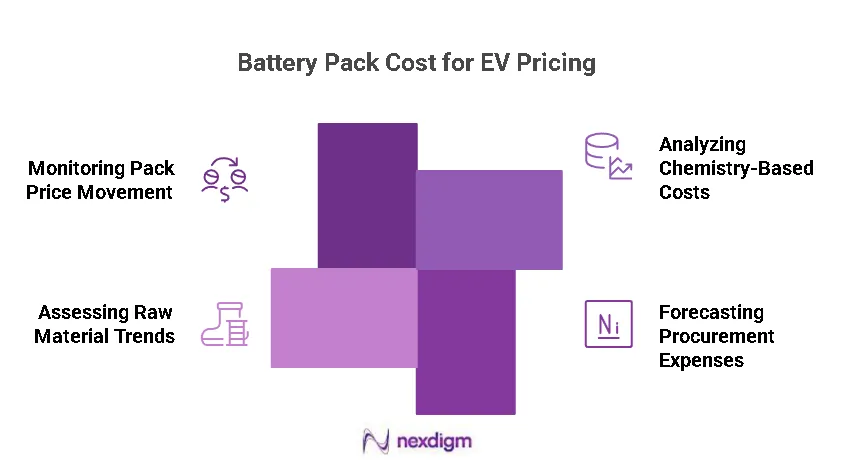
- Monitoring Pack Price Movement: Tracks battery pack price changes to support accurate EV pricing, sourcing, and profitability decisions.
- Analyzing Chemistry-Based Costs: Compares LFP, NMC, and other chemistries to understand cost differences across EV platforms.
- Assessing Raw Material Trends: Reviews lithium, nickel, cobalt, and graphite price shifts affecting battery costs.
- Forecasting Procurement Expenses: Uses pricing trends to estimate future battery sourcing costs and budget requirements.
Nexdigm LFP vs NMC Battery Pack Cost Comparison
Nexdigm LFP vs NMC Battery Pack Cost Comparison uses pricing analysis to compare battery chemistry costs, supplier pricing, raw material exposure, performance trade-offs, and platform suitability. The assessment helps EV manufacturers identify cost-saving opportunities, improve sourcing decisions, strengthen supplier negotiations, and protect margins across different vehicle segments.
How Can Nexdigm Forecast Battery Pack Costs for EV Profitability?
Nexdigm can forecast battery pack costs using pricing analysis, raw material trends, supplier benchmarks, chemistry comparisons, and demand projections to support EV pricing, sourcing decisions, and profitability planning.
- Raw Material Trend Analysis: Tracks lithium, nickel, cobalt, and graphite prices to forecast battery pack cost movements.
- Supplier Benchmarking: Compares supplier quotations to identify cost gaps, negotiation scope, and sourcing risks.
- Chemistry Cost Comparison: Reviews LFP, NMC, and other chemistries to estimate future battery pack pricing.
- Demand Projection Review: Analyzes EV demand trends to assess battery procurement volumes and cost impact.
Nexdigm’s case:
Nexdigm helped an EV manufacturer forecast battery pack costs across 3 platforms and 10 suppliers. Through pricing analysis, Nexdigm assessed raw material trends, chemistry shifts, and supplier benchmarks, identifying 8% potential cost volatility over 12 months. The company improved battery cost forecasting accuracy by 25%, reduced procurement risk by 15%, and protected nearly 3% of EV margin through better sourcing and pricing decisions.
To take the next step, simply visit our Request a Consultation page and share your requirements with us.
Harsh Mittal
+91-8422857704