

Battery supplier expansion is gaining momentum as global EV production continues to rise and automakers require reliable access to cells, battery packs, raw materials, and localized supply networks. As electric vehicle demand grows, battery suppliers are moving closer to OEM manufacturing hubs to reduce logistics risks, improve cost efficiency, and meet regional sourcing expectations.
A clear market entry strategy helps companies assess EV production demand, supplier ecosystems, policy incentives, mineral access, manufacturing capacity, and partnership opportunities. A strong battery supplier market entry strategy supports scalable production, supply chain resilience, OEM alignment, and long-term competitiveness in fast-growing electrification markets.
Battery supplier expansion is supported by strong EV production and battery demand growth. Electric car sales exceeded 20 million units in 2025, rising 20% from 2024 and reaching 25% of global car sales. EV battery deployment reached 1.2 TWh in 2025, nearly 30% higher than 2024 and over seven times 2020 levels. The EV battery market is also projected to grow from USD 61.31 billion in 2024 to USD 198.86 billion by 2030.
Understanding Where Battery Suppliers Should Enter as EV Production Scales Globally
This heading focuses on identifying regions where EV production, OEM demand, battery incentives, mineral access, infrastructure, and supplier gaps create strong opportunities for battery suppliers to enter and expand:
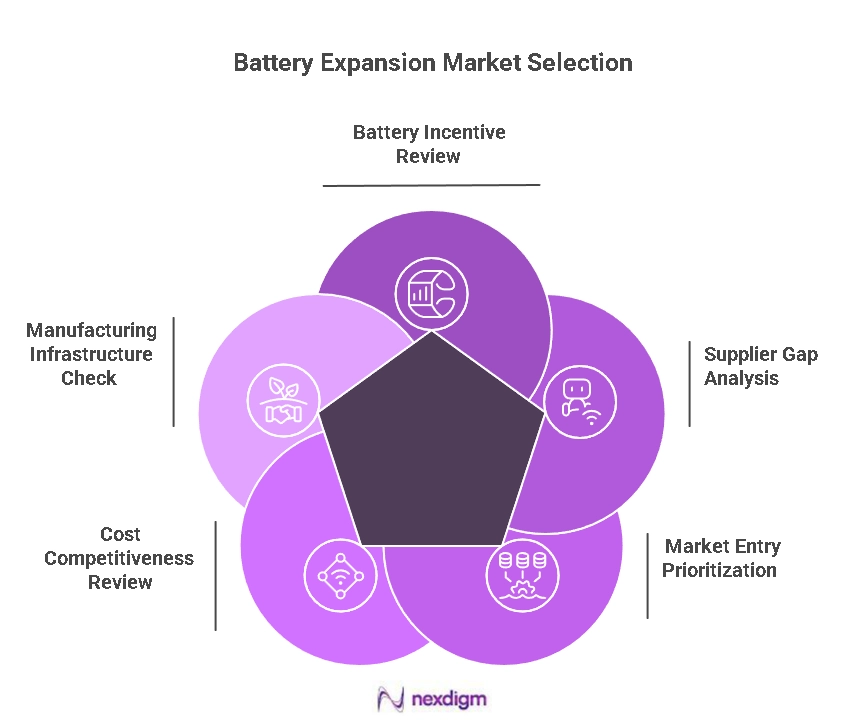
- Battery Incentive Review – Evaluate subsidies, tax benefits, production-linked incentives, and government support for battery manufacturing and supply chain localization.
- Manufacturing Infrastructure Check – Assess gigafactory presence, industrial parks, logistics access, utilities, skilled labor, and testing facilities for battery production.
- Supplier Gap Analysis – Identify markets where battery demand exceeds local supplier capacity, creating entry opportunities for new battery suppliers.
- Cost Competitiveness Review – Compare labor, energy, logistics, duties, incentives, and operating costs across potential battery supplier entry markets.
- Market Entry Prioritization – Rank regions based on EV demand, OEM proximity, incentives, raw material access, supplier gaps, and long-term scalability.
Nexdigm’s Go-to-Market Planning Support for Battery Supplier Expansion
Nexdigm’s Go-to-Market Planning Support for Battery Supplier Expansion helps battery suppliers plan market entry across high-growth EV regions. Nexdigm can assess target customers, OEM demand, partner opportunities, pricing models, localization needs, supply chain risks, and competitive positioning. This support enables suppliers to prioritize markets, build launch plans, engage stakeholders, and scale battery supply operations effectively.
Nexdigm’s OEM Battery Requirement Mapping Across Target Automotive Markets
Nexdigm’s OEM battery requirement mapping helps suppliers assess automaker demand for cells, modules, packs, battery chemistry, performance standards, localization needs, sourcing timelines, and qualification requirements across target markets.
- Cell, Module, and Pack Needs – Nexdigm maps whether OEMs require individual cells, battery modules, integrated packs, or complete battery systems.
- Performance Standard Mapping – Nexdigm reviews OEM expectations for range, charging speed, durability, safety, thermal performance, and lifecycle efficiency.
- Localization Requirement Analysis – Nexdigm identifies local sourcing rules, regional content targets, assembly expectations, and supplier location preferences.
- Supplier Qualification Criteria – Nexdigm assesses OEM approval requirements, certifications, testing standards, production capacity, and quality benchmarks for battery suppliers.
- Sourcing Timeline Tracking – Nexdigm tracks OEM procurement schedules, model launch timelines, contract cycles, and battery supply planning windows.
Nexdigm’s case:
Nexdigm helped a battery supplier evaluate OEM battery requirements across target automotive markets before expanding its EV battery supply operations. Nexdigm reviewed 30+ OEM electrification programs, mapped demand for LFP and NMC chemistries, and assessed cell, module, and pack requirements across passenger cars, two-wheelers, and light commercial vehicles. The study helped the company shortlist 18 potential OEM customers, identify two priority markets, and estimate an annual supply opportunity.
To take the next step, simply visit our Request a Consultation page and share your requirements with us.
Harsh Mittal
+91-8422857704