

Evaluating safety standards across warehouses handling high operational risk is a key competitive intelligence exercise for understanding how companies manage workplace safety, compliance, and operational resilience. Through benchmarking warehouse safety standards, businesses can compare safety protocols, incident prevention practices, equipment handling procedures, emergency response systems, training programs, and regulatory adherence against industry peers.
This helps identify gaps in safety maturity, assess competitor best practices, and prioritize improvements in high-risk environments such as hazardous goods storage, heavy material movement, cold chains, and automated warehouses. Strong safety benchmarking supports risk reduction, productivity, employee protection, and long-term competitive advantage.
In 2025, U.S. warehousing and storage recorded 4.8 injury and illness cases per 100 full-time workers, with 4.1 cases involving days away, job restriction, or transfer. The sector also reported 32 fatalities, highlighting the risk intensity of warehouse operations. Broader workplace data shows 2.5 million employer-reported injury and illness cases in 2025, reinforcing the need for benchmarking warehouse safety standards to improve compliance, risk controls, and competitive performance.
Benchmarking Safety Practices Across High-Risk Warehouse Operations
Benchmarking safety practices across high-risk warehouse operations compares safety protocols, training, equipment handling, incident prevention, and emergency response practices against peers to identify gaps, reduce risks, and improve operational resilience:
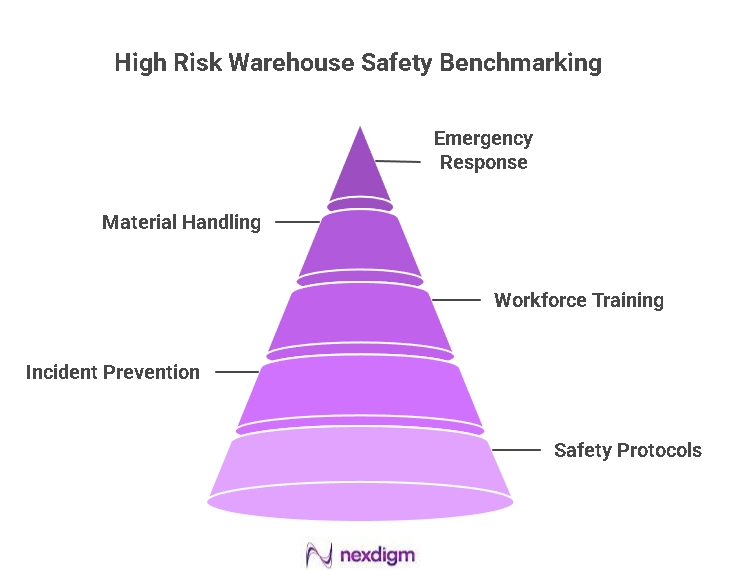
-
Safety Protocol Benchmarking
Compares warehouse safety rules, SOPs, access controls, hazard reporting, and compliance practices across high-risk operations.
-
Incident Prevention Measures
Reviews how warehouses prevent accidents through risk assessments, inspections, signage, audits, and preventive maintenance.
-
Workforce Safety Training
Evaluates employee training on equipment handling, hazardous materials, emergency procedures, and safe warehouse practices.
-
Material Handling Safety
Assesses safety practices for forklifts, conveyors, pallet movement, loading docks, and heavy material handling.
-
Emergency Response Readiness
Benchmarks fire safety, evacuation plans, first-aid systems, spill response, and crisis management procedures.
Nexdigm’s Competitive Intelligence-Led Warehouse Safety Benchmarking
Nexdigm’s Competitive Intelligence-Led Warehouse Safety Benchmarking helps companies compare their warehouse safety standards with industry peers and competitors. It evaluates safety protocols, incident prevention practices, workforce training, material handling controls, emergency response systems, and compliance readiness. The insights help identify safety gaps, adopt best practices, reduce operational risks, and strengthen overall warehouse performance.
Nexdigm’s Evaluation of Incident Prevention and Risk Mitigation Practices
Nexdigm’s Evaluation of Incident Prevention and Risk Mitigation Practices assess how warehouses prevent accidents, manage hazards, follow safety controls, and reduce operational risks through audits, training, compliance checks, and process improvements.
-
Preventing Incident Controls
Reviews safety controls used to prevent accidents, near misses, equipment failures, spills, and workplace injuries.
-
Risk Mitigation Process Assessment
Evaluates procedures for reducing high-risk exposures through SOPs, inspections, audits, and preventive maintenance.
-
Safety Training Evaluation
Examines employee training on hazard awareness, emergency response, equipment handling, and safe operating practices.
-
Compliance and Audit Readiness
Assesses whether warehouse safety practices align with regulatory standards, documentation needs, and inspection requirements.
-
Emergency Preparedness Review
Reviews fire safety, evacuation plans, first-aid response, spill control, and crisis management readiness.
Nexdigm’s case:
Nexdigm assisted a French logistics company strengthen operational controls across 90+ warehouses, 30+ locations, and 4.5+ million sq. ft. of warehousing space. Through process review, transaction checks, SOP redesign, and control-gap identification, Nexdigm reviewed one lakh transactions and identified revenue leakage of around INR 43–45 lakh, supporting stronger risk mitigation, process discipline, and operational governance.
To take the next step, simply visit our Request a Consultation page and share your requirements with us.
Harsh Mittal
+91-8422857704