

Entering a new beverage market is about more than launching an innovative product or building a compelling brand story. Success often depends on a crucial strategic decision that determines how efficiently products reach consumers: choosing the right distribution model.
For beverage companies expanding into new regions, markets, or customer segments, the choice typically comes down to three primary routes: distributor-led networks, direct distribution, or digital channels. Each model offers distinct advantages, challenges, and growth implications.
Organizations like Nexdigm, help businesses focus heavily on product development while underestimating distribution strategy. Through specialized beverage distribution entry strategy services, we help organizations design market-entry models that balance reach, profitability, operational efficiency, and long-term scalability.
Distribution Strategy: The Foundation of Beverage Market Entry
A strong product can fail if customers cannot access it conveniently. Conversely, even emerging beverage brands can gain market share quickly when supported by an effective route-to-market model. The right distribution approach influences:
- Market penetration speed
- Customer acquisition costs
- Brand visibility
- Retail availability
- Profit margins
- Long-term growth potential
At Nexdigm, we view distribution not as a logistics decision but as a strategic growth lever that directly impacts market success.
Distributor, Direct, or Digital Channel
Before entering a new market, beverage companies must answer a fundamental question: Which distribution model provides the strongest balance between reach, control, profitability, and scalability? The answer varies by market conditions, product category, customer profile, and business objectives. Through our beverage distribution entry strategy services, Nexdigm helps companies evaluate all three models through a structured and data-driven framework.
Distributor-Led Market Entry
For many beverage companies, partnering with distributors is often the fastest route into a new market. Established distributors provide:
- Existing retailer relationships
- Local market knowledge
- Sales infrastructure
- Warehousing capabilities
- Geographic reach
Instead of building operations from scratch, brands can leverage existing networks to accelerate market access. Several key advantages include:
- Rapid Expansion: Distributors can quickly place products across multiple retail channels.
- Reduced Initial Investment: Companies avoid building extensive sales and logistics infrastructure.
- Local Expertise: Distributors understand retailer requirements, regulatory expectations, and market dynamics.
The Nexdigm Perspective
Through beverage distribution entry strategy services, Nexdigm assesses whether distributor partnerships align with a company’s growth ambitions, category positioning, and operating model. The deep industry expertise help clients evaluate:
- Distributor capabilities
- Geographic coverage
- Financial stability
- Portfolio compatibility
- Performance expectations
Direct Distribution
Some beverage brands prefer to retain complete control over sales and customer relationships through direct distribution. Under this model, the company manages:
- Sales teams
- Warehousing
- Logistics
- Retail relationships
- Customer engagement
Rather than relying on intermediaries, businesses build and manage their own route-to-market infrastructure. Some core benefits of choosing direct channel include:
- Greater Market Control
- Stronger Customer Relationships
- Better Data Ownership
How Nexdigm Evaluates Direct Entry
Nexdigm helps businesses determine whether direct distribution is commercially viable by examining:
- Market size
- Investment requirements
- Revenue potential
- Operational capabilities
- Scalability projections
Digital-First Distribution
Digital commerce has become a powerful market-entry channel for beverage brands. Many companies now use online platforms to test demand, build awareness, and gather consumer insights before expanding into traditional retail. The rise of digital channels include:
- E-commerce platforms
- Quick-commerce providers
- Direct-to-consumer websites
- Subscription models
- Marketplace partnerships
Advantages of Digital Entry
- Faster Consumer Access: Products can reach consumers without extensive physical retail infrastructure.
- Lower Entry Barriers: Digital models often require less upfront investment compared to nationwide retail expansion.
- Consumer Insights: Online sales provide valuable data regarding behavior, preferences, and purchasing patterns.
- Agile Market Testing: Brands can validate demand before investing heavily in distribution networks.
Nexdigm’s Digital Channel Assessment
As part of beverage distribution entry strategy services, Nexdigm evaluates the following key areas:
- Digital channel economics
- Consumer buying behavior
- Customer acquisition costs
- Platform opportunities
- Omnichannel scalability
This helps businesses determine whether digital should be a primary channel, supporting channel, or market-entry testing platform.
Selecting Right Distribution Model for Your Beverage Brand
The answer depends upon the channel chosen as each one has their respective pros and cons. Choosing a distributor led entry can be helpful when:
- Speed-to-market is critical
- Local market knowledge is limited
- Investment budgets are constrained
- Broad geographic coverage is required
While a business can choose Direct Entry Channel when:
- Brand control is a priority
- Customer relationships are critical
- Long-term margins outweigh short-term investment concerns
- Operational capabilities are well established
On the other hand, Digital Channel can be preferred when:
- Demand validation is required
- Consumer insights are a priority
- The target audience is digitally active
- Market entry risks need to be minimized
The Nexdigm Answer
In many cases, the most successful strategy is not choosing one model exclusively but combining multiple channels strategically. For example:
- Digital for market validation
- Distributors for rapid scale
- Direct relationships with key retail accounts
Nexdigm frequently helps clients create hybrid models that maximize strengths while reducing channel-specific limitations.
Nexdigm’s Strategic Approach to Beverage Market Entry
Successful distribution strategies require market knowledge, commercial expertise, and operational insight. Nexdigm supports beverage companies through:
- Market-entry strategy development
- Route-to-market assessments
- Distribution network evaluation
- Digital commerce strategy
- Commercial feasibility studies
- Channel profitability analysis
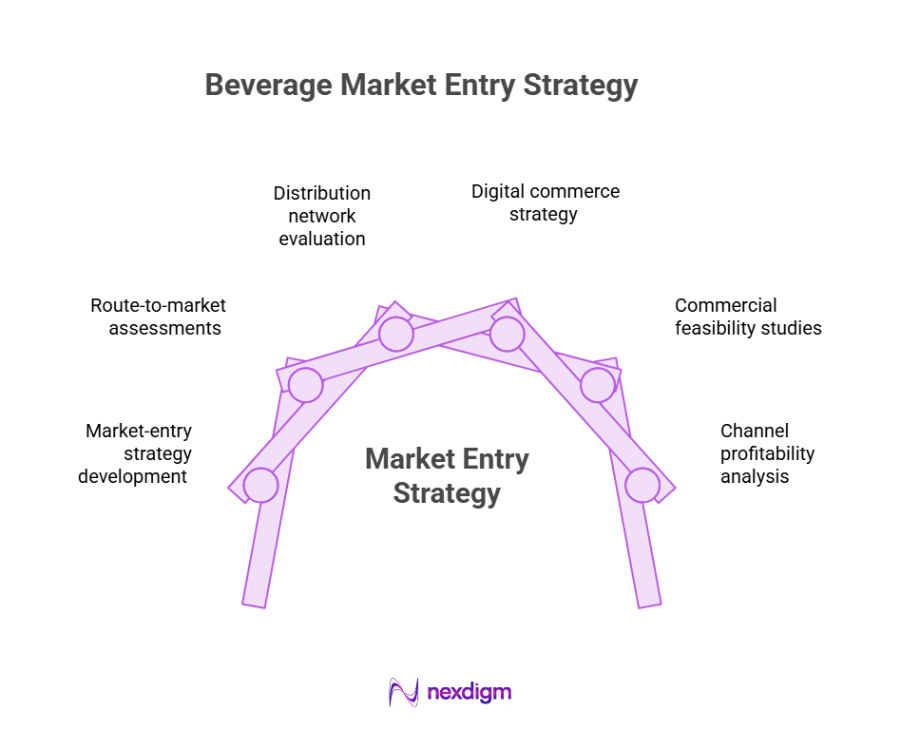
This multidisciplinary approach helps companies align distribution decisions with broader business objectives.
Nexdigm’s Case
Nexdigm got an opportunity to support a beverage industry client in selecting the right distribution model across distributors, direct sales, and digital channels. Real-time analysis improved channel profitability by 31%, increased reach potential by 27%, reduced distribution costs by 22%, and accelerated market entry.
Nexdigm’s beverage distribution assessment approach enabled the client to optimize channel mix, expand market reach, and build a scalable route-to-market strategy for sustainable growth.
To take the next step, simply visit our Request a Consultation page and share your requirements with us.
Harsh Mittal
+91-8422857704