

The beverage market is becoming more fragmented around occasions and consumer needs. Traditional categories continue to compete on familiarity and affordability, while newer propositions are being built around energy, hydration, gut health, nutrition, performance, and premium experiences.
For beverage companies, this creates a different growth problem from simply finding a large category. The opportunity may exist within a particular consumer segment, consumption occasion, format, or channel.
India’s functional beverages market was valued at US6.9billion in 2025 and is projected to reach US18.8 billion by 2034, according to IMARC. Energy drinks currently lead the segment, while health-oriented and functional propositions are expanding the addressable market.
Beverage Growth Is Splitting Around Need States
Beverage demand can increasingly be understood through the reason consumers are drinking the product.
Energy and performance products target consumers looking for alertness, exercise support, or sustained energy.
- Functional products appeal to consumers seeking specific health attributes.
- Traditional soft drinks and juices continue to serve refreshment and indulgence occasions, while premium beverages compete through ingredients, provenance, taste, and experience.
These categories can contain very different growth trajectories.
A beverage company therefore needs to identify which consumer need is expanding, how frequently it occurs, and whether existing products adequately address it.
Consumer research should examine consumption frequency, purchase occasions, switching behavior, purchase triggers, brand perceptions, and willingness to pay. This helps distinguish a broad consumer trend from a commercially viable demand pool.
Channel Availability Can Create or Close a Market
Beverages are particularly sensitive to availability because many purchases are immediate or habitual.
- Supermarkets and hypermarkets provide scale, convenience stores can capture impulse occasions, while e-commerce allows brands to reach more specific consumer communities.
- Quick commerce can become relevant where immediate consumption is an important part of the proposition.
The commercial opportunity therefore depends partly on whether the intended consumer can access the product through the right channel at the right price.
Channel analysis should consider distribution reach, margins, cold-chain requirements, pack economics, promotional intensity, replenishment frequency, and the consumer profile associated with each channel.
The Beverage Opportunity Framework
Nexdigm’s beverage growth opportunity market assessment can translate these market signals into a structured opportunity assessment built around four stages.
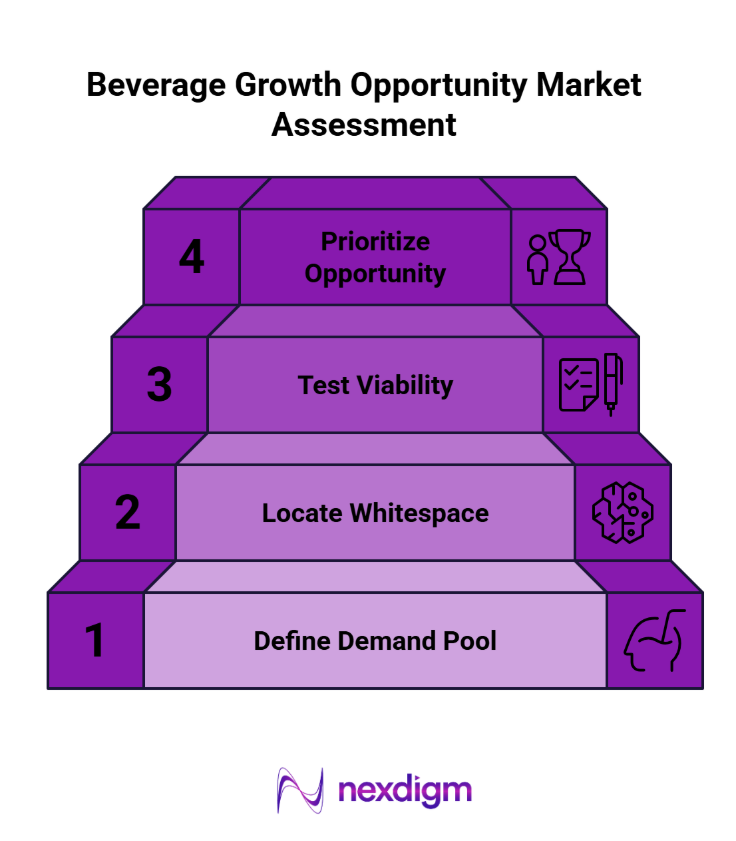
- Define the demand pool
Start by identifying the consumer need rather than the product category.
Assess who is consuming the product, what occasion drives consumption, how frequently the occasion occurs, and whether demand is increasing among demographic or income groups. - Locate the whitespace
Competitive benchmarking can assess product formats, ingredients, functional claims, pack sizes, pricing, positioning, distribution, and brand perceptions.
This can reveal gaps such as an underserved price point, a missing format, an unaddressed consumption occasion, or a functional proposition that lacks a credible mainstream option. - Test commercial viability
A demand gap does not automatically constitute an attractive opportunity.
Nexdigm can evaluate willingness to pay, price sensitivity, expected purchase frequency, competitive pricing, channel margins, distribution requirements, and potential market size. - Prioritize the opportunity
The final stage connects demand potential with execution conditions.
Opportunities can be assessed according to market size, growth potential, consumer fit, competitive intensity, pricing headroom, channel accessibility, and entry complexity.
From Consumer Insight to Beverage Strategy
This framework gives beverage companies a clearer basis for deciding what to enter, whom to target, how to position the proposition, which price points to test, and which channels to prioritize.
It also prevents a common market-assessment problem: treating a rapidly growing category as automatically attractive. Growth needs to be connected to identifiable consumers, recurring consumption occasions, acceptable pricing, and a route to market that can support scale.
A Beverage Brand Where Loyalty Exposed the Opportunity
A Singapore FMCG beverage brand recorded 38% repeat purchase and an NPS of -12 among 1,200 shoppers. Nexdigm identified stockouts and price perception as key issues; subsequent improvements raised retention by 27% within six months.
To take the next step, simply visit our Request a Consultation page and share your requirements with us.
Harsh Mittal
+91-8422857704