

International beverage trade is becoming more diverse as consumer preferences, product innovation, and sourcing networks evolve. The broader food and agricultural trade sector has expanded substantially, with FAO reporting that its value increased fivefold between 2000 and 2024 to around US$2 trillion. This expansion has created more cross-border opportunities, but also more complex competitive and sourcing structures.
For beverage manufacturers and exporters, the challenge is no longer simply identifying countries that import beverages. Companies need to understand which products are driving imports, where supply gaps exist, who the active trade partners are, how prices differ, and which suppliers are gaining or losing market share.
This makes beverage import export analysis a useful tool for connecting trade movements with commercial opportunities across products, markets, suppliers, buyers, and distribution networks.
Where Beverage Market Gaps Emerge
Market gaps can appear when demand grows faster than domestic production, when established suppliers lose competitiveness, or when buyers begin diversifying their sourcing.
At product level, these gaps may be visible through rising imports, increasing shipment frequency, changing supplier shares, or widening differences between demand and available supply. Identifying these signals can help exporters determine where additional supply may have a realistic opportunity.
Trade Partners Reveal More Than Country Rankings
Country-level trade data can show where beverages are moving, but company-level information can reveal who is actually participating. Mapping importers, distributors, exporters, manufacturers, and trading companies can help businesses understand existing commercial relationships and identify potential partners. It can also reveal whether a market is highly concentrated among a few organizations or supported by a broader network of participants.
Nexdigm In Offering Trade Partner Intelligence Services
Nexdigm combines trade intelligence, beverage-industry knowledge, and company-level market research to identify the organizations shaping international beverage flows and assess their commercial relevance through:
- Partner Identification: Nexdigm maps importers, distributors, exporters, manufacturers, and trading companies to identify active participants and potential business partners across priority beverage markets.
- Relationship and Share Analysis: Nexdigm examines supplier relationships, company-level trade shares, shipment activity, product portfolios, and sourcing patterns to understand market influence and competitive positioning.
- Commercial Partner Prioritization: Nexdigm evaluates trade volumes, product relevance, market coverage, and purchasing activity to prioritize partners offering stronger potential for distribution, sourcing, or export expansion.
This approach helps businesses move from country-level trade statistics to actionable intelligence on the companies influencing beverage markets and the relationships that can support commercial growth.
Nexdigm’s Industry Specific Expertise for Beverage Markets
Nexdigm evaluates beverage trade through beverage import export analysis, connecting trade flows with consumption trends, product categories, pricing, packaging, distribution channels, regulatory requirements, and competitive dynamics. This helps businesses understand not only where beverages are traded, but what is driving demand and how market structures influence export, sourcing, and partnership opportunities.
Nexdigm’s Beverage Import Export Analysis
Understanding beverage trade opportunities requires more than tracking import and export volumes. Businesses must evaluate demand trends, supply dynamics and trade relationships to identify markets with the strongest commercial potential. Nexdigm combines trade intelligence and market analysis to provide a comprehensive view through:
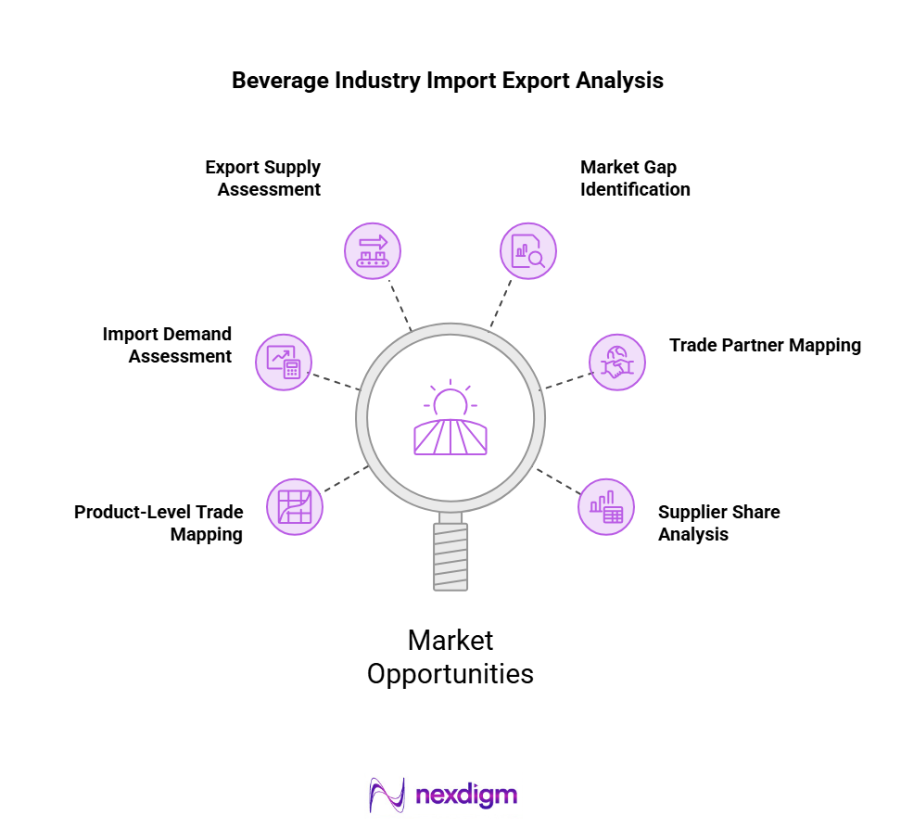
- Product-Level Trade Mapping: Examination of specific beverage products and HS codes to identify where import and export activity is increasing and which categories drive cross-border growth.
- Import Demand Assessment: Nexdigm analyses historical import values, volumes, growth, and shipment activity to identify markets showing sustained demand for relevant beverage products.
- Export Supply Assessment: Tracking of exporting countries, companies, product categories, and destination markets to identify established and emerging beverage supply bases.
- Market Gap Identification: Comparison of demand growth, supplier participation, and sourcing structures to identify markets where additional beverage supply may have commercial relevance.
- Trade Partner Mapping: Identification of importers, distributors, trading companies, and exporters to reveal established relationships and potential commercial partners.
- Supplier Share Analysis: Nexdigm evaluates country and company shares to determine which suppliers dominate individual beverage markets and where competitive openings may exist.
By integrating demand analysis, supply assessment, competitive intelligence, and trade partner mapping, Nexdigm helps beverage businesses identify, prioritize, and pursue import-export opportunities with greater confidence and strategic clarity.
Nexdigm’s Case
Nexdigm supported a beverage-sector client by evaluating 12 product categories across 14 international markets, analyzing import growth, supplier concentration, pricing, and buyer activity. The assessment identified 5 priority markets, 26 high-value buyer prospects, and 9 alternative supplier origins, helping the client concentrate export-development resources on higher-potential opportunities.
To take the next step, simply visit our Request a Consultation page and share your requirements with us.
Harsh Mittal
+91-8422857704