
Beverage procurement involves a wide range of inputs, from water, sugar, fruit concentrates, tea, coffee, and dairy ingredients to bottles, cans, caps, labels, and cartons. Each category has different supply dynamics, and savings in one area can be offset by higher costs elsewhere.
A meaningful benchmark should connect ingredient markets with packaging, manufacturing requirements, distribution, and supplier commercial terms. The goal is to establish whether the buyer’s total category cost is competitive, not simply whether one ingredient is being purchased cheaply.
Track Input-Market Signals
Beverage costs are exposed to distinct commodity cycles. Sugar prices can respond to crop conditions and production policy, while coffee and cocoa depend on growing regions, weather, inventories, and global trade. Fruit concentrates may be influenced by harvest yields and processing availability, while packaging costs depend on materials, conversion, and energy.
The FAO Food Price Index illustrates why broad inflation assumptions can be misleading. Its September 2026 reading was 5.8% above the year-earlier level, but commodity groups did not move uniformly. Buyers should track the indicators most relevant to their actual recipes and packaging formats rather than treating the overall index as a direct measure of beverage inflation.
Examine Packaging and Conversion Costs
For many beverage categories, packaging is a substantial part of the purchased product’s cost structure. Bottles, cans, closures, labels, and cartons differ by material, size, weight, print requirements, and production volume. Custom packaging may also involve tooling costs, minimum order quantities, and longer lead times.
For beverage procurement cost benchmarking services, supplier comparisons should distinguish the price of the beverage itself from packaging and conversion charges wherever the data allow. Buyers should also assess transport efficiency: heavier packaging or inefficient case configurations can increase distribution costs even when the purchase price is competitive.
Compare the Total Category Cost
Beverage economics extends beyond ingredient quotations. Yield loss, production changeovers, rejected batches, storage conditions, freight, promotions, and inventory can all affect total spend. A concentrate with a higher unit price may provide better dilution yield, while a cheaper packaging format may require equipment changes or generate more damage.
Procurement teams should compare costs using a consistent unit, such as cost per litre of saleable product or cost per thousand packaging units. The calculation should reflect recipe specifications, production yield, packaging, and delivery assumptions.
Beverage Procurement Cost Benchmarking Framework
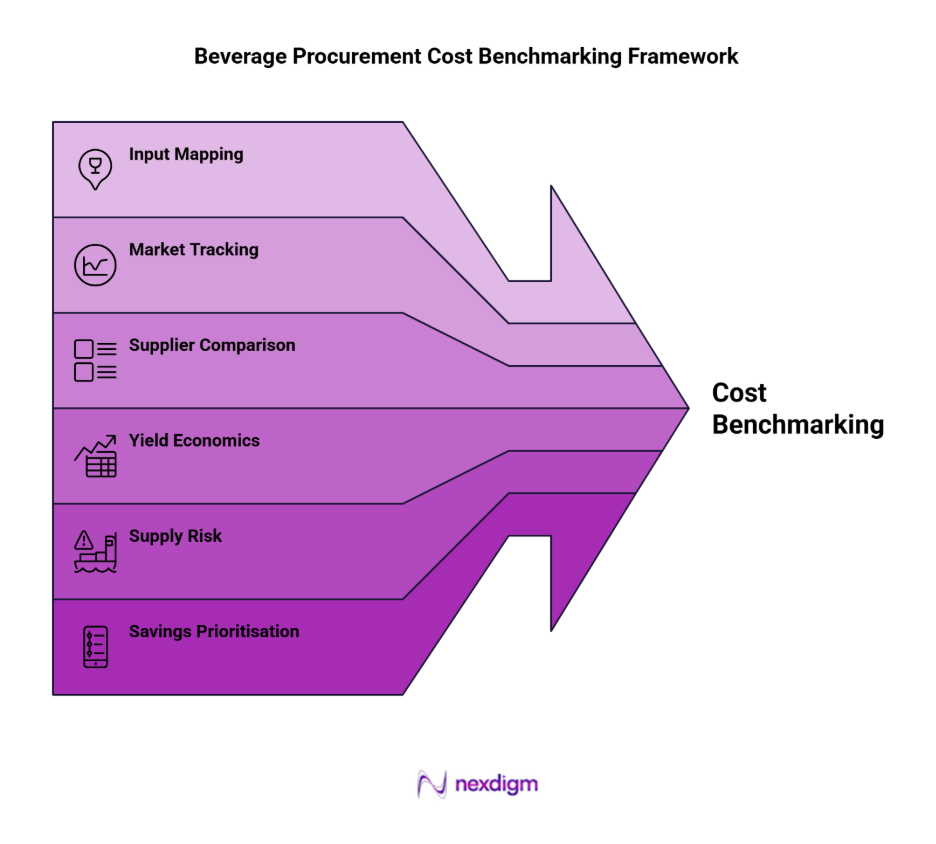
- Input Mapping: Identify major ingredients and packaging materials by product line, supplier, specification, origin, and share of total category expenditure.
- Market Tracking: Monitor relevant sugar, coffee, cocoa, dairy, fruit, and packaging indicators, matching each to the actual inputs and contract periods involved.
- Supplier Comparison: Normalise product quality, concentration, packaging specifications, minimum quantities, freight, rebates, and payment terms before comparing quotations.
- Yield Economics: Calculate cost per litre or saleable unit, incorporating dilution, production yield, changeovers, rejects, wastage, and packaging consumption.
- Supply Risk: Assess supplier concentration, crop exposure, lead times, packaging availability, production capacity, and the time required to qualify alternatives.
- Savings Prioritisation: Rank opportunities by addressable spend, feasible substitutions, commercial leverage, operational impact, and the risk of changing specifications or suppliers.
What the Next Procurement Cycle Should Focus On
Beverage buyers should separate negotiable supplier margins from costs driven by input markets, production constraints, and technical specifications. Negotiation may be appropriate where comparable vendors offer different terms, while long-term agreements or alternative sourcing may be more useful for volatile inputs.
The strongest benchmark links each proposed saving to a measurable operating assumption, including volume, yield, quality, and delivery performance.
Nexdigm’s Case Study
A beverage manufacturer reviewed ₹26 crore in annual ingredient and packaging spend across three product lines. Normalised quotations revealed inconsistent packaging rates and differences in concentrate yield. Supplier renegotiation and revised order allocation reduced addressable procurement costs by 4.1% over two quarters while maintaining agreed formulation and packaging standards.
To take the next step, simply visit our Request a Consultation page and share your requirements with us.
Harsh Mittal
+91-8422857704