

Global merchandise trade remained dynamic in 2025, with world exports increasing 7.2% in value terms, while Asia’s exports grew 9% and Africa’s 10%. Within this broader landscape, beverages represent a distinct trade category spanning soft drinks, juices, water, coffee, tea, alcoholic beverages, functional drinks, and other preparations. WTO trade datasets allow product-level analysis of these categories across more than 200 economies.
For beverage companies, however, identifying an attractive export market requires more than measuring total imports. Product preferences, packaging formats, regulatory requirements, price points, distribution structures, local competitors, and buyer relationships can significantly affect whether a market is commercially viable.
The key questions therefore become: Which beverage categories are gaining international demand? Which countries are emerging as attractive destinations? This is where beverage trade analysis can help convert cross-border trade activity into actionable products, market, buyers, suppliers, and export intelligence.
Beverage Demand Is Becoming More Fragmented
Beverage demand varies significantly by product and market. A destination experiencing strong imports of packaged water may have completely different drivers from one growing in functional beverages, coffee, juices, or alcoholic drinks. Consumer preferences, income, climate, health trends, foodservice development, and retail structures can all influence demand.
Consequently, exporters benefit from analyzing specific beverage categories, products, pack formats, price levels, and destinations rather than relying on broad food-and-beverage market estimates.
Export Opportunity Depends on More Than Market Size
A large beverage-importing market can also have intense competition, high regulatory requirements, or expensive distribution of economics. Conversely, a smaller market may offer attractive growth, limited supplier concentration, and stronger price realization.
A robust opportunity assessment therefore needs to connect to import demand, supplier activity, pricing, buyer concentration, market accessibility, logistics, and route-to-market conditions before identifying priority export destinations.
Nexdigm’s Beverage Industry Expertise
Nexdigm brings sector expertise across the food and beverage ecosystem, covering areas such as alcoholic beverages, soft drinks, functional beverages, hot beverages, health drinks, ingredients, foodservice, and related packaging markets. Our beverage trade analysis examines consumer trends, product innovation, regulatory changes, competitive structures, supply chains, pricing, and market opportunities, to help businesses get a view of where beverage demand exists and whether an exporter can realistically compete.
The Growing Need for Beverage Trade Analysis
Beverage trade analysis helps businesses understand where cross-border demand is developing, which suppliers and buyers are shaping trade flows, and where product-market opportunities may support profitable expansion.
- Product and Market Intelligence: Nexdigm analyses beverage categories, products, import demand, growth patterns, pricing, and destination markets to identify segments and geographies with stronger commercial potential.
- Buyer and Supplier Mapping: Nexdigm identifies active importers, distributors, exporters, and suppliers, evaluating trade activity and market shares to uncover potential accounts and competitive sourcing opportunities.
- Export Opportunity Assessment: Nexdigm combines demand, pricing, competition, regulatory conditions, logistics, and route-to-market factors to prioritize beverage markets offering stronger prospects for sustainable international expansion.
Together, these capabilities help beverage businesses move from trade data to actionable decisions on product selection, market prioritization, buyer targeting, sourcing, and export strategy.
Why Businesses Partner with Nexdigm
Experts at Nexdigm combine food and beverage industry expertise with trade intelligence and market research to translate complex cross-border movements into commercially relevant insights.
Our structured framework connects products, buyers, suppliers, pricing, demand, competition, regulation, logistics, and distribution, helping businesses make more informed decisions about where to export, which buyers to target, and which markets deserve investment.
Nexdigm’s Beverage Trade Analysis Framework
Nexdigm can structure beverage trade analysis around six connected stages, moving from product-level trade intelligence to validated market and commercial opportunities. This involves the following steps:
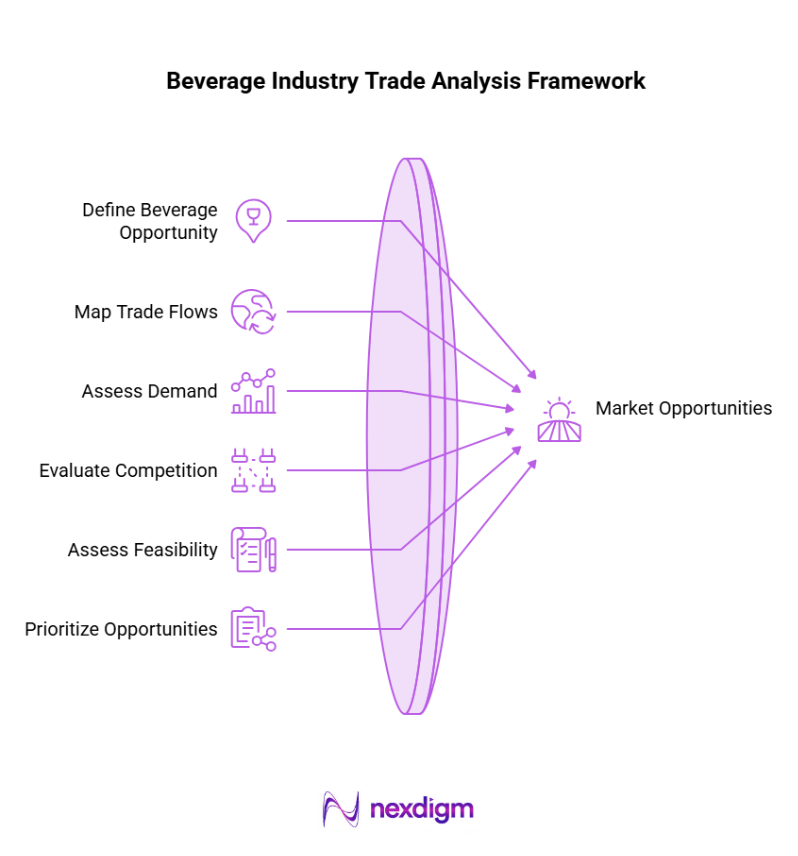
- Define the Beverage Opportunity: Identify priority categories, products, HS codes, brands, pack formats, and target geographies to establish the scope of analysis.
- Map Global Trade Flows: Analyze import and export values, volumes, growth rates, origins, destinations, ports, and trade corridors to understand how beverage products move internationally.
- Assess Demand and Market Attractiveness: Evaluate import growth, market size, consumption indicators, product momentum, supplier participation, and market trends to identify high-potential destination markets.
- Evaluate Buyers, Suppliers, and Competition: Map importers, distributors, exporters, suppliers, and competitors while assessing market shares, sourcing relationships, supplier concentration, buyer activity, and competitive positioning.
- Assess Commercial Feasibility: Examine indicative pricing, tariffs, regulatory requirements, logistics, distribution structures, landed costs, supply readiness, and route-to-market conditions to determine practical market-entry potential.
- Prioritize and Validate Opportunities: Score product-market combinations based on demand, pricing, competition, accessibility, and strategic fit, then validate priority findings through primary research and on-ground market assessment.
This enables beverage manufacturers, exporters, importers, distributors, and investors to move from raw trade movements to evidence-based decisions on where to compete, whom to target, and how to enter or expand in international markets.
Nexdigm’s Case
Nexdigm supported a beverage-sector client by evaluating 12 product categories across 14 international markets, analyzing import growth, supplier concentration, pricing, and buyer activity. The assessment identified 5 priority markets, 26 high-value buyer prospects, and 9 alternative supplier origins, helping the client concentrate export-development resources on higher-potential opportunities.
To take the next step, simply visit our Request a Consultation page and share your requirements with us.
Harsh Mittal
+91-8422857704